
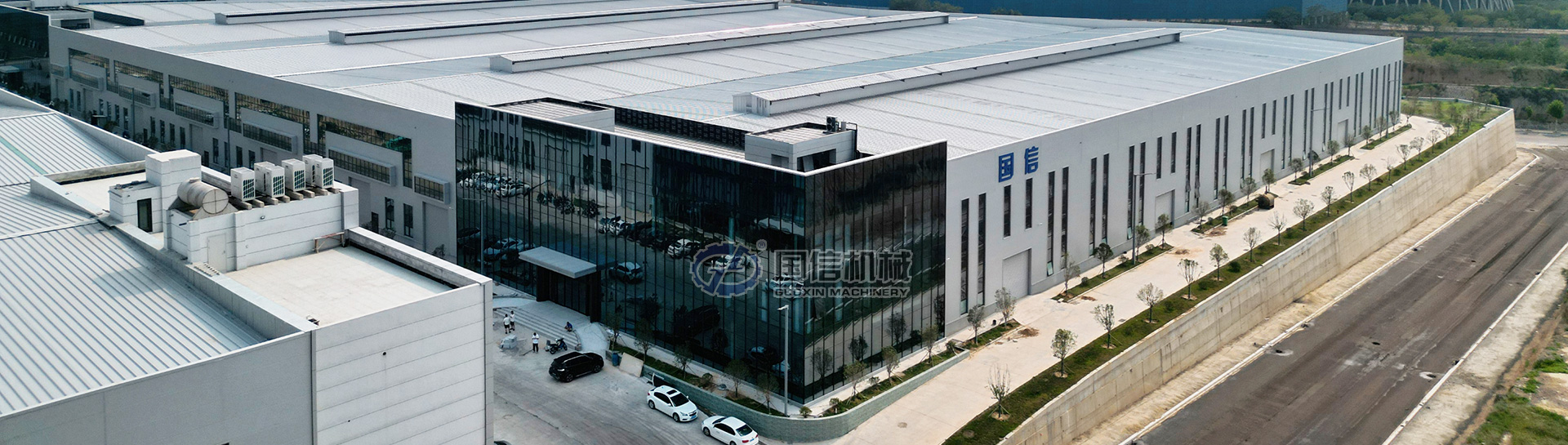
Video Showcase:
Turnkey MSW Sorting Plant Engineering Overview:
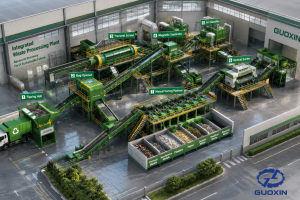
- Category: Municipal Solid Waste (MSW) Sorting Solutions
- Project Capacities: 100 – 500+ TPD (Tons Per Day) / 10 – 50+ TPH
- Core Engineering Value: 3D material-flow simulation to eliminate conveyor drop clearance errors and plant bottlenecks before fabrication.
- Primary Outputs: High-purity RDF alternative fuel, sorted metals, aggregate fractions, and high-purity organic residues.
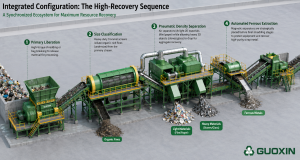
1. Integrated MSW Sorting Plant Design: Engineered for Zero Bottlenecks
The precision of its initial layout integration defines the long-term ROI and efficiency of a municipal solid waste (MSW) recovery project.
As a dedicated general contractor and machinery manufacturer, Henan Guoxin Group provides custom MSW sorting plant solutions. By utilizing advanced 3D spatial layout and material-flow simulation, our engineering team eliminates operational bottlenecks, material spillage, and conveyor wrapping before equipment fabrication even begins.
2. 3D Spatial Layouts for Heavy Conveyor Systems & Machinery Integration
In an industrial MSW waste sorting line, individual machinery units—such as heavy trommel screens, air separators, and fine shredders—are only as efficient as the material transport network linking them. Traditional 2D plant plotting often overlooks vertical clearance drop angles and velocity matching between sequential processing stages, leading to severe downtime.
To eliminate these spatial risks, our engineering division visualizes the entire system transfer sequence via advanced 3D model layout design software:
Conveyor Transition Interfaces: Calculating exact drop heights and chute angles between primary feeder plates and downstream screening units to prevent organic clogging.
Velocity Synchronization: Designing specific Variable Frequency Drive (VFD) controls for heavy conveyor belt networks to match the volumetric processing pace of the line.
Spatial Allocation: Routing long-distance transfer belts beneath structural platforms to minimize total facility floor area while guaranteeing 100% safe forklift and maintenance access.
3. Engineering Logic: From Waste Characterization to 3D Simulation
Standardized layouts often fail because local waste composition varies by geography and season. Guoxin’s MSW sorting plant design begins with a rigorous Waste Characterization Analysis to determine local moisture content, bulk density, and Particle Size Distribution (PSD).
Material Flow Logic: Utilizing linear or U-shaped plant configurations to prevent cross-contamination between organic fines and high-value recyclables.
Volumetric Optimization: Accounting for peak hourly volumetric loads rather than static daily averages, ensuring bag breakers and feeders run smoothly without surging.
Modular Scalability: Every integrated waste processing plant 3d model layout design includes pre-engineered expansion zones for future equipment additions, such as optical PVC sorters or fine RDF refining loops.
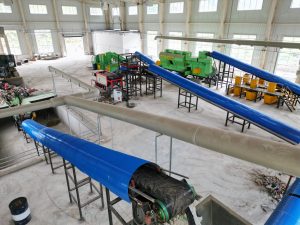
4. Integrated MSW Configuration: The High-Recovery Sequence
An integrated waste processing plant is a synchronized ecosystem. Our 3D engineering guarantees seamless transitions across each mechanical sorting stage:
Primary Liberation: High-torque dual-shaft shredding or bag breaking to release material for processing.
Size Classification: Heavy-duty trommel screens isolate organic-rich fines (undersize) from the primary stream.
Pneumatic Density Separation: Air separators utilize 3D layout logic to lift light 2D materials (film/paper) while allowing heavy 3D objects (stones/glass) to drop for aggregate recovery.
Automated Ferrous & Non-Ferrous Extraction: Magnetic separators are strategically placed before final shredding stages to protect equipment and recover high-purity scrap metal.
5. Technical Specifications & Plant Footprint Benchmarks
Use the following reference data to align your project requirements with the necessary plant footprint and equipment configuration:
| Processing Capacity (TPH) | Estimated Footprint (sqm) | Core Equipment Configuration | Primary Resource Outputs |
| 10 Tons / Hour | 1,500 – 2,500 | Bag Breaker + Trommel + Mag-Separator | Aggregates, Metals, Organic Fines |
| 20 Tons / Hour | 3,000 – 4,500 | 10T Config + Air Separator + Baling | High-Calorific RDF, Metals, Stones |
| 50+ Tons / Hour | 7,000 – 10,000+ | Full Automation + RDF Refining Line | Boiler-Ready RDF, Purity-Graded Metals |
6. Request Technical Engineering Diagrams & 3D Assets
Planning the structural layout of an integrated waste processing plant requires precise CAD data. To assist your project engineering team, Guoxin Group provides access to verified plant design blueprints and modular equipment templates.
- Standardized .dwg / .dxf CAD layouts for 100-500 TPD sorting plants.
- Modular .step / .iges 3D engineering models for heavy trommel screens and conveyor structures.
- Complete material flow block diagrams showing optimized mass-balance routing.
Direct Contact: Eve@guoxinmachinery.com
7. Real-World Implementation: Cases
Our design logic is validated by operational data from recent 2026 projects. In Guigang, Guangxi, and various other locations, our integrated sorting facility handles mixed municipal and construction waste, utilizing automated conveyor systems to transform raw debris into high-value construction aggregates and RDF for local power plants.
In Taizhou, the focus was on spatial optimization. By utilizing a multi-level 3D design, we successfully integrated a heavy-duty shredding line and an air separation system within a constrained urban site, achieving a landfill diversion rate exceeding 80%.
8. Request a Custom 3D Plant Layout & ROI Analysis
A professional sorting plant requires a project-specific approach. To receive a preliminary technical proposal, please provide your engineering requirements:
- Expected Daily Input (TPD)
- Primary Waste Composition (MSW, C&D, or Mixed)
- Required End-Products (RDF, Recycled Aggregates, or Metal Recovery)
Direct Engineering Contact: Eve@guoxinmachinery.com
9. FAQ
Q: How does the 3D layout design reduce on-site installation time?
A: By simulating every conveyor connection and equipment interface in a 3D environment, we identify potential physical interferences and material “dead zones” before fabrication. This typically reduces on-site commissioning time by 25-30% compared to traditional 2D planning.
Q: What separation efficiency can be expected for RDF production?
A: With our integrated air separation and trommel screening logic, the resulting light fraction (RDF feedstock) typically achieves a purity level of 90-95%, ensuring a consistent calorific value suitable for Waste-to-Energy (WtE) boilers.
Q: Can the plant design accommodate high-moisture organic waste?
A: Yes. For high-moisture MSW, our layouts incorporate advanced leachate collection systems under the primary feeders and trommels. We also adjust the incline angles of conveyor belts and the rotation speed of trommel screens to prevent material sticking.
Q: How is the system protected from damage by un-shreddable bulky waste?
A: The integrated design includes a PLC-monitored “protection loop.” If the primary shredder or bag breaker encounters a high-hardness object (such as a heavy steel block), the system automatically triggers a reverse-and-stop sequence while alerting the operator via the centralized control interface.
Q: What technical formats are included in your preliminary plant layout proposals?
A: Every customized engineering proposal includes production-ready 2D CAD diagrams, technical sizing charts, and space-optimization 3D model layout designs for the entire integrated waste processing plant. These files specify exact equipment footprints, elevation clearances, and maintenance access zones tailored to your factory’s exact dimensions.
Q: Do your technical layouts specify the routing and synchronization of the conveyor systems?
A: Yes. Optimal material flow relies entirely on conveyor performance. Our comprehensive layouts feature detailed industrial MSW waste sorting machine material routing, including the spatial configuration, inclination angles, and motor drive specifications for every heavy-duty conveyor belt 3D model or diagram within the sorting sequence.