
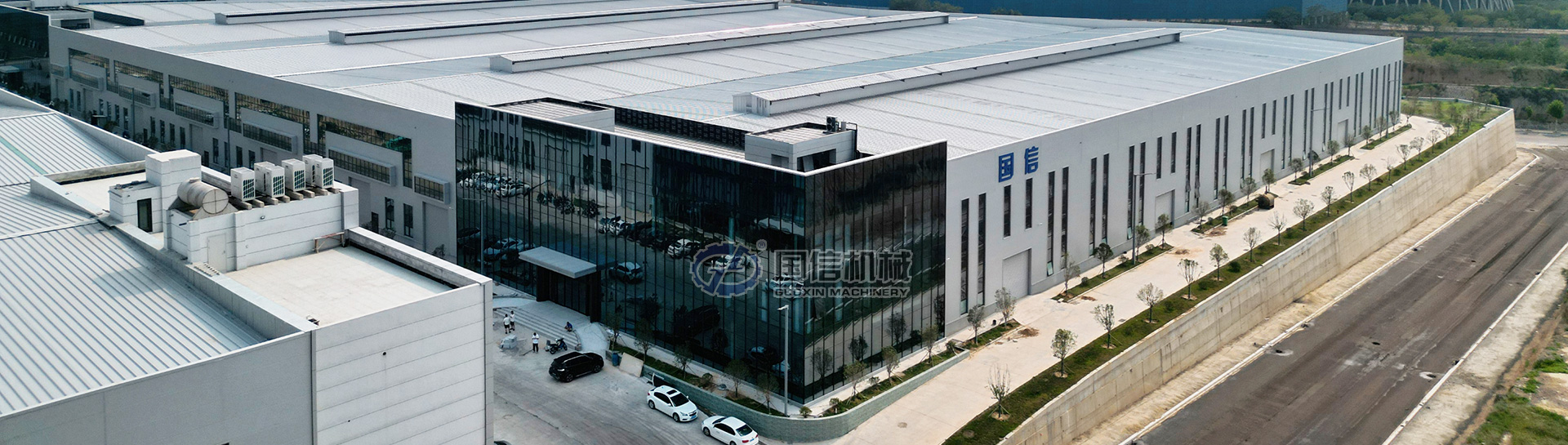
Project Partner: Zhongyuan Environmental Protection
System Provider: Henan Guoxin Machinery Manufacturing Co., Ltd.Movies 2 Core Technologies: High-Torque Shredding, Multi-Stage Sorting, Integrated Leachate Treatment
The Challenge of Commingled Organic Waste Streams
In large-scale municipal waste management, food waste (kitchen waste) and bulky waste (furniture, wood debris) present distinct operational challenges. Food waste is characterized by high moisture content and organic acidity, requiring robust leachate management, while bulky waste demands high-torque shredding to reduce volume for downstream processing.
The project for Zhongyuan Environmental Protection serves as a benchmark for integrating these two streams into a unified pretreatment and environmental compliance system.
Technical Configuration: Sorting and Shredding
Efficiency in food waste processing is determined in the first 15 minutes of the material flow. Our system prioritizes material liberation and contaminant removal to protect downstream anaerobic digestion or composting assets.
High-Torque Industrial Shredding
-
Application: Primary volume reduction for bulky waste and bag-breaking for food waste.
-
Technical Logic: Utilizing twin-shaft slow-speed shredders to ensure high shearing force with minimal heat generation. This prevents the “glazing” of plastics and ensures consistent particle size distribution (PSD) for subsequent sorting stages.
-
Durability: Blades are engineered from specialized alloy steel to resist the corrosive environment typical of high-acid kitchen waste.
Multi-Stage Mechanical Sorting
To achieve high purity in the organic fraction, the line incorporates:
- Trommel Screening: Separating undersized organic fines from oversized inorganic contaminants (plastics, textiles).
-
Density Separation: Air and hydraulic systems isolate light plastics and heavy minerals/glass.
-
Magnetic Recovery: Removing ferrous contaminants to prevent damage to downstream refining equipment.
Integrated Leachate Treatment Systems
High-moisture kitchen waste inevitably generates high concentrations of leachate during the collection and shredding phases. Without integrated treatment, this poses a significant environmental risk and equipment corrosion hazard.
Our solution integrates an onsite Leachate Treatment Module that handles:
-
Primary Filtration: Removal of suspended solids (TSS) from the liquid stream.
-
Oil-Water Separation: Extracting waste oils (Gutter Oil), which can be repurposed for biodiesel production, adding a secondary revenue stream to the plant.
-
Advanced Oxidation/Biological Treatment: Reducing Chemical Oxygen Demand (COD) and Ammonia Nitrogen (NH3-N) levels to meet local discharge or recycling standards.
Operational Data and EPC Standards
The Guoxin system is designed for continuous industrial operation (24/7). By focusing on the Pretreatment Phase, we reduce the total volume of waste for landfill by up to 80% and ensure the organic fraction is optimized for energy recovery.
Our engineering approach relies on 3D layout diagrams and material flow simulations, ensuring that the integration between the shredders, feeders, and leachate pumps is seamless, preventing bottlenecks in high-volume municipal operations.
Technical Consultation & Project Design: For detailed specifications on our food waste shredders or leachate treatment configurations, contact our engineering department.
Email: Eve@guoxinmachinery.com
FAQ
1. What is the typical separation efficiency of a food waste sorting line?
A properly calibrated system, like the one used in the Zhongyuan project, can achieve organic purity levels of over 90-95%. This is critical for preventing “grit buildup” in anaerobic digesters and ensuring high-quality compost output.
2. How does the shredder handle the high acidity of kitchen waste?
We utilize anti-corrosive coatings on the shredder housing and high-alloy stainless or specialized tool steel for the blades. This prevents the rapid degradation of equipment caused by the low pH levels of fermenting organic waste.
3. Why is bulky waste processed on the same site as food waste?
Integrating the two allows for shared logistics and equipment. Often, the shredded bulky waste (wood/fibers) can act as a “bulking agent” if the food waste is destined for aerobic composting, helping to regulate moisture and airflow.
4. What are the COD limits that the leachate treatment system can handle?
Our leachate systems are modular. For high-strength kitchen waste leachate (where COD can exceed 50,000 mg/L), we utilize a multi-stage process including anaerobic treatment (UASB/IC) followed by membrane filtration (MBR/RO) to meet stringent environmental discharge standards.