
Quick Technical Specifications:
- Capacity Range: 5 – 50+ TPH (Customizable EPC Solutions)
- Target Output NCV: 14,000 – 16,500 kJ/kg
- Moisture Reduction: Down to <18% via precision mechanical sorting (Optional thermal RDF dryers available)
- Primary Applications: Cement kiln alternative fuel, WtE power plants & industrial boilers
A turnkey RDF production line is designed to convert mixed waste into stable alternative fuel for cement kilns, power plants, and industrial boilers. Typical input materials include municipal solid waste (MSW), construction and demolition waste (C&D), and light combustible waste fractions.
Our RDF production line solutions support capacities from 5 TPH to over 50 TPH, ensuring controlled particle size, stable calorific value, and reliable long-term operation in waste-to-energy (WtE) and industrial fuel applications. Tell us your waste type, processing capacity (TPH), and RDF fuel requirements — our engineers will provide a customized RDF production line design and equipment configuration.
What Is a Turnkey RDF Waste Sorting & Processing Plant?
How does a mechanical MSW sorting line optimize RDF moisture and calorific value without thermal drying systems?
A heavy-duty mechanical MSW sorting plant controls alternative fuel moisture and calorific value by mechanically screening out up to 85% of high-moisture organic fines (< 30 mm municipal kitchen waste) early in the processing matrix. This mechanical segregation drops the collective bulk moisture of the remaining combustible fraction from 45% down to a stable <22%, effectively elevating the Net Calorific Value (NCV) to a premium 14,000–16,500 kJ/kg without requiring capital-intensive thermal dehydration energy expenditure.
An RDF (Refuse-Derived Fuel) production line is an integrated system that processes mixed waste into a combustible fuel with controlled particle size, calorific value, and moisture content.
Unlike standalone machines, a complete RDF system coordinates shredding, screening, sorting, and material flow control to ensure consistent fuel quality under real operating conditions.
RDF production plays a critical role in modern waste management by:
- Reducing landfill volume
- Recovering high-calorific combustible materials
- Supporting alternative fuel supply for cement kilns and WtE plants
A well-designed RDF production line ensures stable output quality and reliable long-term operation, which is essential for downstream energy recovery systems.
Mechanical Moisture Control vs. Thermal RDF Dryers
Many project developers search for RDF dryers and RDF drying plant manufacturers** to lower moisture before fuel burning. While thermal drying is effective, standard thermal RDF dryer systems require heavy operational energy and high capital investments.
How Guoxin Minimizes Thermal Dryer Energy Costs:
- Precision Mechanical Moisture Separation: Guoxin’s heavy-duty GX-TS Rotary Trommel Screen mechanically segregates up to 85% of wet organic fines (<30mm municipal kitchen waste) at the start of the line.
- Calorific Value Elevation: Removing wet organics drops collective fuel moisture from ~45% down to <18%–22% naturally, elevating the Net Calorific Value (NCV) to 14,000–16,500 kJ/kg without consuming fuel for thermal evaporation.
- Optional Downstream Thermal RDF Dryer Integration: For cement kilns demanding ultra-dry RDF (<15% moisture), our engineering team can integrate modular indirect thermal RDF drying units at the end of the sorting circuit.
Industrial RDF Production Line & Sorting System Process
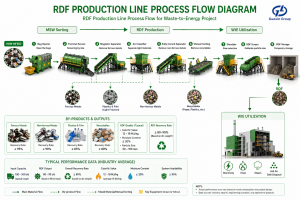
A typical RDF production line includes the following stages:
1. Waste Pre-sorting & Preparation
Incoming waste is pre-treated to remove bulky materials and recover recyclables. This stage is often integrated with MSW sorting systems.Integrates seamlessly with upstream MSW or C&D sorting plants
2. Size Reduction & Primary Shredding
Shredders reduce material size to prepare for downstream separation and fuel processing.
3. High-Efficiency Separation of Light Combustible Fractions
The calibrated material stream is discharged into a high-capacity waste air separator (air classifier). Utilizing a synchronized aerodynamic matrix of positive-pressure air knives and negative-pressure dust extraction loops, the system segregates materials based on their weight-to-surface-area ratio. High-surface-area “light fractions” (such as flexible packaging films, paperboard, and textiles) are entrained by the airflow and lifted over an adjustable splitter plate, completely separating them from heavy inert contaminants like stones, glass, and dense rubbers.
4. Metallurgical Extraction & Sensor-Based Sorting Refining
Before passing into the secondary high-torque shredding stage, the concentrated combustible stream passes beneath high-gradient cross-belt overbelt magnetic separators to extract liberated iron wires and ferrous structural fragments. Immediately following, an Eddy Current Separator isolates non-ferrous aluminum composites. To meet strict industrial kiln emissions standards, the line can be integrated with Near-Infrared (NIR) Optical Sorters to systematically scan and pneumatically eject Polyvinyl Chloride (PVC) plastics, keeping the final fuel’s chlorine concentration strictly below 1%.
5. RDF Storage & Feeding
Processed RDF is conveyed, stored, and fed into cement kilns, boilers, or WtE systems.
Each stage is engineered as part of a coordinated system to ensure stable fuel quality, controlled particle size, and efficient energy recovery.Connects directly to downstream cement kiln burners or boiler feed systems.
RDF Production Line Capacity & Output Control
System configurations and mechanical machinery are customized based on input waste composition and target fuel specifications:
| Target System Input Capacity | Equipment Footprint Range | Key Mechanical Separation Machinery | Target Output Moisture (Mechanical Control) | Finished Fuel Particle Sizing |
| 5 – 10 TPH | 1,500 – 2,500 m² | Industrial Bag Breaker, Single-Deck Trommel Screen, Overbelt Magnet, Manual Quality-Control Belt | < 25% (Organic Fines Extracted) | < 80 mm |
| 15 – 25 TPH | 3,500 – 5,500 m² | Heavy-Duty Apron Feeder, Dual-Fraction Trommel Screen, Single-Stage Air Classifier, Cross-Belt Magnets | < 22% (Precision Screening) | < 50 mm (Homogeneous) |
| 30 – 50 TPH+ | 8,000 – 12,000+ m² | VFD Steel Apron Conveyor, Multi-Stage Sizing Trommels, Ballistic Separators, Dual-Loop Air Classifiers, Ferrous/Non-Ferrous Processing Circuit | < 18% (Ultra-Pure Combustibles) | < 30–40 mm (Premium Grade) |
Planning an Alternative Fuel / RDF Production Project?
Our engineering team designs customized 3D plant CAD layouts, mass balance flowcharts, and complete equipment lists tailored to your waste composition (MSW, C&D, or Landfill Mining Material).
Turnkey RDF Line Scope & Engineering Services
For projects requiring integrated multi-stage processing and strict alternative fuel specifications, Guoxin provides complete EPC services:
- Waste Characterization: Waste composition analysis & mass balance process design
- Equipment Supply: Precision manufacturing (Shredders, Trommel Screens, Air Classifiers, Magnetic Separators)
- Electrical Integration: Industrial PLC / VFD central control cabinets & automation programming
- Turnkey Delivery: On-site installation guidance, commissioning, and operator training
RDF Production Line Cost – Key Factors
The cost of an RDF production line depends on multiple project-specific factors:
- System capacity and configuration
- Number of shredding and processing stages
- Automation level and control requirements
- Integration with sorting or WtE systems
- Local installation and commissioning conditions
Project cost varies significantly depending on system design and integration level. We provide customized cost estimation based on your waste characteristics and fuel requirements.
Real-World RDF & Waste Sorting Site Commissionings
- Stale Waste & Landfill Mining Line: [View Kaifeng 2026 Landfill Sorting Project Case Study]
- Indoor Aggregate Recovery Plant: [High-Throughput Municipal Solid Waste (MSW) Sorting Plant in Guangzhou Zhongxin]
Start Your RDF Production Project
If you are planning an RDF production line or alternative fuel project, share your waste type, capacity, and target fuel specifications.
Our engineering team will provide:
- RDF production line process flow
- Equipment configuration proposal
- Project cost estimation
Request a customized RDF production solution to support your waste-to-energy or recycling project.