
Mechanical Residential Waste Sorting & Fraction Segregation Matrix in Malaysia – GuoxinGroup
Quick Engineering Specifications:
- Processing Capacity: 100 – 2,000+ TPD (Tons Per Day)
- Core Applications: Municipal Waste Sorting, RDF Alternative Fuel Production & WtE Pre-treatment
- Key Technology: Variable-torque Bag Openers, Anti-clogging Trommel Screens, Optical Sorters & Air Classifiers
- Landfill Diversion Rate: Up to 90% Volume Reduction
What is a Municipal Solid Waste (MSW) Sorting Plant?
A municipal solid waste (MSW) sorting plant and equipment line is an automated system designed to separate mixed household waste into recyclable materials, organic fractions, and combustible components such as RDF.
These plants are widely used in modern waste management systems to reduce landfill volume, recover valuable materials, and support waste-to-energy (WtE) projects.
Typical MSW sorting plants process 100–2000 tons per day (TPD) and are applied in municipal waste treatment, recycling centers, and energy recovery projects.
Planning an MSW sorting plant project?
Please tell us your waste type, daily capacity (TPD), and target output (RDF, recycling, WtE).
Our engineers will provide a customized plant design and equipment configuration.
How Does an MSW Sorting Plant Work?
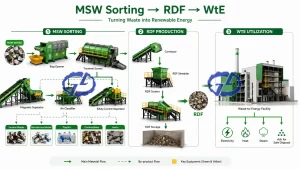
Municipal solid waste MSW sorting plant equipment flow diagram
A typical MSW sorting plant follows a structured process:
1. Waste Receiving and Feeding
2. Bag Opening and Material Liberation
3. Screening and Size Separation
4. Recyclable Recovery (metals, plastics)
5. Combustible Fraction Preparation (RDF)
6. Final Disposal or Energy Recovery
This simplified process ensures efficient separation before entering detailed engineering stages.
Optimizing MSW Sorting Operations with Advanced Recycling Machines
Efficient day-to-day msw sorting operations rely heavily on the synergy between automated mechanical separation and robust material handling. A high-performing msw sorting machine line must maintain a continuous, unblocked material flow to prevent unscheduled downtime.
To maximize recovery rates and minimize manual labor in municipal facilities, Guoxin integrates specialized msw recycling machine units at critical operational nodes:
- Primary Separation Operations: Heavy-duty optical sorters and air separators automatically isolate high-value polymers (PET/HDPE) from the organic fractions.
- Operational Efficiency Control: Every msw sorting machine in our turnkey line is interconnected via a centralized PLC SCADA system. This allows operators to monitor real-time throughput, belt speeds, and motor loads, ensuring safe, continuous 24/7 msw sorting operations even when handling high-moisture waste streams typical in municipal solid waste management.
Engineered MSW Sorting Process for RDF & Recycling
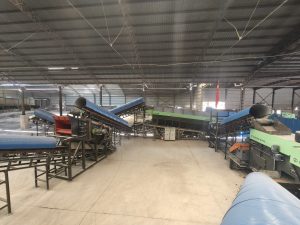
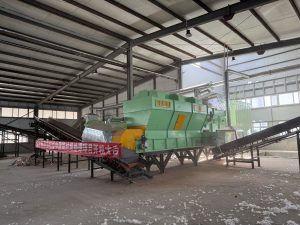
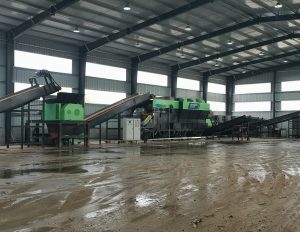
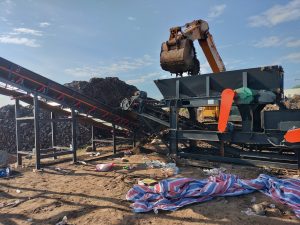
Core MSW Sorting Process & Equipment Flow
A high-performing municipal solid waste sorting plant follows a 4-stage automated mechanical matrix:
Stage 1: Primary Liberation & Dosing (Bag Opening)
Heavy-duty variable-torque bag openers achieve a 98% liberation rate, opening waste bags while preserving material integrity for downstream sorting machines.
Stage 2: Mechanical Size Fractionation (Trommel Screening)
VFD-controlled trommel screens classify material into three streams: Fine Organics (<80mm), Mid-sized Recyclables (80–250mm), and Oversized Combustibles (>250mm).
Stage 3: Density & Sensor Separation (Air Classification & Optical Sorters)
- Air Separator: Isolates light plastics and paper with >90% efficiency for high-calorific RDF.
- Magnetic & Eddy Current Separators: Extract 95%+ of ferrous and non-ferrous metals.
- Optical Sorters (Optional): Automated PET/HDPE polymer separation.
Stage 4: Quality Control & Baling Operations
Final manual/robotic quality control ensures zero-contamination in recovered bales before discharging RDF or recyclables for storage.
Integration with RDF & Waste-to-Energy Systems
An MSW sorting plant is often the front-end system of energy recovery projects. Our solutions seamlessly integrate with:
- RDF Production Line Solutions
- Light Combustible Waste Processing Systems
- Waste-to-Energy Pre-treatment Systems
- RDF Shredder and Size Control Solutions
The light combustible fraction recovered from the sorting system can be processed through an RDF production line to produce alternative fuel for cement kilns or waste-to-energy plants. This integrated design ensures stable fuel quality and long-term operational reliability.
Modular System Extensions: Shredding & Bulky Waste Pre-Treatment
To accommodate variable municipal waste streams, Guoxin provides fully integrated sub-system modules that connect directly into the core MSW sorting line:
1. Turnkey Shredder Plant for RDF & Fuel Preparation
For projects focused on Alternative Fuel (RDF/SRF), standard MSW contains bulky packaging and oversized textiles that require primary and secondary size reduction.
- Primary Pre-Shredding: High-torque twin-shaft shredders break down bulky waste to protect downstream optical and magnetic sorting machines.
- Secondary Fine Shredding: Positioned after the air separation circuit, specialized fine shredders reduce light combustibles to <50mm for cement kiln combustion.
- Engineering Advantage: Fully synchronized conveyor speeds prevent material surging between the primary sorting matrix and the turnkey shredder plant.
2. Bulky Waste Sorting & Pre-Treatment Line
Bulky waste sorting (handling mattresses, furniture, and oversized wood) is integrated at the receiving stage to reduce mechanical load on downstream trommel screens and ensure plant safety.
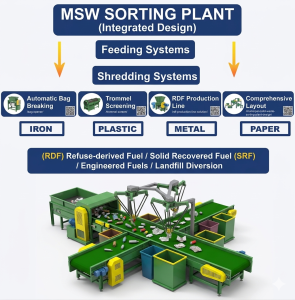
MSW Sorting Plant Process Flow Diagram with RDF Production
What are the requirements for designing a municipal solid waste sorting plant?
Each MSW sorting project is unique. Typical processing capacity ranges from 100 TPD to over 2000 TPD.
Our systems are customized based on:
- Waste composition and moisture content
- Required processing capacity (TPD / TPH)
- Recycling targets and RDF output requirements
- Local regulations and land conditions
- Investment budget and ROI expectations
Most municipal solid waste sorting plants operate between 200 and 2000 TPD, depending on local waste generation.
Technical Comparison: Manual vs. Automated Sorting
| Feature / System Type | Manual Sorting Line | Semi-Automated Line | Fully Automated AI Line |
| Core Technology | Conveyors + Manual | Trommels + Magnetic | Robotic + Optical + Air |
| Staffing (Per Shift) | 25 – 45 workers | 10 – 18 workers | 2 – 5 operators |
| Footprint (sqm) | 1,000 – 1,500 | 2,500 – 5,000 | 8,000 – 15,000+ |
| Power Load (kW/h) | 80 – 120 | 250 – 450 | 600 – 1200+ |
| Sorting Efficiency | Low (Labor dependent) | Moderate | High (95%+ Purity) |
| Estimated ROI | 4 – 5 Years | 2.5 – 3.5 Years | 1.5 – 2.5 Years |
Successful MSW Projects: Thailand & Tianjin Cases
-
Thailand: 200 TPD MSW Sorting Line for RDF production.
-
Tianjin: Integrated MSW + C&D recycling plant (EPC service).
Value-Driven Advantages of Guoxin MSW Plants
Our custom-engineered waste separation lines deliver distinct operational and financial advantages tailored to different project stakeholders:
-
For Municipal Governments: Achieves up to 90% landfill diversion and volume reduction, drastically extending the lifespan of local landfills and lowering municipal carbon tax liabilities.
-
For Waste Management Companies: Converts liabilities into assets by generating stable, high-purity revenue streams from recovered commodities (metals, plastics, paper) and high-calorific RDF flakes.
-
For EPC Contractors & PPP Project Owners: Reduces project execution risk through our true turnkey EPC capability. From initial waste composition analysis to a fully operational turnkey shredder plant and sorting line, we guarantee system integration, mechanical performance, and strict compliance with local environmental regulations.
- A complete turnkey scope typically includes:
• Project feasibility analysis and waste composition study
• Process flow design and system layout planning
• Equipment manufacturing and supply
• Installation layout and foundation guidance
• Electrical and control system integration
• Commissioning and operator training
MSW Sorting Plant Cost – What Affects the Price?
The cost of an MSW sorting plant depends on multiple factors, including:
- Daily processing capacity
- Level of automation
- Sorting accuracy requirements
- RDF or WtE integration
- Local installation conditions
Rather than offering a fixed price, we provide project-based cost estimation after understanding your specific requirements.
Start Your MSW Sorting Project
Typical project evaluation includes
• waste composition analysis
• sorting process design
• equipment configuration
• investment estimation
If you are planning an MSW sorting plant, RDF production line, or waste-to-energy project, share your waste type, daily capacity, and target output. Our engineering team can evaluate your waste composition, plant capacity, and recycling targets. We are ready to support you with a customized solution.
FAQ
Q1: How does the system handle high-moisture MSW typical in developing regions?
A: For high-moisture MSW (often >50% moisture in tropical or developing regions), our MSW sorting equipment incorporates dynamic variable-torque bag openers and anti-wrapping rotary trommel screens fitted with internal cleaning brushes. Additionally, a pre-drying airflow stage or high-velocity air separator prevents wet organic waste from clogging downstream screens and belt conveyors.
Q2: What is the purity level of the RDF produced by your sorting line?
A: Our integrated lines typically achieve a calorific value (CV) of 15,000–18,000 kJ/kg for the light fraction, with chlorine content controlled under 1% through multi-stage air and optical separation.
Q3: Can the sorting plant be scaled up as the city’s waste volume grows?
A: Yes. Our plant design is modular. We provide the initial layout with “reserved bays” for future equipment, such as adding optical sorters or additional shredding units, without stopping the entire production line.
Q4: What are the maintenance requirements for a 500 TPD turnkey plant?
A: Standard maintenance involves daily inspection of conveyor tracking and weekly cleaning of screening media. Our systems include automated lubrication for critical bearings to minimize downtime.