
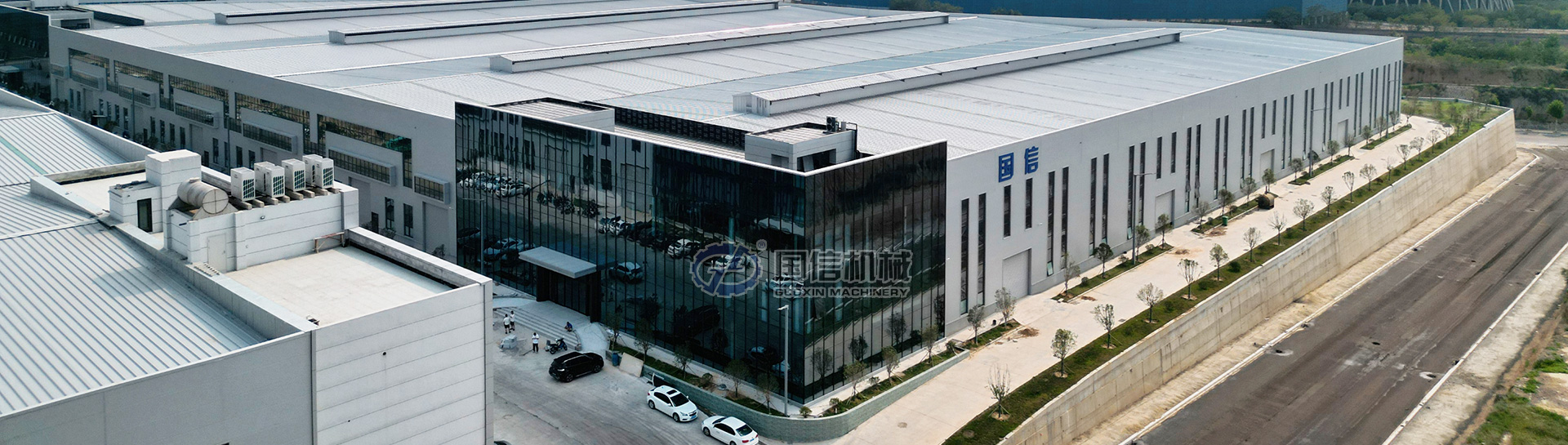
How do automated MSW sorting lines optimize municipal waste recycling and fuel production (RDF)?
Industrial municipal solid waste (MSW) sorting plants process unsorted domestic waste by separating it into clean, high-value fractions: recyclables (plastics, metals), high-calorific combustibles for Refuse-Derived Fuel (RDF) production, and organic fractions. By utilizing synchronized heavy-duty shredding, high-inclination transit matrices, and automated density/magnetic separation, these systems reduce landfill volume by up to 80% to 90% while establishing a highly profitable, circular resource-recovery loop.
1. Project Overview & Operational Environment
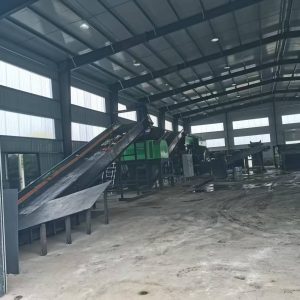
Commissioned in July 2026 at a facility in Zhongxin, Guangzhou, this large-scale urban waste sorting installation handles complex, high-moisture domestic waste streams. Municipal solid waste in urban centers presents severe processing challenges due to intertwined plastics, organic kitchen waste, household textiles, and tightly knotted plastic disposal bags.
The Guoxin engineering matrix deployed on-site automates the segregation flow, eliminating hazardous manual sorting while ensuring high purity in the reclaimed material streams.
2. Step-by-Step Processing Sequence & Mechanical Execution
The plant operates on a continuous, multi-stage automated processing loop engineered to eliminate material wrapping, mechanical jamming, and processing bottlenecks.
Stage 1: Primary Shredding & Automated Bag Breaking
Unsorted municipal waste contains massive quantities of tied plastic bags that shield materials from downstream optical or mechanical sorters. The waste feeds directly into a high-torque, heavy-duty double-shaft waste shredder and bag breaker.
The interlocking wear-resistant alloy shafts rotate counter to one another, tearing open commercial plastic bags and down-sizing bulky materials (such as plastics, textiles, and organic matter) without over-shredding materials that need to remain whole for recycling.
Stage 2: High-Inclination Conveyor Transit Matrix
Once the waste stream is opened and homogenized by the shredder, it drops onto a series of heavy-duty inclined belt conveyors.
- Engineered Anti-Slip Side Skirting:
The conveyor belts feature deep-vane side containment walls to prevent loose or liquid-heavy organic waste from sliding backward or spilling into the mechanical chassis.
- Continuous Mass Flow Distribution:
The high-inclination angle lifts the waste to secondary processing decks (trommel screens, air classifiers, and magnetic separators) while naturally spreading the material bed thin for highly accurate downstream sorting.
Stage 3: Multi-Fraction Material Discharge & Accumulation
Following mechanical and air separation stages, individual material fractions are routed to dedicated discharge points. sorted materials (primarily mixed light plastics, film, and flexible packaging debris) are continuously discharged into designated sorting bays or compaction bunkers. From this point, the clean plastic fraction is transferred to an automated baling line or directly routed into an RDF pelletizing system.
3. Plant Technical Specification Matrix
The table below outlines engineered industrial configurations for Guoxin municipal solid waste processing lines.
| Engineered Parameter | Model GX-MSW-100 | Deployed Guangzhou Model | Model GX-MSW-300 |
| Daily Processing Output | 100 to 150 Tons/Day | 200 to 250 Tons/Day | 400 to 500 Tons/Day+ |
| Target Input Substrates | Domestic Mixed MSW | Urban Domestic Mixed MSW | Industrial & Commercial MSW |
| Primary Bag Breaker Drive | Dual-Shaft 75 kW × 2 | Dual-Shaft 110 kW × 2 | Heavy-Duty Hydraulic Drive |
| Shredder Blade Metallurgy | NM450 / Manganese Steel | H13 / Cr12MoV Alloy | Custom Hard-Faced Tool Steel |
| Conveyor Belt Tensile | EP200 High-Wear | EP400 Cross-Stabilized | Steel-Cord Reinforced |
| Separation Accuracy Bounds | 82% – 88% Purity | 90% – 95% Pure Fractions | 92% – 97% Pure Fractions |
| Control System Architecture | Central Analog Panel | PLC / Smart Touch Cabinet | Full SCADA Plant Automation |
FAQ
Q1: How does the system handle abrasive elements like metals, glass, or stone without breaking the primary shredder blades?
A: Standard recycling shredders frequently suffer from blade fracturing when processing unsorted urban waste due to hidden stones, concrete blocks, or heavy scrap metals. Guoxin eliminates this vulnerability by engineering our dual-shaft bag breakers with an auto-reverse PLC protection loop. When the internal sensors detect an un-shreddable object causing a sudden torque spike, the shafts instantly stop, reverse direction to clear the obstruction, and trigger a warning light on the control console. Additionally, the blades are forged from premium Cr12MoV high-alloy tool steel, allowing them to absorb extreme mechanical shock without micro-cracking.
Q2: High-moisture organic kitchen waste often clogs screening equipment. How does this line maintain consistent throughput?
A: High moisture causes small plastics and paper fibers to paste together, blinding standard mesh screens and creating mass blockages. In this Guangzhou installation, the problem is resolved by placing the shredder matrix immediately before a multi-stage trommel screen and air classifier. The trommel screen uses internal mechanical agitators that continuously tumble the material, stripping wet organic fines away from light combustibles (plastics/film). The light combustibles are then swept upward by a high-velocity air knife onto the inclined sorting belts shown in our case video, leaving the wet organics to drop cleanly onto a separate sub-grade conveyor belt.