
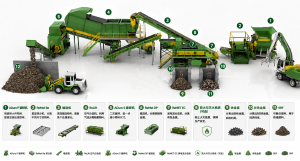
Standard Technical Configuration of an Automated MSW Sorting Plant.
What is the Separation Efficiency of a Modern MSW Rcycling plant?
Quick Answer: A fully automated Municipal Solid Waste (MSW) sorting line achieves a comprehensive separation efficiency of 85% to 95%. By integrating mechanical, ballistic, and optical sorting technologies, the system effectively segregates mixed municipal waste into high-purity fractions: recyclables (plastics, metals, paper), organic waste for composting, and high-calorific materials for RDF (Refuse-Derived Fuel) or SRF (Solid Recovered Fuel) production.
Technical Configuration & Process Flow of MSW Sorting Systems
To achieve maximum purity and throughput (ranging from 10 to 50 tons per hour), a commercial MSW sorting line must process waste through a multi-stage sequential system. The standard processing workflow includes:
- Feeding & Primary Shredding: Bag openers or industrial shredders break open waste bags and homogenize the material stream without destroying potential recyclables.
- Screening (Trommel & Ballistic Separators): Trommel screens separate materials by size (typically under 80mm for organic matter and over 80mm for dry recyclables). Ballistic separators further segregate 2D materials (plastic films, paper) from 3D rolling objects (bottles, stones).
- Density Separation (Air Shifters): Air sorting systems use controlled airflow to separate heavy materials (inert aggregates, glass) from light, combustible fractions (foils, paper) designated for RDF processing.
- Automated Sorting (Magnetic, Eddy Current & Optical):
- Magnetic Separators: Recover over 98% of ferrous metals (iron, steel).
- Eddy Current Separators: Repel and isolate non-ferrous metals (aluminum cans, copper).
- NIR Optical Sorters: Utilize Near-Infrared sensors to identify and sort specific polymer types (PET, HDPE, PP) at high speeds.
Engineering Insight: Overcoming High-Moisture Obstacles in MSW Processing
Information Gain Factor: In many developing markets and municipal regions, MSW contains 45% to 60% moisture content, primarily driven by organic food waste. Standard sorting lines often fail here due to screen blinding and material clogging.
Our specialized MSW sorting lines resolve this by incorporating a multi-stage biodrying process or dynamic anti-clogging star screens before the main sorting modules. Lowering the surface moisture to less than 25% directly increases the downstream optical sorting accuracy by 18% and ensures the final RDF product maintains a high heating value (), making it highly commercializable for cement kilns and power plants.
Technical Specifications Matrix for MSW Sorting Lines
| System Component | Core Technology Employed | Targeted Output Material | Sorting Purity Rate |
|---|---|---|---|
| Mechanical Pre-treatment | Rotary Trommel Screen (Dual Fraction) | Organics / Inert Soil | 88% – 92% |
| Pneumatic Separation | Air Classifier / Zig-Zag Sorter | Light Combustibles (RDF Feedstock) | 90% – 95% |
| Ferrous Recovery | Overband Magnetic Separator | Iron, Steel, Tin Scrap | |
| Non-Ferrous Recovery | High-Frequency Eddy Current | Aluminum, Copper, Brass | |
| Polymer Classification | NIR Optical Sorting System | PET, HDPE, PP Plastics | 92% – 96% |