
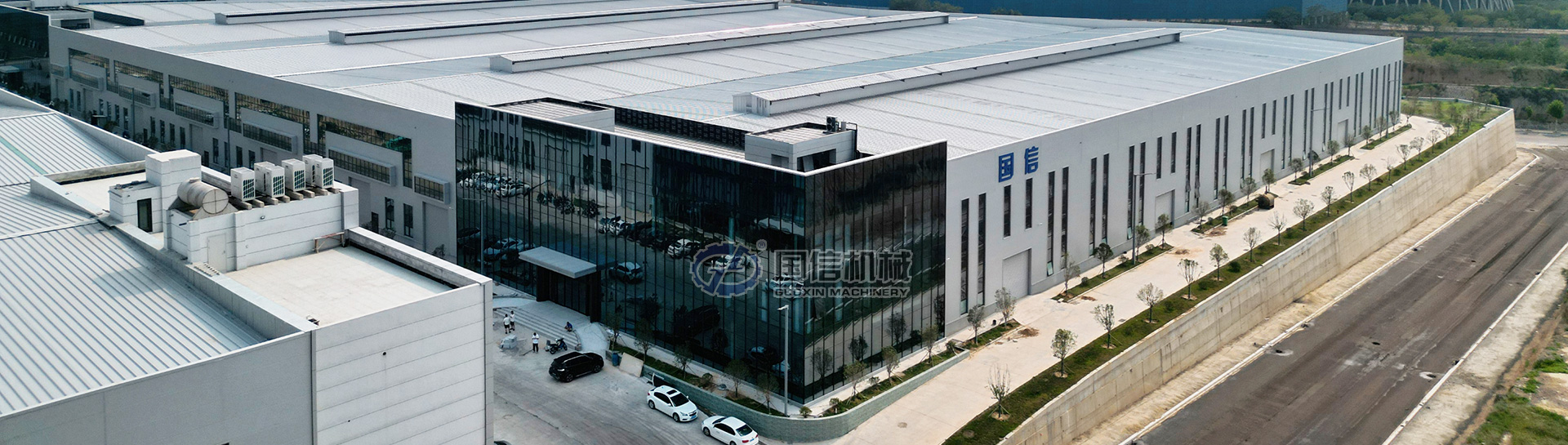
Project Location: Guigang, Guangxi, China
Commissioning Date: April 28, 2026
Waste Composition: Mixed Municipal Solid Waste (MSW) and Construction & Demolition (C&D) Waste
Primary Objective: Resource recovery and landfill diversion through automated density and size separation.
Project Background
Rapid urbanization in southern China has led to high volumes of “mixed urban waste,” where household refuse is often commingled with construction debris. The Guigang facility was established to address the challenge of separating heavy aggregates from high-calorific light materials. By implementing a modular Guoxin sorting line, the site achieves systematic recovery of metals, combustibles, and mineral materials.
Technical Process Flow and Equipment Configuration
1. Primary Size Reduction and Material Feeding
The processing begins with the stabilization of oversized construction debris. Large concrete blocks and mineral fragments are processed through a heavy-duty industrial crusher (as documented in the April 2026 site visit).
-
Plate Feeder System: Crushed C&D waste and raw MSW are loaded onto a heavy-duty feeder plate, ensuring a consistent volumetric flow rate into the primary sorting line to prevent system bottlenecks.
2. Multi-Stage Automated Separation
The core of the Guigang plant relies on the physical properties—density and size—of the waste stream.
-
Trommel Screening: The mixed stream is first classified by size. Fines (soil and small organics) are removed, while oversized materials proceed to density separation.
-
Air Separation (Pneumatic Sorting): High-velocity air currents separate the stream into “lights” and “heavies.”
-
Light Fraction: Plastics, textiles, and paper move upward and are captured for RDF (Refuse-Derived Fuel) production.
-
Heavy Fraction: Stones, bricks, and glass move downward for mineral recycling.
-
-
Magnetic Separation: Over-belt magnetic separators extract ferrous metals from the stream with a recovery efficiency exceeding 95%, protecting downstream shredders from damage.
3. Final Resource Outputs
The integrated system transforms raw mixed waste into four distinct industrial products:
-
Recycled Aggregates: Cleaned stones and gravel used for road base or recycled brick manufacturing.
-
RDF (Refuse-Derived Fuel): Baled light materials with high calorific value, supplied to Waste-to-Energy (WtE) power plants.
-
Recovered Metals: Ferrous scrap ready for foundry processing.
-
Fine Soil/Organics: Used for landfill cover or stabilized for non-structural fill.
Performance Data and Operational Value
Operational data from the Guigang site indicates a significant reduction in landfill requirements. The separation of combustibles (plastics/textiles) from inert minerals (concrete/bricks) allows the client to monetize waste that was previously a disposal cost. The use of automated conveyor belt systems reduces manual labor requirements while maintaining a high throughput capacity suitable for 24/7 industrial operation.
Engineering Consultation for Customized Layouts
Each waste stream is unique. At Guoxin, we utilize 3D design and layout diagrams to simulate material flow before manufacturing. This ensures the equipment configuration matches the specific density and moisture content of the local waste characterization.
Technical Inquiries: For detailed specifications of the trommel screens, air separators, or industrial crushers used in this project, please contact our technical department.
Email: Eve@guoxinmachinery.com
FAQ:
1. How does the system handle high-moisture MSW typically found in mixed streams?
The system incorporates heavy-duty trommel screens that utilize mechanical agitation to break up clumps. In regions with high organic content, we recommend an initial “bag-breaking” stage to ensure materials are loose before entering the air separator.
2. What is the expected purity of the recycled aggregates?
With properly calibrated air separation and magnetic recovery, the inert heavy fraction achieves a purity level suitable for secondary construction applications, such as sub-base materials and the production of non-load-bearing recycled bricks.
3. What is the average EPC (Engineering, Procurement, and Construction) duration for a plant of this scale?
For a standard 100-300 TPD (Tons Per Day) integrated line, the cycle typically ranges from 4 to 6 months, including 3D design optimization, equipment manufacturing, and on-site commissioning.
4. Can the RDF produced meet the calorific requirements of power plants?
Yes. By isolating plastics, paper, and textiles from non-combustible minerals and soil, the resulting RDF maintains a consistent, high calorific value, making it a viable coal-alternative for WtE facilities.