
Municipal Solid Waste (MSW) streams are inherently heterogeneous, characterized by high moisture profiles, volatile organic ratios, and abrasive matrix materials. For municipal authorities and private waste management concessionaires, individual sorting machines are insufficient. Economic viability requires an integrated processing plant capable of high-throughput automated segregation to achieve maximum landfill diversion and generate clean, market-ready secondary raw materials.
Guoxin’s industrial MSW sorting plants are engineered for continuous 24/7 duty cycles, scaling from 100 to 500+ Tons Per Day (TPH). By integrating sequential sizing, high-velocity air-knife density calibration, and ballistic material extraction, our systems achieve up to an 85% diversion rate, separating raw waste into distinct profit vectors: organic fines for composting, high-purity polymers, ferrous/non-ferrous scraps, and alternative fuels (RDF).
System Process Architecture: The Mass-Balance Sequence
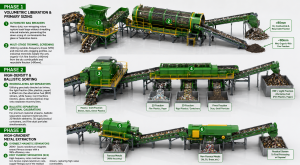
To prevent sorting cross-contamination, our plant layouts utilize a rigid, multi-stage mechanical sorting flow calculated against volumetric density and particle dynamics.
Phase 1: Volumetric Liberation & Primary Sizing
- Automated Bag Breakers: Heavy-duty, non-wrapping rotors rupture trash bags without shredding internal materials, preventing the down-sizing of contaminants like glass or hazardous items.
- Multi-Stage Trommel Screening: Utilizing variable-frequency drives (VFD) and internal anti-clogging profiles, our industrial trommels isolate the wet, organic-rich fine fraction (<80mm) from the dry combustible and recyclable fraction (>80mm).
Phase 2: High-Density & Ballistic Sorting
- Recirculating Air Separators: Utilizing precisely directed air knives, the light fraction (film plastics, paper) is lifted into the alternative fuel (RDF) stream, while heavy, inert fractions (stones, glass, dense plastics) drop onto separate recovery lines.
- Ballistic Separation (Optional Calibration): For premium material streams, ballistic separators segment materials into 2D flexible elements, 3D rigid plastics/containers, and fine dust particles simultaneously.
Phase 3: High-Gradient Metal Extraction
- Overbelt Magnetic Separators: 2000+ Gauss neodymium magnets extract ferrous scraps with a 98% efficiency rate.
- Eddy Current Separators (ECS): High-frequency rotor matrices repel non-ferrous metals (aluminum cans, copper fittings) out of the residual stream, capturing high-value commodities.
Technical Performance Benchmarks
Our municipal sorting complexes are delivered as modular, scalable EPC (Engineering, Procurement, and Construction) packages, engineered to mitigate high-moisture sorting drop-offs.
| Operational Metric | MSW-Plant 150 | MSW-Plant 300 | MSW-Plant 500+ |
| Daily Processing Capacity | 100 – 150 Tons/Day | 250 – 350 Tons/Day | 500 – 800+ Tons/Day |
| Hourly Throughput (TPH) | 15 – 20 Tons/Hour | 30 – 45 Tons/Hour | 60 – 100 Tons/Hour |
| Target Organics Purity | ≥ 90% | ≥ 93% | ≥ 95% |
| System Automation Level | PLC Central Control | SCADA + Optical Prep | Full Cloud Automation |
Engineering for Harsh Environments: Leachate & Abrasion Control
Mixed household waste presents severe operational hazards, including highly corrosive leachate and abrasive mineral fractions. Guoxin engineering counters these risks through targeted metallurgy and defensive structural layouts:
- Corrosion-Resistant Steel Framing: All critical contact zones within the trommel plates, hoppers, and organic chutes are lined with heavy-wall stainless steel (SS304) or high-tensile wear liners (NM450).
- Sealed Conveyor Transitions: Enclosed transfer chutes with integrated drip trays channel highly corrosive waste fluids away from moving rollers, protecting bearings and electrical sensors from structural compromise.
- Centralized SCADA Diagnostics: A master Siemens PLC network monitors drive torques across all belt scales, screens, and separators in real-time, executing automated shutdown cascades if a material choke-point is detected.
Turnkey Project Delivery & Global Compliance
We minimize engineering interface risks for municipal contractors through single-source project responsibility:
-
Feedstock composition mapping and mass-balance calculations.
-
Complete 3D spatial layout design for integration within existing transfer stations or greenfield sites.
-
On-site structural assembly, system balancing, and regulatory environmental compliance verification.
Request a Comprehensive MSW Mass-Balance Matrix
Every municipal waste profile differs by region and moisture loading. To receive a custom 3D plant model, calculated mass-balance metrics, and an investment costing reference, submit your target daily tonnage parameters.
EPC Project Management Team: Eve@guoxinmachinery.com
FAQ
Q1: How does the plant prevent high-moisture organic fractions from fouling the plastic recovery lines?
A: Wet organic fractions (food waste, agricultural components) represent the primary cause of sorting line failure. Our system deploys high-inclination primary trommel screens at the immediate front end of the processing matrix. By isolating the sticky <80mm fraction before any high-speed density sorting occurs, we ensure downstream plastic and paper conveyor lines remain dry and functional.
Q2: What is the average landfill diversion efficiency of a standard 300 TPD Guoxin line?
A: Depending on the raw waste composition, our integrated lines achieve an 80% to 88% diversion rate. By separating the inorganic recyclables, clean organics for anaerobic digestion, and light fractions for RDF processing, only unrecyclable inert materials (such as sweepings or composite multi-layer packaging) are sent to the landfill.
Q3: How are heavy structural jams prevented when processing bulky, un-shreddable waste inserts?
A: All primary conveyors and bag-breakers are equipped with bi-directional torque monitoring sensors connected to the central PLC. If a bulky contaminant (e.g., heavy concrete block or automotive component) creates a spike in mechanical resistance, the line automatically stops and alerts operators via the HMI interface, protecting key structural shafts from bending.
Q4: Can the plant layout be adapted to accommodate future optical sorting upgrades?
A: Yes. All Guoxin plant layouts are engineered with modular conveyor spacing. We explicitly include physical clearance zones and structural foundations post-trommel screening so that Near-Infrared (NIR) optical sorters can be bolted directly into the line at a later stage without requiring a full redesign of the building.