
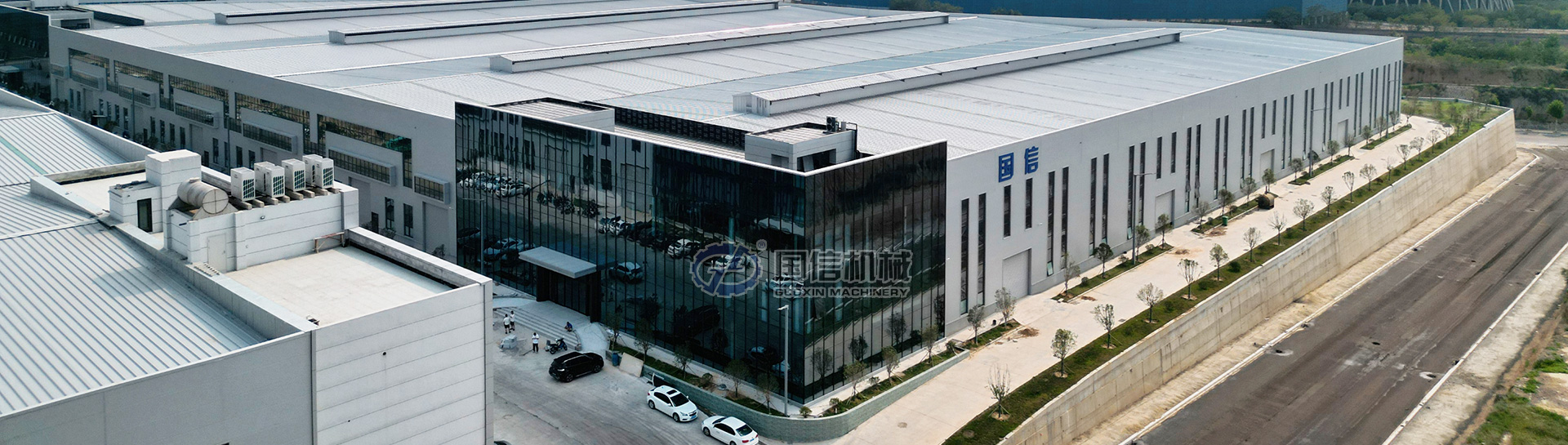
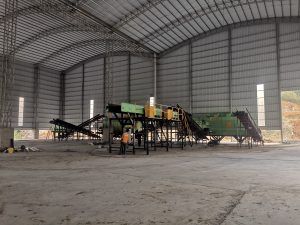
The operational success of a Municipal Solid Waste (MSW) sorting plant is determined by its ability to maintain high throughput despite the inherent heterogeneity of the waste stream. For municipal authorities and EPC contractors, the priority is a system that balances landfill diversion rates with the calorific purity of Refuse-Derived Fuel (RDF).
Guoxin’s approach to MSW sorting operations focuses on a “Process-First” engineering philosophy, ensuring that each mechanical stage—from primary liberation to final baling—is synchronized to prevent volumetric bottlenecks.
Mechanical Process Logic: The Four-Stage Recovery Framework
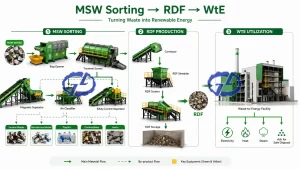
An integrated 100–2000 TPD plant must handle varying moisture levels and material densities. Our process engineering follows a strict mechanical sequence designed for maximum resource liberation.
Stage 1: Volumetric Dosing & Bag Liberation
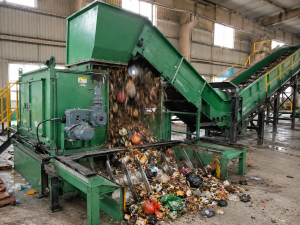
- Action: Utilizing high-torque, variable-speed bag openers.
- Technical Goal: Achieve a 98% liberation rate. The engineering focus here is on “tearing” rather than “shredding” to preserve the particle size of recyclables (PET/Glass) for downstream optical or manual recovery.
Stage 2: Three-Fraction Size Separation
- Action: VFD-controlled trommel screening.
- Fractionation Logic: Fine Fraction (<80mm): High organic content, diverted for stabilized landfilling or anaerobic digestion.
-
Mid-Fraction (80-250mm): High-density recyclables.
-
Oversize Fraction (>250mm): Heavy combustibles targeted for primary RDF shredding.
-
Stage 3: Density Isolation & Metal Extraction
- Air Separation: We utilize recirculating airflow systems to isolate light film plastics and paper with >90% efficiency. This is the critical step for ensuring the resulting RDF meets moisture and chlorine specifications.
- Magnetic Graduation: Integration of high-gradient magnets (2000+ Gauss) and Eddy Current Separators to recover up to 95% of ferrous and non-ferrous metals, creating a high-purity secondary revenue stream.
Stage 4: RDF Refining & Quality Control
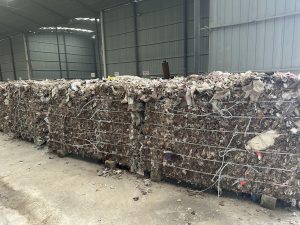
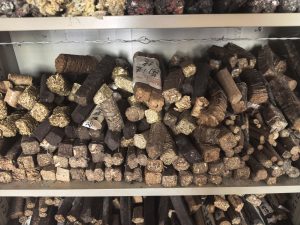
The light combustible fraction is processed through secondary shredders to reach a uniform particle size (typically <50mm or <80mm), ensuring a stable burn rate for cement kilns or WtE boilers.
EPC Service Scope: Not Limited to Equipment Supply
A Turnkey solution is defined by the integration of the components, not just the machines themselves. Our EPC (Engineering, Procurement, and Construction) scope covers the full project lifecycle:
- Feasibility & Waste Characterization: Analysis of local waste moisture (often >50% in developing regions) and calorific value.
- 3D Layout Engineering: Spatial optimization to fit high-capacity lines (up to 2000 TPD) into constrained urban footprints.
- System Integration: PLC-based centralized control for real-time monitoring of motor loads and conveyor speeds.
- On-site Commissioning: Technical training for local operators to ensure long-term mechanical uptime.
Operational Benchmarks: Manual vs. Automated Systems
For large-scale municipal projects (500+ TPD), the transition to automated mechanical sorting is a requirement for meeting modern environmental regulations.
| Metric | Manual/Semi-Auto Sorting | Guoxin Fully Automated Line |
| Recovery Efficiency | 40% – 55% | 85% – 95% |
| RDF Calorific Value | 10,000 – 12,000 kJ/kg | 15,000 – 18,000 kJ/kg |
| Operational Labor | High (50+ persons/shift) | Low (10-15 persons/shift) |
| Consistency | Variable | Stable (PLC-Controlled) |
Case Verification: Thailand & Tianjin
In Rayong, Thailand, our 200 TPD MSW sorting line was engineered specifically for high-moisture tropical waste, successfully producing boiler-ready RDF for local industrial use. In Tianjin, we implemented an integrated MSW and Construction & Demolition (C&D) recycling plant, showcasing the versatility of our heavy-duty screening and density separation technology in a high-volume urban setting.
Technical Feasibility & Cost Estimation:
MSW plant costs are determined by daily throughput requirements and desired automation levels. For a customized process flow design and ROI analysis, please provide your waste composition data.
Consulting Engineer: Eve@guoxinmachinery.com
FAQ
Q1: How is the “Wrapping” of long fibers prevented in the MSW sorting process?
A: Wrapping is the primary cause of downtime. Our bag openers and trommels feature specialized blade geometries and “cleaner fingers” that prevent film and textiles from tangling around the rotors. Combined with a PLC-controlled auto-reverse system, this ensures continuous operation.
Q2: What is the impact of high moisture (50%+) on sorting efficiency?
A: High moisture causes organics to stick to recyclables. We solve this through higher-inclination conveyors and high-velocity air separators that use “air knives” to break material surface tension, ensuring the light fraction remains dry enough for RDF production.
Q3: Can a 500 TPD plant be upgraded to 1000 TPD later?
A: Yes. Our turnkey designs are modular. We provide the initial 3D layout with “reserved bays” and high-capacity main-line conveyors, allowing you to add parallel sorting modules or additional optical sorters as city waste volumes grow without re-engineering the entire facility.
Q4: What are the chlorine and moisture specs for the output RDF?
A: Through multi-stage air separation and the removal of PVC via optional optical sorting, our lines can maintain chlorine levels under 1%. Moisture content is typically reduced through the mechanical removal of wet organic fines during the trommel stage.