
In Waste-to-Energy (WtE) operations, particularly for cement kiln co-processing, the commercial value of Refuse-Derived Fuel (RDF) or Solid Recovered Fuel (SRF) is determined by its combustion stability.
This stability relies on one technical variable: Consistent Particle Size Distribution (PSD). Guoxin’s secondary fine shredding solutions are engineered to bridge the gap between mixed combustible waste and boiler-ready fuel. We focus on delivering a uniform <50mm or <30mm output while minimizing the Total Cost of Ownership (TCO) through advanced metallurgy and intelligent motor control.
The Physics of Secondary Shredding: Particle Homogeneity
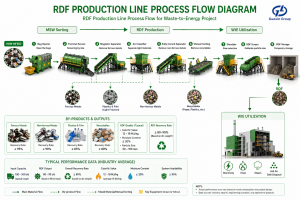
The Secondary Shredding stage is the critical path to RDF quality
While primary shredders focus on volume reduction, our secondary fine shredders are designed for specification calibration.
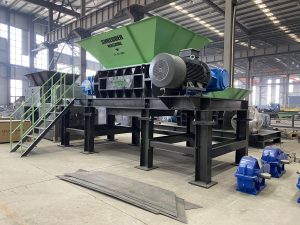
- Hydraulic Pusher Logic: To prevent material bridging or slipping, our single-shaft fine shredders utilize a PLC-controlled horizontal pusher. This ensures the feedstock is forced against the high-speed rotor at a constant pressure, maintaining a stable Amperage draw and a continuous output flow.
- Shearing vs. Impact: We utilize a high-density rotor layout with precision-ground square cutters. The shearing action ensures clean cuts through elastic textiles and films, which are notorious for wrapping in lower-quality machines.
Technical Specs: The GRS Series Performance (2026 Engineering)
Our GRS series is calibrated for high-availability industrial environments. These specifications are designed for project managers who require 24/7 operational reliability.
| Technical Parameter | GRS-1200 (Compact) | GRS-1500 (Industrial) | GRS-2000 (High-Capacity) |
| Throughput (TPH) | 5 – 10 Tons/Hour | 15 – 25 Tons/Hour | 30 – 50+ Tons/Hour |
| Output Size (P95) | 30mm – 80mm (Adjustable) | 40mm – 100mm (Adjustable) | Custom Configuration |
| Rotor Diameter | 450 mm | 600 mm | 850 mm |
| Main Motor Power | 75 – 110 kW | 132 – 160 kW | 200+ kW |
Note: All units feature VFD (Variable Frequency Drive) integration for optimal energy efficiency across varying waste densities.
Operational Durability: Optimizing Blade Life & TCO
The primary OPEX (Operating Expense) of an RDF line is blade wear. Our engineering addresses this through two distinct mechanical features:
- Four-Way Reversible Cutters: Each blade is manufactured from Cr12MoV hardened alloy steel. The square design allows operators to rotate the blade four times before replacement, effectively cutting consumable costs by 75% compared to single-edge designs.
- Adjustable Counter-Knives: The gap between the rotor blades and the stator knives is externally adjustable. This allows for the compensation of natural wear, ensuring the particle size remains within the required spec for a longer duration between maintenance intervals.
Safety & System Protection
RDF feedstock often contains unshreddable contaminants (bolts, heavy steel plates) that bypass magnetic separators.
- Friction Clutch Protection: We integrate a high-sensitivity friction clutch between the motor and the gearbox. In the event of a sudden rotor stall caused by heavy metal, the clutch disengages within 0.1 seconds, preventing shaft deformation or gearbox teeth fracture.
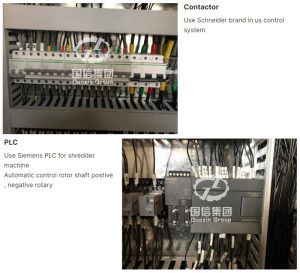
- Smart Auto-Reverse: The Siemens PLC monitors torque spikes. If a resistance threshold is met, the rotor automatically reverses to attempt liberation of the object before alerting the operator via the HMI panel.
Proven Industry Application
Guoxin’s secondary shredding technology is currently deployed in high-capacity SRF lines, including:
- Cement Kiln Co-processing: Producing <50mm high-calorific fuel from industrial plastic scraps to replace coal in calciners.
- Large-scale MSW Energy Recovery: Processing the light fraction from 500 TPD sorting plants into stabilized RDF for dedicated WtE boilers.
Request a Technical Proposal & ROI Calculation
Selecting the correct shredder requires a deep understanding of your feedstock’s moisture and density. Provide your project parameters for a custom 3D layout and energy-consumption analysis.
Contact Our Engineering Team: Eve@guoxinmachinery.com
FAQ
Q1: Why is a single-shaft shredder preferred for secondary RDF production?
A: Single-shaft shredders allow for the use of a screen. This ensures that 100% of the output is filtered by size. In a double-shaft shredder, there is no screen, meaning long strips of plastic could pass through and clog the pneumatic injection systems of a cement kiln.
Q2: How does your system handle high-moisture (40%+) combustible waste?
A: High-moisture material tends to stick to the screen. We utilize a high-velocity rotor design that generates a “centrifugal cleaning” effect, combined with a specialized screen geometry that prevents material buildup, maintaining throughput in humid environments.
Q3: What is the typical burnout rate of RDF produced by this shredder?
A: Due to the high surface-area-to-volume ratio of the <50mm particles produced, our RDF typically achieves a >98% burnout rate in cement kilns, ensuring no unburnt carbon ends up in the clinker.
Q4: Can the system be integrated into an existing 3D plant layout?
A: Absolutely. Our shredders are designed with modular support frames. We provide the STEP/CAD files to your engineering team to ensure the discharge conveyor and feed hopper align perfectly with your existing facility’s material flow.