
In a commercial RDF production line, the sizing circuit serves as the final link between raw, segregated waste and a high-value commodity.
Cement kilns, coal-fired power plants, and gasification facilities enforce strict technical specifications on Refuse-Derived Fuel (RDF) and Solid Recovered Fuel (SRF).
To command premium pricing, the finished material must not only meet moisture and chlorine thresholds but also maintain absolute particle-size uniformity—typically restricted to three-dimensional dimensions of <30mm or <50mm.
When engineering the size-reduction phase, project developers face a fundamental choice: Should the line deploy a high-speed single-shaft shredder or a low-speed, high-torque dual-shaft shear shredder?
Choosing the wrong mechanical configuration leads to volatile output sizing, excessive material wrapping, and inflated power consumption. Optimizing your plant’s operational expenditure (OPEX) requires matching the specific cutting physics of each machine to its correct position within the processing matrix.
Mechanical Kinematics and Cutting Physics
The fundamental division between these two industrial shredder classes lies in how they apply mechanical force to liberate and downsize materials.
Dual-Shaft Shredders (High-Torque Shearing)
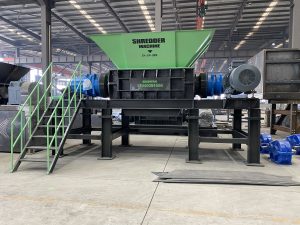
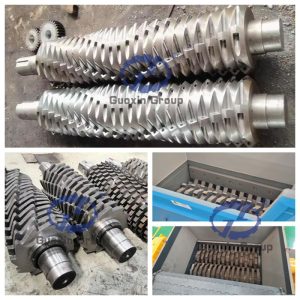
Dual-shaft shredders utilize two parallel counter-rotating shafts equipped with interlocking, hooked disks.
- The Mechanism: The shafts turn at low speeds (typically 10–40 RPM) but generate massive hydraulic torque. Sizing is determined purely by the width and hook profile of the interlocking blades.
- The Limitation: Because there is no internal physical barrier to retain the material, flexible or thin materials (like linear low-density polyethylene films or long textile fibers) can slip vertically through the gaps between blades without being cut crosswise. This yields elongated, “stringy” fractions.
Single-Shaft Shredders (High-Speed Shearing + Screen Calibration)
A single shaft shredder operates at significantly higher rotational velocities (typically 60–120 RPM) and relies on a hydraulic pusher ram to press material against a single, high-mass rotor.
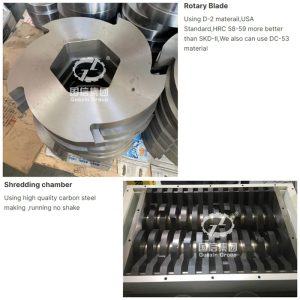
- The Mechanism: The rotor is populated with small, square indexable knife inserts that shear against a fixed counter-knife bar at tight tolerances (0.5mm–1.0mm).
- The Defining Feature: Beneath the rotating shaft sits a semi-cylindrical, heavy-duty calibration screen. Material cannot exit the shredding chamber until it is down-sized enough to pass through the screen apertures. Any oversized fraction is swept back up by the rotor for a secondary cut.
Core Engineering Performance Matrix
| Performance Parameter | Dual-Shaft Shear Shredder | Industrial Single-Shaft Shredder |
| Primary Processing Role | Primary/Pre-shredding (Bulk reduction) | Secondary/Fine shredding (Calibrated sizing) |
| Rotational Shaft Speed | Low (10 – 40 RPM) | High (60 – 120 RPM) |
| Torque Profile | Extremely High (Excellent anti-jamming) | Moderate (Relies on flywheel/VFD mass) |
| Output Size Consistency | Variable (Elongated strips possible) | Highly Precise (Determined by screen diameter) |
| Tramp Metal Tolerance | High (Passes or stalls without fracturing) | Low to Moderate (Requires tight upstream sorting) |
| Friction & Heat Generation | Low | High (Requires active load management) |
Why the Single-Shaft Architecture Dominates Premium RDF Sizing
For processing lines tasked with supplying cement factories or fluid-bed boilers, the single-shaft configuration is almost universally mandated for the secondary refinement phase due to three structural advantages:
Absolute Multi-Dimensional Size Control
Dual-shaft units excel at ripping open compressed mattresses, car tires, or baled municipal solid waste, but they cannot guarantee a strict three-dimensional limit. A plastic strip might be 30mm wide (the width of the dual-shaft disk) but 300mm long. In a cement kiln’s pneumatic feeding line, that 300mm strip will bridge and clog the air transport system. The built-in screen of a single-shaft unit guarantees that no material exceeds the maximum rated diagonal dimension.
Indexable, Low-Cost Blade Maintenance
When a dual-shaft blade wears down or chips on a piece of hidden iron, the entire shaft assembly must often be pulled, disassembled, and rebuilt via expensive hardfacing welding. In contrast, a premium single-shaft rotor utilizes exchangeable, bolt-on square cutters manufactured from DC53 or premium tool steel. When an edge dulls, a technician simply loosens the retaining bolt and rotates the knife 90 degrees to expose a fresh, razor-sharp cutting face. Each knife can be flipped four times before replacement is required.
Clean Shearing vs. Compression Tearing
The tight mechanical tolerance between the rotor knives and the stator bed in a single-shaft system creates a true scissor-like shearing action. This clean cut minimizes dust generation (micro-fines) and prevents low-melting-point polymers from melting and smearing onto the blade faces, which is a common cause of friction-induced fire hazards in high-volume production plants.
Systems Integration: Designing the Ideal Twin-Stage RDF Processing Circuit
To maximize throughput while controlling wear-part costs, a world-class rdf production line should not choose between these two machines; it should integrate them sequentially.
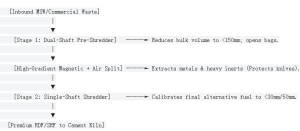
- The Primary Phase: A dual-shaft pre-shredder handles the raw, unpredictable inbound waste stream, reducing bulk volume to a manageable <150mm matrix and liberating trapped materials.
- The Intermediary Cleaned Phase: The pre-shredded material passes under high-gradient overbelt magnets and through air knives to remove tramp metal, concrete chunks, and glass.
- The Refinement Phase: The cleaned, high-calorific fraction feeds into the single shaft shredder. Because the heavy abrasives and impact hazards have been stripped upstream, the high-speed single-shaft rotor can run continuously at peak efficiency, extending blade lifespans from a typical 200 hours to over 700 operating hours.
Calibrate Your Sizing Output
Achieving the exact particle morphology required by off-takers requires precise tuning of rotor torque, pusher speed, and screen geometries.
Contact our engineering division for a custom mass-balance simulation, 3D line layout integration, or a technical consultation on optimizing your shredding circuits.
EPC Project Directorate: Eve@guoxinmachinery.com