
The transition from a raw demolition site to a profitable resource recovery facility requires more than standalone machinery; it requires an integrated engineering approach. For EPC contractors and municipal project owners, the primary goal is a turnkey C&D waste sorting plant that balances high throughput with the purity levels required for secondary market sales.
Guoxin provides comprehensive project delivery, covering the entire lifecycle from initial waste characterization to the commissioning of automated sorting lines. Our systems are engineered to handle the abrasive nature of Construction & Demolition (C&D) waste, ensuring stable Recycled Aggregate (RA) production and high-calorific Refuse-Derived Fuel (RDF) output.
The Turnkey EPC Framework
A successful Turnkey delivery removes the technical risk for the project owner. Our engineering scope focuses on four critical pillars:
- Process Engineering & 3D Layout: Customizing the material flow to fit within existing land constraints while optimizing for the lowest energy consumption per ton processed.
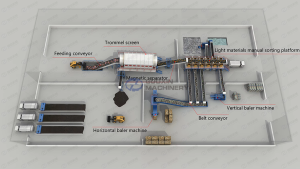
- Automated Material Isolation: Integration of mechanical screening, high-gradient magnetic recovery, and air density separation to ensure consistent purity thresholds.
- Electrical & PLC Integration: Centralized control systems with real-time monitoring of torque, load, and belt speeds to prevent mechanical failure in abrasive environments.
- Commissioning & Operator Training: On-site technical support to ensure local teams can maintain 90%+ operational uptime.
Integrated Process Sequence for Resource Recovery
To meet the Waste-to-Energy and Circular Economy targets, the C&D waste stream is processed through a multi-stage mechanical sequence:
Phase 1: Primary Liberation & Sizing
Heavy-duty vibrating or trommel screens isolate the fines (soil/sand) immediately. This protects downstream secondary crushers and separators from excessive wear, a critical factor in reducing Total Cost of Ownership (TCO).
Phase 2: Metallic & Inert Recovery
High-gradient overbelt magnets recover 95% of ferrous rebar, transforming a waste liability into a high-value secondary revenue stream. Meanwhile, clean concrete and brick fractions are isolated as Recycled Aggregates for road base construction.
Phase 3: Density Separation (RDF Fraction)
Utilizing high-velocity recirculating air separators, the light combustible fraction (wood, plastics, textiles) is isolated from the heavy inerts. This light fraction serves as the primary feedstock for RDF production, supporting industrial Waste-to-Energy (WtE) targets.
Technical Specifications: Project Scale & Output
Our turnkey solutions are configured based on daily processing volumes, ranging from regional recycling centers to large-scale municipal facilities.
| Project Metric | Tier 1 (Compact) | Tier 2 (Industrial) | Tier 3 (EPC Large-Scale) |
|---|---|---|---|
| Throughput Capacity | 50 – 80 TPH | 100 – 150 TPH | 200+ TPH |
| Automation Level | Semi-Automated | Full PLC Control | AI/Optical Integration |
| Recovery Focus | Aggregates / Metals | Aggregates / RDF / Metal | Multi-Purity Fractions |
| Service Scope | Equipment + Design | EPC Turnkey Delivery | EPC + Managed Ops |
Operational Reliability in Abrasive Environments
C&D waste is the most demanding material stream in the recycling industry. Our systems are engineered with:
- NM450 Wear Liners: Installed in all high-impact chutes and hoppers to handle concrete and stone.
- Reinforced Conveyor Logic: Utilizing 4-ply rubber belts with high cut-resistance to manage sharp metal rebar.
- Dust Suppression Systems: Integrated misting or bag-house filtration to meet local environmental compliance for urban sorting facilities.
Request a Technical Project Evaluation
A successful C&D project starts with accurate data. Provide your waste composition and target output requirements for a customized technical proposal and ROI analysis.
EPC Project:Eve@guoxinmachinery.com
FAQ
Q1: How does a Turnkey solution reduce the overall project risk?
A: A turnkey project provides a single point of accountability. Instead of managing multiple vendors for conveyors, screens, and separators, Guoxin handles the mechanical integration, ensuring that all components are synchronized for the specific moisture and density of your local C&D waste.
Q2: Can the plant produce RDF that meets cement kiln specifications?
A: Yes. By integrating our secondary air separators and fine shredding modules, the light fraction can be processed to a <50mm particle size with high calorific value, making it suitable for co-processing in cement kilns or dedicated WtE boilers.
Q3: What is the typical lead time from design to commissioning for a 100 TPH plant?
A: A standard EPC delivery cycle is typically 4 to 6 months, depending on the complexity of the site layout and the degree of automation (e.g., the inclusion of optical sorters for high-purity plastic recovery).
Q4: How does the system handle tramp metal like heavy I-beams or thick rebar?
A: We utilize high-clearance overbelt magnets and reinforced primary screening. If an unshreddable object is detected, the PLC-controlled torque sensors trigger an emergency stop or reverse to protect the structural integrity of the rotors and belts.