
In industrial solid waste management, size reduction is the critical baseline process that dictates the efficiency of downstream recycling, gasification, or incineration. However, different waste streams require distinct mechanical tearing and shearing mechanisms. Two of the most challenging equipment configurations in this sector are the heavy-duty RDF shredder and the highly regulated medical waste shredder.
While both machines rely on high-torque reduction profiles, their structural engineering, blade metallurgy, and containment setups must be custom-tailored to their respective material inputs to prevent catastrophic blade breakage or environmental contamination.
1. Demanding Torque: Engineering an Efficient RDF Shredder Line
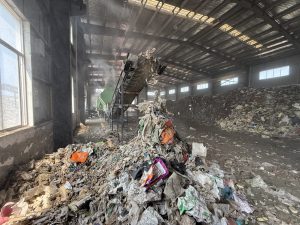
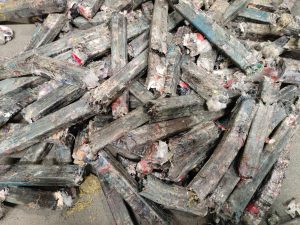
Refuse-Derived Fuel (RDF) and Solid Recovered Fuel (SRF) production lines process highly heterogeneous municipal and industrial waste (MSW/C&I). The input material contains a chaotic mix of high-elasticity plastics, tough textiles, rubber tires, and occasional non-shreddable tramp metals.
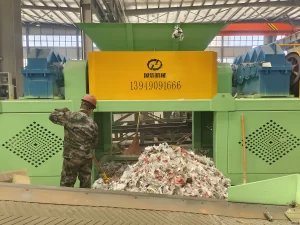
To process this material into a uniform alternative fuel source, an industrial RDF shredder typically utilizes a dual-shaft shear design running at low speeds (10–20 RPM) with exceptionally high torque.
- Particle Size Control:
The primary engineering goal is to reduce bulk waste into a uniform fraction size of < 50 mm or < 30 mm in a single pass. This ensures rapid, complete combustion in cement kilns and waste-to-energy boilers.
- Blade Metallurgy:
Blades must feature superior impact toughness to resist cracking when striking undetected metal pieces. Standard setups utilize high-strength 42CrMo or forged alloy steels surface-welded with wear-resistant tungsten carbide coatings.
- Auto-Reverse Anti-Jam Mechanisms:
When the PLC detects a sudden amperage spike (indicating a non-shreddable object jammed between the cutters), the drive system automatically reverses the shaft rotation within 0.5 seconds, clearing the hook before attempting a forward shredding cycle again.
2. Biosecurity and Precision: Sealing Standards for Medical Waste Shredders
Processing hazardous medical waste (such as syringes, IV bags, surgical instruments, and infectious organic tissue) requires an entirely different engineering focus. Here, the primary objective is not throughput volume, but absolute pathogen containment, volume reduction, and sterilization preparation.
An optimized medical waste shredder must incorporate several strict design adaptations:
- Negative-Pressure Hermetic Sealing:
To prevent hazardous aerosols, viruses, and odors from escaping into the facility, the shredding chamber must be completely sealed and integrated with a localized negative-pressure HEPA filtration and carbon adsorption system.
- Aggressive Blade Geometry:
Medical waste contains incredibly dense and slick polymers alongside thin-walled stainless steel needles. Blades require a highly aggressive hook profile manufactured from premium D2 (Cr12MoV) or H13 tool steels, vacuum-heat-treated to a hardness of 58–61 HRC to maintain sharp shearing edges over long cycles.
- Integrated Disinfection Interface:
Advanced medical waste processing layouts configure the shredder directly inline with an autoclave system or introduce chemical disinfectant spray nozzles inside the hopper chamber to neutralize pathogens simultaneously during the mechanical crushing phase.
3. RDF vs. Medical Waste Shredder Technical Matrix
When selecting or custom-configuring shredding systems within a larger waste separation machine framework, engineering teams should reference the following mechanical baselines:
| Technical Parameters | Heavy-Duty RDF Primary Shredder | Specialized Medical Waste Shredder |
| Drive System Configuration | Dual-Motor Hydraulic or High-Torque Gearbox | Direct-Drive Electric Gearmotor |
| Shaft Rotation Speed (RPM) | 10 – 15 RPM (Low speed, high impact) | 25 – 40 RPM (Medium speed, high shear) |
| Target Output Particle Size | Variable screen sizes (<50mm standard) | Micro-fraction shredding (<20mm) |
| Chamber Environment | Heavy-duty open hopper with dust suppression | Hermetically sealed with negative pressure |
| Cutter Alloy Selection | 42CrMo / Hard-faced structural alloys | High-Chromium D2 / DC53 Cold-Work Tool Steel |
4. Systems Integration for Modern Turnkey Plants
A standalone shredder is only as good as the material handling system supporting it. In modern automated recycling infrastructures, feeding an rdf shredder requires a continuous, non-pulsing bulk material stream—typically managed via automated chain slat conveyors or variable-speed belt systems—to prevent chamber choking and maximize cutting efficiency.
For complex environmental engineering projects, integrating precise 3D CAD modeling early in the design stage is paramount. Properly mapping the footprint, structural static loads, dynamic vibration dampening, and maintenance clearance spaces prevents costly field modifications during plant erection.
Engineering CAD & Layout Support:
Developing a complete mechanical outline for alternative fuel or hazardous waste processing requires certified equipment spacing profiles. To access standardized engineering templates, structural load data, and full process schematics, explore our integrated waste processing plant 3d model layout design master configuration center.