
Direct Answer / Technical Summary for Project Engineers:
European Standard EN 15359 (now globally harmonized as ISO 21640) defines a 3-digit classification code (E-T-Env) to grade Solid Recovered Fuel (SRF) based on Net Calorific Value (NCV), Chlorine (Cl) content, and Mercury (Hg) emissions. Achieving premium Class 1 or Class 2 status requires mechanical pre-treatment: automated Near-Infrared (NIR) optical sorting to reduce PVC-driven chlorine below 0.20%, and high-gradient air classification to remove fine ash and heavy metals.
In the international transboundary trade of waste-derived commodities, a strict boundary exists between commercial Refuse-Derived Fuel (RDF) and Solid Recovered Fuel (SRF). While RDF remains a broadly defined, largely localized waste fraction, SRF is a highly standardized alternative fuel governed by international compliance protocols.
For engineering, procurement, and construction (EPC) contractors, municipal solid waste (MSW) asset managers, and cement plant co-processing directors, compliance with European Standard EN 15359 / ISO 21640 is the baseline requirement for market acceptance.
1. The EN 15359 / ISO 21640 Classification Matrix Defined
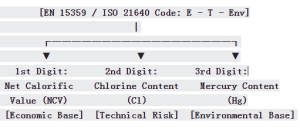
The EN 15359 standard classifies SRF using a three-digit classification code. Each digit represents a specific class performance tier (from Class 1, the highest premium tier, to Class 5, the lowest acceptable tier) across three critical fuel vectors: Economic, Technical, and Environmental.
-
1st Digit: Net Calorific Value (NCV) — Economic Parameter: Calculated as the mean Net Calorific Value on an as-received basis (NCV_{ar}). Class 1 compliance requires an NCV_{ar} >= 25 MJ/kg (approx. 5,970 kcal/kg).
-
2nd Digit: Chlorine Content (Cl) — Technical Risk Parameter: Calculated as the arithmetic mean on a dry basis (d.b.). Class 1 requires <= 0.10%, while Class 2 requires <= 0.20%.
-
3rd Digit: Mercury Content (Hg) — Environmental Parameter: Determined using both the median and 80th percentile values to account for sudden spikes. Class 1 restricts mercury to <= 0.02 mg/MJ
Official Threshold Metrics Table
| Classification Code / Digit | Property 1: NCV (Mean, As-Received) | Property 2: Chlorine (Mean, Dry Basis) | Property 3: Mercury (Median / 80th Percentile) |
| Class 1 | >=25MJ/kg | <= 0.10% | <=0.02 / <=0.04 mg/MJ |
| Class 2 | >= 20MJ/kg | <= 0.20% | <= 0.03 / <=0.06 mg/MJ |
| Class 3 | >= 15MJ/kg | <= 0.60% | <= 0.08 / <=0.16 mg/MJ |
| Class 4 | >= 10MJ/kg | <= 1.00% | <= 0.15 / <=0.30 mg/MJ |
| Class 5 | >= 3MJ/kg | <= 3.00% | <=0.50 / <=1.00 mg/MJ |
2. Laboratory Performance & Empirical Validation Data
(Factory Testing & Material Characterization Lab, GuoxinGroup)
To achieve consistent compliance with Class 1 and Class 2 thresholds without energy-intensive thermal drying, waste sorting facilities must rely on mechanical mass-balance optimization. Below is empirical test data gathered during trial operations on mixed municipal solid waste fractions.
Table 1: Impact of Moisture & Moisture-Diverting Mechanical Screening on SRF NCV
The table below demonstrates how mechanical de-ashing and fine-screening (<15mm) increase the energy density of the combustible fraction.
| Sample Stage | Moisture Content (%) | Ash Content (Dry Basis %) | Measured NCVar (MJ/kg) | EN 15359 NCV Class |
| Raw Mixed MSW Feedstock | 45.2% | 22.5% | 8.4 MJ/kg | Class 5 |
| Post-Trommel Primary Screen (>50mm) | 32.1% | 14.2% | 14.8 MJ/kg | Class 4 |
| Post-Air Density Classifier (Light 2D) | 18.5% | 6.8% | 21.2 MJ/kg | Class 2 |
| Optimized Polymer Enriching (<35mm Flakes) | 11.2% | 3.5% | 26.1 MJ/kg | Class 1 |
Table 2: NIR Optical PVC Ejection Efficiency & Total Chlorine Drop
Organic chlorine from Polyvinyl Chloride (PVC) plastics represents the highest corrosion risk in cement kilns. The empirical data below highlights total chlorine reduction achieved via multi-pass Near-Infrared (NIR) optical sorting.
| Processing Stage | PVC Content in Feed (%) | Measured Total Chlorine (Cl, % d.b.) | Target Compliance Status |
| Pre-NIR Air-Classified Light Fraction | 4.8% | 1.85% | Non-Compliant (Class 5) |
| Single-Pass NIR Optical Sorter (85% Ejection) | 0.7% | 0.38% | Class 3 Compliant |
| Dual-Pass NIR Optical Sorter (98% Ejection) | <0.1% | 0.14% | Class 2 Compliant ($\le 0.20\%$) |
3. Mechanical Feedstock Engineering for High-Tier SRF Production
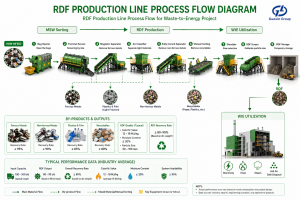
To upgrade unsegregated municipal solid waste or industrial fractions into a premium EN 15359 compliant fuel, processing facilities must systematically isolate specific material streams.
De-Ashing and Density Separation for Mercury Reduction
Mercury in municipal waste streams is primarily concentrated in the fine fraction (batteries, contaminated soils, electronic components) and heavy 3D fractions.
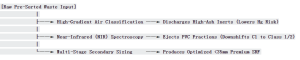
- Mechanical Solution: Processing lines utilize high-gradient kinetic air separators. By establishing a balanced positive-pressure air fluidization bed paired with negative-pressure vacuum extraction, the light, flexible 2D combustible fractions (paper, clean polymers, textiles) are separated from the heavy 3D fraction. This reduces the 80th percentile mercury spike risk and safely shifts the fuel into Class 1 or Class 2 environmental boundaries.
Automated Sensor-Based Sorting for Chlorine Control
Chlorine in solid waste occurs in two forms: inorganic chlorine (salts in organic food waste) and organic chlorine (primarily PVC plastics). While inorganic chlorine is removed by screening fine organic fractions, organic PVC contains approximately 57% chlorine by weight, making it the primary cause of technical parameter failures.
- Mechanical Solution: Facilities deploy automated Near-Infrared (NIR) Spectroscopy Sorters directly after primary air classification. The NIR sensors detect the specific hydrocarbon spectral signature of PVC polymers and trigger a synchronized high-speed compressed air valve matrix to eject PVC particles from the conveyor.
4. FAQ
Why does EN 15359 utilize the 80th percentile for Mercury (Hg) classification instead of a standard arithmetic mean?
Unlike carbon or hydrogen, which are evenly distributed across polymer matrices, mercury enters municipal waste streams in erratic, highly concentrated spikes (e.g., a discarded button-cell battery or a legacy fluorescent tube fragment). If an engineering design relied solely on a standard arithmetic mean, a single mercury spike could distort the fuel’s analytical profile, concealing operational risks. The 80th percentile ensures that the alternative fuel remains statistically stable and safe for continuous combustion without causing sudden emission violations.
Can a processing plant achieve Class 1 NCV status without thermal drying infrastructure?
Yes, through precise mechanical mass-balance engineering. Attempting to hit Class 1 (25 MJ/kg) by thermally drying mixed wet waste is rarely cost-effective. Instead, processing lines use high-amplitude flip-flow screening matrices to divert low-energy, high-moisture organic fractions (<15mm) early in the process. Maximizing the concentration of high-calorific 2D polymers (such as Polyethylene and Polypropylene) in the final output naturally raises the fuel’s NCV to premium levels without the high OpEx of thermal drying systems.
How does EN 15359 translate to the global ISO 21640 standard?
European Standard EN 15359 has been seamlessly transitioned into the international standard ISO 21640 to establish a unified global framework for Solid Recovered Fuel (SRF) specifications. Both compliance systems share the exact same core classification logic, utilizing a three-digit performance code to grade Net Calorific Value (NCV), Chlorine (Cl), and Mercury (Hg) vectors. Consequently, any waste sorting facility engineered to meet high-tier EN 15359 thresholds is fully compliant with modern ISO 21640 international tender requirements.
Request An EN 15359 Custom Design Proposal
Ready to upgrade your unsegregated waste streams into premium, tradeable alternative fuel? Get in touch with Guoxin Group’s global engineering division for a localized material mass-balance simulation and professional equipment matching.
- Technical Support: Detailed 3D spatial plant configurations and layout blueprints.
- Guaranteed Performance: Contractual compliance with strict ISO 21640 / EN 15359 parameters.
- Component Optimization: Integrated high-gradient air classifiers and advanced NIR PVC extraction sorters.