
For municipal environmental authorities and engineering, procurement, and construction (EPC) contractors, legacy unsanitary landfills and saturated dumpsites represent massive environmental liabilities. These aged waste mass-flows generate continuous leachate plumes, uncontrolled methane (CH4) emissions, and severe land capitalization constraints.
Landfill Mining and Reclamation (LFMR) has transitioned from a theoretical remediation concept into a highly viable, mechanically driven industrial discipline.
By deploying advanced front-end sizing and aerodynamic segregation matrices, waste asset managers can excavate closed or active dumpsites to reclaim valuable real estate, recover high-calorific fractions for Refuse-Derived Fuel (RDF) manufacturing, and isolate stabilized humus soil for municipal engineering applications.
This technical paper outlines the rheological characteristics of excavated aged waste and defines the mechanical engineering workflows required to optimize fraction segregation yields economically.
1. Characterization of Excavated Aged Waste: The Material Matrix
Unlike fresh municipal solid waste (MSW), aged waste excavated from a landfill cell that has undergone anaerobic degradation for 5 to 20+ years exhibits highly complex, cohesive, and abrasive physical properties. The material matrix typically breaks down into three distinct industrial fractions:
[Excavated Aged Waste Input]
       │
       ├──► 1. Stabilized Humus Soil / Fine Fractions (<15mm / 20mm)
       │       └─► 40%–60% of total mass. High moisture, high mineral ash density.
       │
       ├──► 2. Combustible Fraction / RDF Feedstock (>50mm)
       │       └─► 20%–35% of total mass. Degraded 2D plastic films, textiles, and wood.
       │
       └──► 3. Heavy Inerts & Recyclables
               └─► 10%–20% of total mass. Ferrous scrap, concrete blocks, glass aggregates.
The Moisture and Cohesion Challenge
Excavated aged waste features an average composite moisture content ranging from 35% to 45%. Because the organic kitchen waste fraction has completely degraded over time into micro-porous organic humus soil, this fine dirt binds tightly to the surfaces of flexible plastics and textiles.
If this sticky, abrasive matrix is fed directly into standard shredding or optical sorting equipment without highly aggressive primary dimensional delamination, it causes immediate equipment blinding, severe tool abrasion, and unviable carryover rates.
2. The Multi-Stage Mechanical Processing Architecture
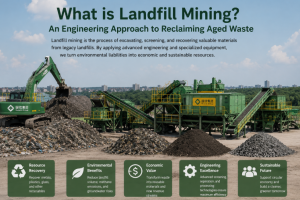
To achieve clean mass-balance separation without high operating costs (OpEx), an engineered LFMR processing plant utilizes a sequential mechanical processing line designed to break surface adhesion and isolate materials by size and density.
[Raw Excavated Waste] ──► [Stage 1: Heavy-Duty Trommel] ──► [Separates Coarse Combustibles]
                                                                    │
                                                                    ▼
[Premium Clean RDF]   ◄── [Stage 3: Air Classifier]    ◄── [Stage 2: Flip-Flow Screening]
                               (Removes Rocks/Glass)           (Isolates Sub-15mm Humus)
Stage 1: Coarse Sizing and Material Liberation (Heavy-Duty Trommels)
The primary processing node requires a heavy-duty rotary drum screen (trommel) configured with a dual-aperture punched plate array (typically 50 mm and 100mm).
- Kinematic Objective: The trommel must run at an optimized Froude number (Fr = 0.6–0.65) to create a high-impact cataracting motion.
- The Engineering Fix: To combat the extreme blinding risks caused by sticky humus soil, the drum must feature synchronized external mechanical clearing devices (such as heavy-duty polyurethane rotary paddles). These paddles continuously push through the apertures from the exterior, ejecting wedged fractions and maintaining a stable tons-per-hour (TPH) throughput.
Stage 2: Micro-Fine Soil Removal (High-Acceleration Flip-Flow Screens)
Material falling through the sub-50mm classification line contains the bulk of the damp humus soil. Standard vibrating screens quickly blind over due to the cohesive nature of this fine soil.
- The Mechanism: The stream is fed into an inclined Flip-Flow Screen (Relaxing Mesh Sorter). The polyurethane screen mats are alternately tensioned and relaxed at high frequencies, creating acceleration forces up to 50G.
- The Engineering Fix: This intense kinetic energy instantly ruptures the surface tension of wet mud cakes, separating clean humus soil (<15m) from small rigid plastics and stones. The reclaimed humus soil can then be directly diverted for use as daily landfill cover or for municipal landscaping remediation.
Stage 3: Aerodynamic Density Segregation for Clean RDF Recovery
Once the fine soils are removed, the remaining mid-to-coarse fractions (>50 mm) consist of high-calorific plastics, textiles, and wood mixed with heavy stones, bricks, and glass bottles.
- The Mechanism: The material stream enters a high-gradient Positive/Negative Pressure Composite Air Classifier. An adjustable high-velocity air knife delivers an upward blast from below, while an upper suction hood captures lightweight materials.
- The Engineering Fix: The lightweight, flexible 2D polymers are lifted away instantly into a cyclone discharge collection loop, while heavy stones, concrete aggregate, and glass drop straight down. This mechanical process drops the ash content (A^d) of the recovered combustible fraction below 15%, providing a clean, high-calorific feedstock ready for secondary shredding into commercial-grade RDF.
3. Mass-Balance & Industrial Fraction Recovery Matrix
The data below represents verified mass-balance configurations from an industrial-grade aged waste reclamation line processing landfill material with a 10-year average degradation baseline:
| Sorter Processing Node | Output Stream Destination | Mass Recovery Yield (By Weight) | Moisture Content (W) | Downstream Commercial Value |
| Flip-Flow Fine Screening (<15 mm) | Stabilized Humus Soil / Fines | 45.0%–55.0% | 38.0% –42.0% | Landfill daily cover; brownfield soil remediation |
| Composite Air Classification (Light Fraction) | Clean Combustible RDF Feedstock | 25.0% –35.0% | le 18.0% | Premium alternative fuel for cement kilns (ge 4000 kcal/kg) |
| Overbelt Magnetic Array | Ferrous Metals (Rebar, Cans) | 1.5% –3.0% | le 5.0% | High-value foundry scrap metal commodity |
| Air Classifier Heavy Reject Bed | Inert Aggregates (Stones, Brick, Glass) | 10.0% –15.0% | le 12.0% | Sub-base road aggregate filler; inert backfill material |
4. FAQ
How does the aging profile of a landfill alter the engineering parameters of the screening line?
Landfills aged under 5 years contain high concentrations of volatile organic compounds (VOCs) and unstable biodegradable matter, which require active pre-aeration to manage toxic gas pockets (H_2S andCH_4). From a mechanical standpoint, landfills older than 8 to 10 years have fully transitioned their organic matrix into fine humus soil. This increases the total mass flow directed toward fine-mesh flip-flow screens, meaning the front-end sizing equipment must be configured with a larger surface area to process the higher volume of fines without bottle-necking downstream density sorters.
Why is inline magnetic and eddy-current separation critical before the alternative fuel processing phase?
Excavated aged waste contains high volumes of degraded structural iron, wire ties, and aluminum fragments. If these metallic components slip past the air separators and enter the high-speed secondary shredder loop, they inflict catastrophic damage on the tool alloy teeth. Installing a high-intensity cross-belt neodymium overbelt magnet removes ferrous components early, protecting downstream cutting matrices, extending blade life, and ensuring the final alternative fuel meets strict metal content compliance standards.
Turnkey Infrastructure Design and Heavy Machinery Commissioning
Executing a profitable landfill mining and remediation project requires robust mechanical design and a precise understanding of material mass balances. Henan Guoxin Machinery Manufacturing Co., Ltd. (Guoxin Group) engineers and manufactures heavy-duty, high-capacity aged waste sorting lines and integrated MSW recycling configurations tailored to global environmental markets.
From initial 3D site layout optimization and localized material testing to the integration of automated VFD control systems, our global engineering division ensures your facility hits its processing targets while minimizing operational overhead.
Need an optimized mass-balance layout or equipment configuration for an upcoming Landfill Mining facility? Contact for an engineering brief: Eve@guoxinmachinery.com