

Products Description
Complete C&D Waste Sorting Machine Configurations & Price Range
| Line Configuration | Target Capacity | Core Integrated Machinery | Control & Separation Purity | Estimated System Budget (USD) |
| Standard C&D Line (CD-200) | 100 – 200 TPD | Heavy Plate Feeder, Armored Trommel Screen, Overbelt Magnetic Separator |
Semi-Automated PLC Panel
• ≥90% Aggregate Purity |
$150,000 – $300,000 |
| Heavy-Duty C&D Line (CD-500) | 300 – 500 TPD | Plate Feeder, Reinforced Trommel, Air Classifier (Wind Sifter), Neodymium Magnet |
Siemens PLC + HMI Touchscreen
• ≥95% Aggregate & Metal Purity |
$300,000 – $600,000 |
| Industrial EPC Line (CD-800+) | 600 – 800+ TPD | Heavy Feeder, Multi-Stage Trommels, Dual Recirculating Air Separators, Optical NIR Sorter |
Centralized SCADA Network
• ≥98% Commercial-Grade Purity |
$600,000 – $1,200,000+ |
Modular construction waste sorting systems designed for concrete, bricks, wood, metals, and mixed debris — engineered to match your site conditions, throughput target, and investment budget.
Typical project capacity: 50–800 TPD | System price varies by configuration and automation level
A construction waste sorting machine is not a standard off-the-shelf product.
The final system cost and performance depend on waste composition, input size, required output fractions, and local recycling regulations.
Our construction waste sorting solutions are engineered as complete processing systems — not standalone machines — ensuring stable recovery rates and controlled investment cost for demolition and C&D recycling projects.
Construction waste sorting systems are often integrated with complete municipal solid waste recycling plants for resource recovery.
What Is a Construction Waste Sorting Machine?
A construction waste sorting machine is a complete system designed to separate mixed construction and demolition (C&D) waste into reusable materials such as:
- Concrete and aggregates
- Bricks and stones
- Wood
- Metals
- Plastics
- Light combustible materials
Instead of manual sorting, modern systems use mechanical, air, magnetic, and intelligent separation technologies to achieve higher efficiency and lower labor costs.
Our construction waste sorting machine efficiently processes mixed construction debris, such as concrete, wood, and metals, enabling easy recycling and resource recovery. By integrating advanced sorting technologies, we help minimize landfill usage and maximize material recovery.
Manual Picking vs. Automated C&D Waste Separation Lines
For modern resource recovery facilities, transitioning from manual picking to an automated waste separation machine line is the turning point for project profitability. Manual sorting is limited by throughput and high operational risks, whereas an intelligent recycling sorting machine matrix ensures continuous, high-purity separation.
| Comparison Items | Manual Picking Lines | Automated Waste Separation Machines |
| Labor Cost & Safety | Extremely High / High Risk | Low / Closed Automated PLC Control |
| Sorting Accuracy | Unstable (Operator Dependent) | Consistent (95%+ Purity for Aggregates) |
| Processing Capacity | Limited (<100 TPD) | High-throughput (Up to 800+ TPD) |
| Long-term Project ROI | Low (High ongoing OPEX) | High (Payback within 1.5–2.5 Years) |
For long-term projects, automated or semi-automated systems deliver a better ROI.
Our C&D sorting automation technology reduces labor costs by up to 70%.
Why invest in Automated Waste Separation Machines?
For modern C&D recycling plants, a professional waste separation machine is the core of project profitability. Unlike traditional manual picking, automated waste segregation machine systems utilize air density and magnetic properties to achieve a purity rate of over 95% for aggregates and metals.
When evaluating the segregation cost, site operators should consider not just the initial equipment price, but the long-term operational expenditure (OPEX). High-efficiency separation reduces landfill fees and turns “waste debris” into “high-value recyclables” such as RDF and recycled concrete aggregates.
-
Optimized Separation: High-speed vibrating screens and air classifiers.
-
Reduced Segregation Cost: 70% reduction in manual labor through automation.
-
Maximum Recovery: Stable output for wood, plastic, and ferrous metals.
Selecting the Right C&D Waste Sorting & Recycling Equipment
Investing in a heavy-duty recycling sorting machine ensures that your output aggregates meet strict local standards for recycled concrete and road sub-base applications. By removing more than 95% of contaminants (such as organic wood, foam, and wiring), our waste separation machine technology upgrades simple demolition debris into certified commercial-grade construction materials.
Core Processing Equipment Matrix:
1. Heavy-Duty Pre-Treatment: High-torque plate feeding followed by size fractionation using our reinforced Armored Trommel Screens engineered to withstand abrasive concrete blocks.
2. Multi-Stage Density Separation: Utilizing high-velocity recirculating Air Classifiers / Wind Sifters to lift away light wood, plastics, and foam from heavy aggregates with 95%+ precision.
3. Ferrous Metal Extraction: High-gradient Overbelt Magnetic Separators extract structural rebar and ferrous scrap, generating instant secondary revenue streams.
Proven Performance in C&D Recycling
Our sorting systems are currently operational in major infrastructure projects, including a combined MSW and Construction Waste sorting plant in Tianjin, ensuring stable output for recycled concrete aggregates.
Factors Influencing C&D System CAPEX
The initial CAPEX for a C&D sorting plant is dictated by primary waste hardness and required aggregate purity. High-moisture concrete debris with heavy steel rebar requires armored trommels and high-torque plate feeders, whereas mixed demolition streams with high wood/plastic content require multi-stage air classifiers and optical sorters.
| Factor Impact | t on Cost |
|---|---|
| Processing capacity (TPD) | Higher capacity = higher investment |
| Degree of automation | Manual vs semi-auto vs fully automatic |
| Waste composition | More complex waste = more equipment |
| Local labor cost | Affects the automation level |
| Turnkey scope | Design, installation, and training included |
Applications of Construction Waste Sorting Machines
Typical applications include:
- Construction and demolition waste recycling plants
- Urban redevelopment waste treatment projects
- Concrete and brick recycling facilities
- Resource recovery centers for mixed construction debris
- Contractors operating medium to large-scale C&D recycling facilities
- Projects requiring stable output quality and long-term operation
- Government or PPP waste management projects
- Contractors seeking on-site or centralized sorting solutions
These systems help recover valuable materials such as aggregates, metals, and plastics while reducing landfill disposal.
Construction waste sorting machines are widely used in recycling facilities handling demolition and renovation waste.
It may not be suitable for:
- Very small temporary demolition sites
- Projects requiring only simple manual sorting
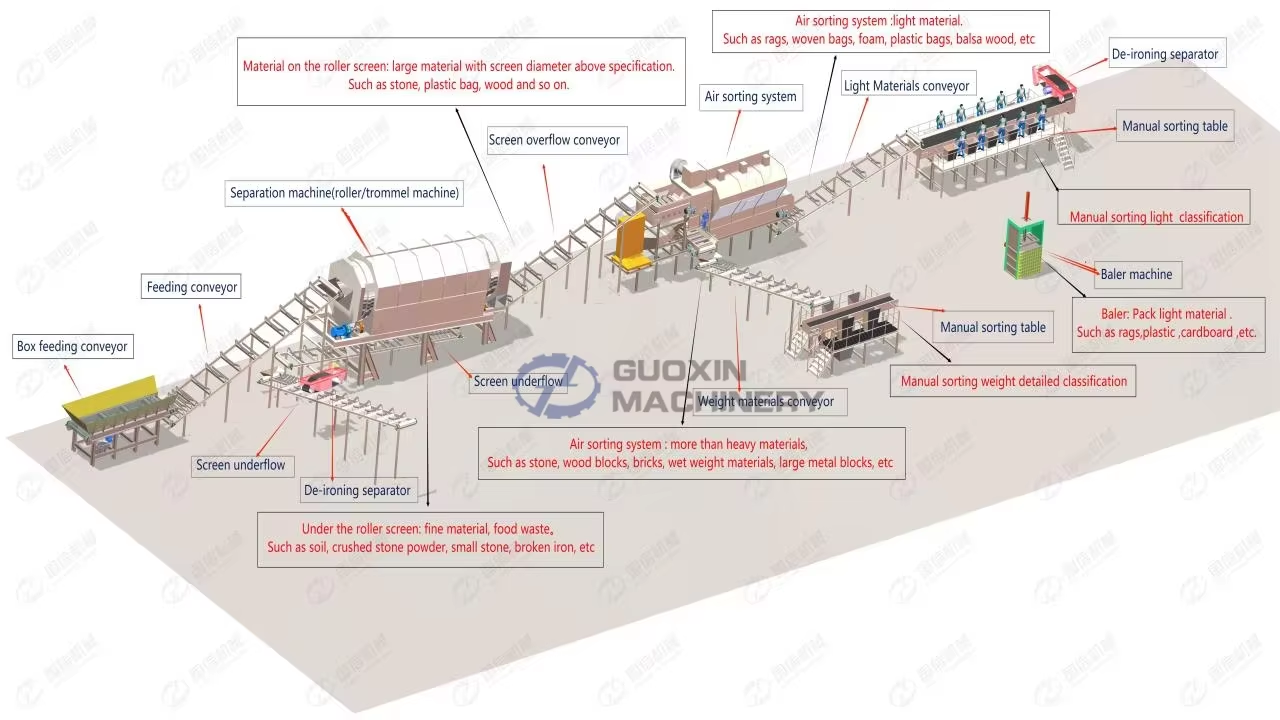
Technical Overview of a Mixed Construction Waste Sorting Plant
Concrete, bricks, and heavy debris require a completely different separation logic compared to municipal waste. A high-efficiency construction waste sorting plant must be engineered to withstand highly abrasive materials while isolating light fractions like plastics, wood, and paper.
In a typical 500 TPD construction waste sorting plant configuration, the heavy mixed debris undergoes a multi-stage separation process:
-
Primary Sizing: A heavy-duty armored trommel screen splits the incoming waste into oversized debris and under-screen soils.
-
Density Separation: The heavy fractions travel into our high-velocity air classifier, where high-pressure recirculating air lifts away light fractions (wood/films), leaving clean, high-purity recycled aggregates behind.
-
Value Extraction: An over-belt magnetic separator extracts rebar and scrap metals, translating hidden waste into direct commercial revenue.
Every Guoxin construction waste sorting plant is custom-designed with modular components, allowing operators to scale up their recycling sorting machine capacity as processing demands grow.
Turnkey Construction Waste Sorting Solution
We provide complete turnkey solutions, including:
- Waste analysis & project evaluation
- Plant layout and process design
- Equipment manufacturing and supply
- Installation and commissioning
- Operator training and after-sales support
Each solution is tailored to your specific waste type, site conditions, and investment budget.
Request a Tailored Construction Waste Sorting Machine Quotation
Evaluating an automated C&D recycling line requires precise sizing based on your local demolition debris composition and target hourly output.
Contact Guoxin’s technical engineering team to receive:
- Customized Line Layout: 3D spatial design optimized for your recycling yard footprint.
- Granular CapEx Breakdown: Detailed itemized pricing for feeding, screening, air separation, and magnetic recovery units.
Direct Line to Engineering Desk: Eve@guoxinmachinery.com