
In municipal solid waste (MSW) sorting plants, the trommel screen (rotary drum screen) is the fundamental mechanical node for dimensional segregation. It typically separates heavy, high-moisture organic fractions from high-calorific 2D/3D dry fractions (such as plastics, paper, and textiles) destined for Refuse-Derived Fuel (RDF) production.
However, processing unsegregated material that is processed in a standard 50mm aperture MSW trommel and outlines the engineering modifications required to maintain municipal waste often introduces massive operational bottlenecks due to screen blinding (mesh clogging). When wet organics, ash, and film plastics paste over the apertures, the screening efficiency plummets, causing severe carryover that compromises downstream optical sorters and air separators.
This technical brief defines the precise thermodynamic and kinematic thresholds where blinding occurs in a standard 50mm aperture MSW trommel and outlines the engineering modifications required to sustain nominal plant throughput.
1. The Critical Moisture Threshold: Capillary Adhesion Dynamics
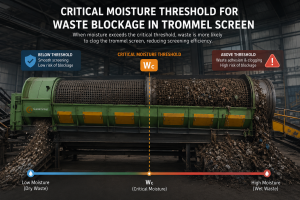
Operational data compiled across municipal waste processing facilities indicates that screen blinding is not a linear function of moisture. Instead, it behaves as a threshold-gated phase change governed by the rheology of the waste stream.
[Inbound MSW Moisture Content]
  │
  ├── < 35%  ──────► Free-flowing; minimal surface adhesion.
  │
  ├── 38% - 42% ───► CRITICAL THRESHOLD: Capillary bridges form; organic slurry glues to mesh.
  │
  └── > 45%  ──────► Saturated paste phase; total blinding within 15-30 operational minutes.
The 38%–42% Operational Breakpoint
When the total composite moisture content of the inbound MSW is below 35%, the material remains relatively free-flowing. Mechanical friction between particles easily breaks minor surface adhesion.
Once the moisture content reaches the 38% to 42% critical threshold, capillary bridges form between fine organic particulate matter (kitchen waste, soil, degraded paper) and the steel plate apertures. At this stage:
- The waste transitions from a frictional bulk solid to a cohesive, viscoelastic slurry.
- Liquid surface tension creates a powerful adhesive bond between the organic paste and the internal surface of the 50mm punched plate.
- Flexible materials, such as thin-film polyethylene (LDPE grocery bags), act as a backing matrix, pressing into the sticky apertures and sealing them completely.
If inbound MSW moisture exceeds 45% (common during monsoon seasons in Southeast Asia or in regions with high kitchen waste ratios), an unmitigated 50mm trommel will experience total blinding within 15 to 30 minutes of continuous operation.
2. Kinematic Optimization: Calculating the Ideal Froude Number (Fr)
To prevent material from simply sliding along the bottom quadrant of the drum—which accelerates capillary paste accumulation—the kinematic behavior of the waste burden must be strictly controlled via Variable Frequency Drives (VFD).
The movement of waste inside a rotary drum is governed by the dimensionless Froude Number ($Fr$), which represents the ratio of centrifugal force to gravitational force:
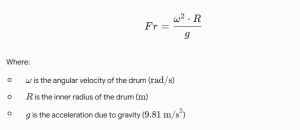
[Fr < 0.3: Cascading / Sliding] ──► Low energy; high blinding risk. Material rolls in a stagnant bed.
[Fr = 0.6 - 0.7: Cataracting]   ──► OPTIMAL: High energy impact. Material lifts and drops violently.
[Fr > 1.0: Centrifuging]        ──► Failure mode. Material sticks to the wall indefinitely; zero screening.
For high-moisture MSW sorting, operations must avoid a cascading or sliding motion (Fr < 0.3). Instead, the drum speed must be calibrated to achieve a cataracting motion (Fr = 0.6\text{–}0.7).
At this velocity, the waste is lifted near the apex of the drum before detaching and airborne fragments crash violently back down onto the screen deck. This high-energy impact generates sufficient localized shear force to rupture capillary liquid bridges and mechanically eject near-size wedged materials from the 50mm apertures.
3. Advanced Engineering Mitigations to Preserve Throughput
Adjusting the speed of the drum alone cannot completely eliminate blinding when moisture consistently exceeds 40%. To maintain the facility’s rated tons-per-hour (TPH) capacity without downtime for manual pressure-washing, heavy-duty processing lines integrate automated, continuous cleaning mechanisms.
A. Dynamic External Paddle/Roller Cleaners
Positioned at the 12 o’clock or 2 o’clock external position of the rotating drum, a counter-rotating shaft fitted with high-elasticity, wear-resistant polyurethane paddles or heavy-duty nylon brushes continuously engages the screen.
As the punched plate rotates beneath it, the tips of these paddles mechanically punch through the 50mm apertures from the outside in. This mechanical action instantly displaces trapped film plastics and compressed organic cakes without causing structural wear to the drum plate.
B. Segmented Variable-Pitch Internal Flighting
Standard continuous scroll flights can cause wet waste to bunch together, accelerating slurry formation. Advanced MSW trommels deploy segmented, aggressive lifting flights with a forward-pitched inclination. These flights actively tear apart bundled plastic bags and spread the waste bed thinly across a larger surface area, reducing the localized moisture density per square meter of screen mesh.
C. Advanced Screen Material Selection
Replacing standard carbon steel plates with high-precision, tapered-aperture HARDOX® or specialized stainless-steel alloy plates significantly reduces surface adhesion. Punched holes engineered with a slight outward taper (e.g., 50mm inner diameter widening to 53mm on the exterior side) create a self-relieving profile: any particle that clears the initial inner lip falls through freely rather than wedging in the middle.
4. Engineering Configuration Comparison Matrix
The table below outlines the performance thresholds of traditional trommel setups versus specialized anti-blinding MSW configurations designed by industrial environmental engineering firms like Guoxin Group.
| Operational Vector | Standard Drum Configuration | High-Moisture MSW Anti-Blinding Configuration |
| Aperture Design | Straight-cut 50mm cylindrical holes | Tapered-relief 50mm punched plates |
| Kinematic Control | Fixed-speed direct drive (Fr \approx 0.35) | VFD-enabled adaptive speed (Fr = 0.62–0.68) |
| Primary Cleaning Array | None (Relies on gravity fall) | Synchronized external polyurethane rotary paddle system |
| Max Moisture Tolerance | Up to35% before significant blinding | Up to 52% continuous sorting efficiency |
| Throughput Stability | Drops by 40% – 60% during wet seasons | Sustains 95% nominal design TPH |
Conclusion & System Engineering Integration
Sustaining high-throughput separation in an MSW sorting plant requires treating the trommel screen as a dynamic reactor rather than a passive mesh. Mitigating the critical $38\%\text{–}42\%$ moisture threshold demands a combined approach: matching high-impact cataracting kinematics with external mechanical clearing arrays.
Henan Guoxin Machinery Manufacturing Co., Ltd|(Guoxin group). designs and manufactures heavy-duty, high-capacity municipal solid waste sorting systems engineered to handle high-moisture organic profiles across global municipal jurisdictions. Our engineering teams provide customized drum geometries, advanced VFD controls, and specialized anti-wrapping internal configurations tailored to your local waste composition.
Need an optimized mass-balance layout or equipment configuration for an upcoming MSW sorting facility please send email to Eve@guoxinmachinery.com