

Project Brief & Engineering Overview:
-
Date of Trial: November 5, 2026
-
Location: Guoxin Heavy Machinery Testing Bay, Henan, China
-
Equipment Tested: Industrial Double-Shaft Shear Shredder with Multi-Hook Alloy Cutters
-
Feedstock Profile: Post-consumer used camouflage backpacks (incorporating thick nylon canvas, heavy webbing, internal foam padding, metal zippers, and rigid plastic buckles)
-
Primary Objective: Validate the shredder’s shear capability on multi-component, hybrid-material soft goods without rotor wrapping or hardware jamming.
1. Materials: Processing Multi-Component Textile Goods
While recycling homogeneous fabrics presents standard mechanical challenges, processing post-consumer manufactured goods like used backpacks, travel bags, and heavy work gear introduces extreme structural complexity:
-
Hybrid Material Construction: Backpacks combine high-tenacity nylon/canvas fabric, elastic webbing, closed-cell foam padding, metal zippers, and thick injection-molded plastic buckles.
-
Hardware Impact & Jamming Risk: Metal zipper teeth and hard plastic clips pose severe risks of cutter chipping, mechanical shock, and shaft locking in conventional single-shaft shredders or hammer mills.
-
Fiber Toughness & Winding: Long, dense straps and shoulder padding tend to wrap tightly around rotating shafts, causing thermal overloads and frequent line stoppages.
2. Workshop Test Setup & Processing Workflow
To evaluate how effectively industrial shear technology handles multi-component waste, Guoxin’s engineering team conducted a live test run on November 5, 2026, using unsegregated surplus backpacks.
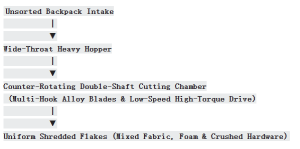
- Direct Hopper In-Feed: Workers fed bulky, rigid-structured backpacks directly into the heavy-duty gravity hopper without prior manual disassembly of zippers or plastic buckles.
-
Low-Speed, High-Torque Shearing: Counter-rotating dual shafts equipped with specialized multi-hook alloy cutter discs engaged the backpacks, forcefully biting through canvas layers, straps, and hardware simultaneously.
-
Smart Overload Reversal: When encountering dense multi-layer fabric clusters or rigid plastic frames, the automated PLC control logic briefly reversed shaft rotation to clear the material instantly before resuming normal shearing.
3. FAT Trial Results & Performance Metrics
The November 5 workshop trial verified exceptional mechanical resilience and output consistency:
| Performance Parameter | Trial Specification | Measured Results | Status |
| Feedstock Handling | Unprepped backpacks with hardware | Clean bite through fabric, zippers & buckles | Passed |
| Cutter Shaft Integrity | Anti-shock & anti-wrapping | Zero shaft entanglement / Zero blade chipping | Passed |
| Output Consistency | Uniform volumetric flakes | Mixed shredded fabric, foam, and pulverized plastic/metal fragments | Passed |
| Operational Stability | Continuous heavy load run | Smooth, continuous discharge with zero motor stalls | Passed |
4. Value for Textile Recycling & Alternative Fuel (RDF) Preparation
The successful shredding of complex manufactured textiles directly unlocks downstream processing efficiency:
-
Liberation of Embedded Materials: Cleanly tearing open multi-layer backpack construction exposes internal foams and fabrics, making subsequent air classification or magnetic separation highly effective.
-
Enhanced Downstream Combustion or Pyrolysis: Produces uniform, pumpable shredded feedstock ideal for thermal recycling, waste-to-energy (WtE) co-processing, or RDF-5 briquetting lines.
Request Custom Material Testing & Plant Proposals
Are you processing post-consumer bags, industrial upholstery, or complex multi-layer textile waste? Guoxin Group provides custom cutter geometry design and full-scale factory trial testing.
-
Send Your Samples: Test your local multi-component waste streams in our heavy testing bay.
-
Get Engineering Layouts: Request 3D plant integrations and mass-balance reports.