
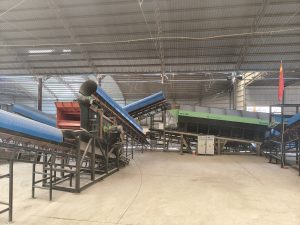
In a Municipal Solid Waste (MSW) recycling facility, the material handling system acts as the absolute backbone of operations. The overall efficiency of heavy equipment—such as trommel screens, magnetic separators, and ballistic sorters—is entirely dependent on the continuous, uniform feed provided by the industrial MSW waste sorting machine conveyor belt system.
When designing a heavy-duty waste processing plant layout design, engineering teams must balance material density variances, moisture fluctuations, and mechanical wear. This guide breaks down the critical mechanical parameters required to optimize conveyor routing and prevent system-wide bottlenecks.
1. Critical Engineering Parameters for MSW Conveyors
Unlike homogeneous bulk materials, municipal solid waste is highly unpredictable, consisting of a volatile mix of organic matter, abrasive aggregates, film plastics, and metals. Standard off-the-shelf conveyor specifications often fail due to tearing, slippage, or material rollback.
The following technical layout rules must be rigorously applied during the CAD modeling stage:
Maximum Inclination Angles
To prevent materials from rolling back down the line (especially round or heavy items like glass bottles and metal cans), the inclination angle of the conveyor must match the friction coefficient of the specific waste fraction being transported.
- Raw/Unsorted MSW: Maximum 18° incline (Smooth belt). If space limitations require steeper angles (up to 25°–30°), a cleated belt (chevron belt) must be utilized.
- Organics & Fine Fractions: Maximum 15° incline due to high moisture levels and fluid sludge characteristics.
- Light Fractions (RDF/Film Plastics): Maximum 22° incline. Side-skirting is essential here to prevent windage losses and spilling.
Belt Speed and Material Layering
To ensure downstream optical sorters and manual picking stations work at peak efficiency, the waste layer must not be piled too deep.
- For sorting feeding lines, a wider belt running at a lower speed (0.5 m/s to 0.8 m/s) is preferred to allow material spreading.
- For reject or residual transport lines, narrower belts running at higher speeds (1.2 m/s to 1.5 m/s) can be deployed to clear volume quickly.
2. Standard System Configuration Matrix
When building a modular 3D layout for a 100 to 500 TPD (Tons Per Day) sorting plant, the following configuration matrix serves as an engineering baseline:
| Conveyor Functional Type | Typical Belt Width (mm) | Motor Power Range (kW) | Recommended Belt Material | Impact Bed/Idler Setup |
| Primary Chain Slat Feeder | 1400 – 2000 | 11 – 22 | Heavy Steel Slat | Heavy Duty Slide Tracks |
| Trommel Feed Conveyor | 1000 – 1400 | 5.5 – 11 | Oil-Resistant Rubber (EP200) | 35° Troughing Idlers + Impact Bars |
| Magnetic Separator Under-belt | 800 – 1200 | 3.0 – 5.5 | Non-Magnetic PVC / PU | Flat Slider Bed |
| RDF / Plastic Discharge Line | 800 – 1000 | 4.0 – 7.5 | Flame-Retardant PVC | 20° Troughing Idlers + Side Skirts |
3. Mitigating Material Spillage and Mechanical Wear
A common failure point in a waste processing plant layout design is the transfer chute area between the primary conveyor and the sorting machinery. High moisture and fibrous materials (like textiles and long plastics) easily wrap around pulleys or wedge into the conveyor structure.
Key Engineering Countermeasures:
- Double-Lip Skirt Scrapers: Install dual-sealing polyurethane skirt boards along loading zones to completely eliminate fines and liquid leakage.
- Self-Cleaning Tail Pulleys: Use winged or spiral tail pulleys instead of solid drums. This ensures that any debris falling onto the return strand is automatically thrown clear rather than being crushed between the belt and the pulley face.
- VFD Integration: All critical material handling lines should be fitted with Variable Frequency Drives (VFDs). This allows operators to dynamically adjust the line velocity based on real-time tonnage spikes, preventing downstream overflows.
4. Download and Integrate Precision Layout Data
Designing an automated recycling system requires absolute structural accuracy to avoid costly field-welding and structural interference during installation.
If you are developing a comprehensive municipal or industrial recycling project, access to verified structural assets is essential. Our team provides fully mapped, engineering-ready configurations to streamline your workflow. You can integrate our standard modules directly into your Master Layout to visualize material flow paths, clearance profiles, and structural foundation requirements.
Technical Engineering Assets Available:
For comprehensive CAD data, structural configurations, and dimensional mass-balance blueprints, explore our fully optimized integrated waste processing plant 3d model layout design matrix.