
Introduction
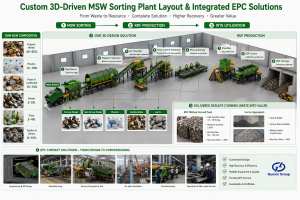
Integrated waste processing plant 3d model layout design
Designing a commercial-scale municipal waste-sorting plant requires a rigorous balance between volumetric material flow and thermodynamic mass-balance stability.
A 300 TPD (Tons Per Day) waste sorting plant serves as the industrial baseline for mid-sized municipal sorting operations. In modern resource recovery frameworks, the engineering design must maximize landfill diversion rates while optimizing the correlation between initial CapEx (Equipment Investment) and long-term operational uptime (OPEX).
Basic Process Flow of a 300 TPD Waste Sorting Plant
A typical high-capacity waste sorting facility relies on a continuous, sequential mechanical matrix to prevent material cross-contamination.
- Waste Receiving and Feeding: Waste collection trucks discharge heterogeneous municipal waste into a low-profile concrete receiving hopper. An integrated apron feeder or heavy-duty chain conveyor transforms irregular batch loads into a uniform volumetric layer. During this preprocessing phase, a high-torque Bag Opener running on variable-frequency drives (VFDs) ruptures plastic trash bags without downsizing rigid containers or crushing hazardous glass fragments.
- Primary Screening (Size Classification): Primary screening segments the liberated material stream based on particle size dynamics. Heavy-duty rotating Trommel Screens (equipped with internal anti-clogging mechanical brushes) classify the inbound waste into distinct mass fractions:
- Fine Organic Fraction (<60mm): Segregated immediately for anaerobic digestion or composting, removing the sticky matrix that fouls downstream lines.
- Mid-Fraction Recyclable Materials (60–120mm): The high-calorific core is directed to automated sorting loops.
- Oversized Waste (>120mm): Routed to primary crushers or manual scavenging platforms. This precise sizing matrix reduces the mechanical loading on all downstream automated sorting loops.
- Recyclable Material Separation: Post-screening, the high-value fractions are isolated through synchronized physical and density vectors. High-gradient magnetic separators extract 98% of ferrous rebar, while high-frequency eddy current separators (ECS) repel non-ferrous aluminum commodities. Simultaneously, Air Density Separator use controlled air knives to split flexible film plastics from heavy inert materials, all integrated within a centralized Mixed Waste Sorting Plant configuration.
- RDF Fuel Preparation:
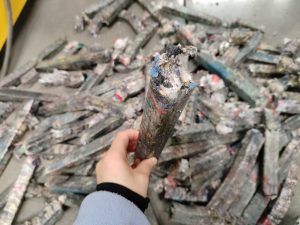
Combustible fractions (dry plastics, non-recyclable paper, textiles) are refined into high-calorific alternative fuels. Modern industrial complexes integrate a dedicated RDF Production Line—utilizing single-shaft fine shredders with calibration screens—to convert loose waste into uniform alternative fuel tailored for cement kiln calciners.
3D Plant Layout & Spatial Engineering (5,500 – 7,200 m²)
A 300 TPD municipal waste sorting plant requires a carefully engineered 3D spatial layout to ensure continuous material velocity while maintaining maintenance access. The facility design is partitioned into five synchronized processing zones:
[Zone 1: Tipping Floor] ──► [Zone 2: Preprocessing] ──► [Zone 3: Automated Sorting]
│
┌───────────────────┴───────────────────┐
▼ ▼
[Zone 4: RDF Fuel Preparation] [Zone 5: Storage & Baling]
Spatial Zone Parameters & Equipment Footprint
1. Zone 1: Raw Material Receiving & Tipping Floor (1,200 – 1,500 m²)
Clear Height Requirement: Minimum 9.5 meters to accommodate high-tilt discharge from 30-ton waste collection trucks.
Infeed System: Heavy-duty concrete hopper integrated with a variable-speed apron feeder inclined at ≤18° to prevent material rollback.
2. one 2: Mechanical Preprocessing (1,000 – 1,200 m²)
Equipment Layout: Houses the bag opener and primary trommel screen.
Elevation Clearance: Trommel units are elevated on steel structural platforms (3.5 – 4.5 meters high) to allow gravity discharge directly into underlying discharge conveyors and organic hoppers.
3. Zone 3: High-Gradient Automated Sorting Loop (1,500 – 2,000 m²)
Conveyor Layout:Features flat belt conveyors running at 1.2–1.8 m/s for thin-layer material distribution.
Overhead Equipment:Magnetic separators are suspended 350–450mm directly above conveyor head drums, with dedicated discharge chutes leading to side collection bays.
4. Zone 4: Secondary RDF Fuel Processing (800 – 1,000 m²)
Enclosure: Fully isolated acoustic enclosure housing the single-shaft fine shredder and air classifiers to contain localized dust and noise (≤85 dB).
5. Zone 5: Baled Commodity Storage Yard (1,000 – 1,500 m²)
Storage Capacity: Minimum 3-day buffer capacity for dense RDF bales and compressed metal scrap awaiting commercial transport.
3D CAD Layout Consultation: Every regional waste stream presents unique moisture and bulk density characteristics. Contact Guoxin’s engineering division to request a customized integrated waste processing plant 3d model layout design tailored to your site boundaries.
Equipment Configuration for a 300 TPD Plant
A typical equipment configuration may include:
| Equipment Module | Quantity | Technical Specification Baseline (300 TPD Line) | Motor Power (kW) | Target Processing Operational Intent |
| Heavy-Duty Bag Opener | 1 | Dual-rotor, High-torque, VFD V-belt drive (15–20 TPH) | 45–55 kW | ≥95% plastic bag liberation without glass crushing |
| Industrial Trommel Screen | 1 | Punch-plate matrix, 2,200mm drum diameter, adjustable pitch | 30–37 kW | Anti-blinding organic fraction (<60mm) separation |
| Overbelt Magnet Separator | 2 | Neodymium permanent core, 2000+ Gauss gradient at 350mm | 4–5.5 kW | Continuous extraction of structural ferrous scrap |
| Recirculating Air Classifier | 1 | Closed-loop recirculating airflow, adjustable air knife | 22–30 kW | Density splitting of light films/paper from inert aggregate |
| Manual QC Platforms | 6–10 | Ergonomic belt width 1,200mm, variable speed (0.5–1.2 m/s) | 5.5 kW | Multi-commodity manual quality control and scavenging |
| Secondary RDF Fine Shredder | 1 | Single-shaft, hydraulic screen opening mechanism | 90–110 kW | Calibrated downsizing (<50mm) for cement kiln RDF feed |
Equipment selection depends on waste composition and recycling targets.
Key Engineering Considerations
- Waste Composition Analysis: Accurate mass-balance design requires empirical data on regional municipal waste streams. Key parameters—including organic loading, plastic volatility, fluctuating moisture profiles (35%-50%), and heavy metal percentages—directly dictate screen sizing thresholds and individual module capacities.
- Plant Layout & Spatial Engineering: Proper 3D layout engineering ensures an unhindered material volumetric flow while minimizing unnecessary conveyor length and energy loss. The site plan explicitly segregates the facility into five isolated industrial zones: waste reception, mechanical preprocessing, high-gradient automated sorting, RDF alternative fuel preparation, and compressed bale storage.
- Environmental & Corrosion Control: Large-scale Commercial Solid Waste Sorting Systems must mitigate severe operational hazards. Our engineering integrates sealed conveyor enclosures with negative-pressure odor control, high-efficiency baghouse dust extraction, and heavy stainless steel (SS304) or NM450 wear liners in all transfer chutes to withstand corrosive leachate fluids and abrasive aggregate impact.
These factors determine equipment selection and system capacity.
FAQ:
Q1: What is the optimal footprint required for a standard 300 TPD municipal waste sorting plant?
A: A stationary 300 TPD facility utilizing automated screening, density splitting, and magnetic separation typically requires a structural footprint between 5,500 and 7,200 square meters. This area accommodates the feeding hoppers, multi-stage sorting loops, and maintenance clearance zones, excluding the raw material tipping floor and finished product storage yards.
Q2: How does the system prevent trommel screen blinding when processing high-moisture organic waste?
A: High-moisture waste (especially during rainy seasons) causes wet organics to mat and blind screen holes. Guoxin designs its industrial trommels with variable-speed internal drum logic and integrates external, heavy-duty rotating nylon cleaning brushes. This mechanical counter-measure continuously clears the punched-plate apertures to maintain rated hourly throughput.
Q3: Can a 300 TPD sorting configuration be upgraded for optical sorter integration in the future?
A: Yes. All Guoxin EPC plant layouts are engineered with future-proof modularity. We explicitly reserve physical clearance zones and standardized conveyor transition heights post-trommel screening so that Near-Infrared (NIR) optical sorters can be bolted directly into the existing automation line without requiring structural building modification.
For large-scale regional installations above 500 TPD, review our [Turnkey Municipal Solid Waste Sorting Plant] solution.