
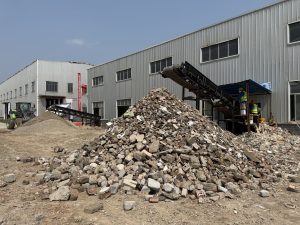
In construction and demolition (C&D) waste recycling, raw material variability is the leading cause of unexpected equipment failure and downtime. A high-tonnage line processing reinforced concrete, clay bricks, structural timber, and steel rebar subjects every mechanical component to severe impact forces and continuous surface abrasion.
Without correct engineering pre-treatment, standard waste separation machinery experiences rapid screen blinding (hole blockage), belt tearing, and severe rotor wear within the first few hundred operational hours.
This technical guide analyzes the primary mechanical bottlenecks in mixed C&D sorting and how system-level engineering adjustments protect line longevity and output purity.
1. Managing Heavy Impact at the Infeed Zone
The receiving hopper is subjected to extreme point loads when dump trucks or wheel loaders discharge massive concrete lumps (often exceeding 500 mm in diameter).
The Bottleneck: Belt Damage & Structural Distortion
Standard heavy-duty rubber belt conveyors fail rapidly under direct gravity loading of sharp aggregate debris. The impact causes carcass puncture, belt misalignment, and frame fatigue.
The Engineering Solution: Slatted Steel Apron Feeders
To withstand continuous heavy loading, industrial receiving stations replace rubber belt feeders with slatted steel apron feeders:
- Manganese Steel Pan Structures: Heavy overlapping steel pans supported by tractor-style roller chains absorb drop impact without permanent deformation.
- Variable-Speed Dosing: Inverter-controlled drives regulate the bed depth of incoming waste, preventing surges into downstream screening units.
[Tipper Truck Dump] ──► [Slatted Steel Apron Feeder] ──► Controlled Material Layer ──► [Sizing Screen]
2. Preventing Screen Blinding in Primary Fractionation
Screening represents the most critical sizing node in any C&D processing matrix. However, fine wet soil, mortar dust, and sticky organic debris frequently blind screen apertures, reducing effective screening area by up to 60%.
Trommel Screen vs. Vibrating Screen Selection
- Vibrating Grizzly Screens: Highly effective for scalping large concrete slabs (>300 mm). However, flat mesh surfaces blind easily when processing high-moisture demolition fines.
- Armored Trommel Screens: Rotating drum action provides continuous tumbling motion. As the drum rotates, heavy aggregate chunks naturally scour the inner screen plates, preventing fines from baking onto the mesh holes.
Anti-Clogging Features for High-Moisture Debris:
-
Self-Cleaning Rotary Brushes: External motorized nylon/steel wire brushes continuously sweep the outer surface of the drum plate during rotation.
-
Variable Punch Hole Geometry: Staggered hexagonal or tapered punch holes reduce material wedging compared to standard square woven wire mesh.
3. Tuning Air Velocity for High-Purity Aggregate Recovery
Extracting light combustibles (wood, plastic film, foam, cardboard) from heavy aggregates is essential for producing commercial-grade Recycled Concrete Aggregate (RCA) that meets strict municipal standards.
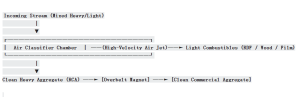
Air Separation Balancing Equation
An air classifier (wind sifter) relies on aerodynamic drag force exceeding the gravitational force of light particles while leaving heavy aggregates unaffected:
- Air Velocity Adjustment: If air velocity ($v$) is set too low, wood planks and rigid plastics stay in the aggregate stream, dropping aggregate purity below 90%.
- Recirculating Air Loop: Modern closed-loop air classifiers recirculate over 80% of process air, preventing dust emissions on site while maintaining constant static pressure inside the separation hood.
4. Protecting Downstream Equipment via Early Magnetic Extraction
Structural rebar and steel wire mesh pose severe risks to secondary crushers and air classifier recirculating fans. A single piece of stray rebar can cut a conveyor belt longitudinally or shatter secondary rotor blow bars.
Dual-Stage Ferrous Recovery Strategy:
-
Cross-Belt Overbelt Magnet: Suspended directly above the trommel discharge chute, where material is suspended in free-fall, allowing maximum magnetic flux penetration.
-
Magnetic Head Pulley: Installed at the discharge end of the aggregate belt conveyor to catch embedded flat iron scrap that passed beneath the primary magnet.
5. Integrating Modular Line Architecture for Long-Term ROI
When evaluating system CapEx against operational lifespan, plant engineers must look beyond individual machine specs. A plant designed with modular skid-mounted chassis allows operators to add optical sorters or secondary fine shredders as site throughput increases.
To review complete equipment matrix configurations, throughput TPH tables, and budgetary investment figures, explore our detailed engineering breakdown of a full-scale construction waste sorting plant.
If you are evaluating equipment parameters for an upcoming project, check current market options for a turnkey construction waste processing line for sale or request a customized layout to determine your project’s overall waste sorting machine price.
Engineering Support & Project Consultation
Guoxin Machinery provides tailored engineering designs, 3D site layout modeling, and mass-balance calculations for global solid waste recovery projects.
Contact at Eve@guoxinmachinery.com to receive custom line flowcharts and equipment specifications for your C&D recycling facility.