
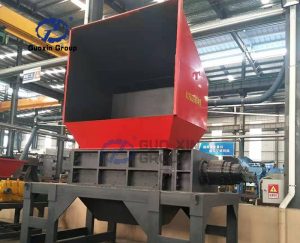
Bag opening is an important mechanical pre-treatment operation in municipal solid waste processing. Its purpose is to release bagged materials before screening and separation while avoiding unnecessary size reduction of the contents.
The engineering design must consider the interaction between rotor configuration, knife geometry, feeding conditions and the characteristics of incoming waste.
1. Operating Principle: Bag Opening vs. Size Reduction
A dedicated bag opener and an industrial shredder serve different processing objectives.
| Engineering Aspect | Bag Opener | Industrial Shredder |
|---|---|---|
| Main Objective | Release materials from bags | Reduce material size |
| Processing Action | Tearing and pulling | Cutting and shearing |
| Main Design Consideration | Bag opening and material release | Target output particle size |
| Typical Application Stage | Front-end waste pre-treatment | Primary or secondary size reduction |
The equipment should be selected according to whether the project requires packaging removal, material liberation or size reduction.
2. Differential-Speed Rotor Configuration
A dual-rotor bag opener can use two rotating shafts operating in opposite directions with different rotational speeds.
This arrangement creates a pulling and tearing action on bagged materials. Rotor configuration, blade geometry and speed settings should be selected according to the characteristics of the incoming bags and waste stream.
Important design considerations include rotor diameter, shaft structure, blade arrangement, drive power and the required processing capacity.
3. Knife Gap and Overload Protection
The working gap between moving and fixed knives affects how the machine engages with bagged materials.
The gap and knife configuration should be designed to suit the material being processed. Where a mechanical overload protection system is installed, its operating range and adjustment requirements should be confirmed according to the actual machine design.
4. Anti-Wrapping Design and Drive Control
Flexible plastic films, textiles and long fibrous materials may wrap around rotating components and affect equipment operation.
Engineering measures may include suitable blade geometry, shaft-end protection, accessible cleaning points and overload monitoring.
Where equipped, variable-frequency drives and automatic reverse functions can help operators respond to changing feed conditions and potential blockages.
5. Engineering Factors for Equipment Selection
The appropriate machine configuration depends on several project inputs:
- Required processing capacity (TPH).
- Incoming bag materials and thickness.
- Waste composition, moisture and bulk density.
- Expected operating hours.
- Feeding conveyor and hopper arrangement.
- Downstream screening and separation requirements.
- Maintenance access and available installation space.
These factors should be reviewed together rather than selecting a machine using throughput alone.
Request Technical Specifications
For the available GX-BO models, processing capacities and equipment configuration, see our Industrial Waste Bag Opener Machine and Bag Breaker Series.
Project-specific machine selection should be confirmed according to the incoming waste characteristics and processing requirements.