
In municipal solid waste (MSW) and material recovery facilities (MRFs), opening plastic garbage bags is the first critical step of front-end pretreatment. However, selecting the wrong primary processing machinery often degrades downstream recyclables value and drastically reduces optical sorting efficiency.
Plant operators frequently debate whether to install a heavy-duty industrial shredder or a dedicated waste bag opener machine at the receiving line.

Direct Technical Comparison: Shearing vs. Soft-Tearing Kinematics
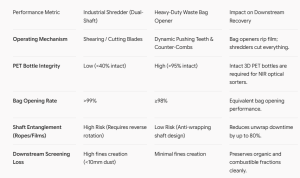
The operational distinction lies in cutting geometry and shaft rotational speed:
Why Shredders Reduce PET & Metal Container Value
High-torque industrial shredders operate using close-tolerance interlocking blades. When a plastic bag containing beverage bottles, aluminum cans, or glass enters the cutting chamber:
-
Destruction of 3D Shape: PET bottles are flattened or shredded into small film-like pieces. Optical sorters (NIR) rely on volumetric 3D shapes and surface reflection to identify polymers. Flattened bottles are misclassified as 2D plastic film and routed into low-value refuse streams.
-
Glass & Liquid Contamination: Shredding punctures sealed containers, releasing residual liquids into paper and cardboard streams, causing mass contamination.
Engineering Advantages of Anti-Wrapping Bag Opener Design
Modern waste bag opener machines utilize asymmetrical pushing rippers rotating at low RPM against adjustable counter-knives:
-
Variable Speed Hydraulic/Inverter Drive: Adjusts rotor speed based on real-time hopper load to prevent jam conditions.
-
Closed End-Cap Bearings: Prevents thin agricultural film, cassette tape, and nylon ropes from wrapping around main shaft bearing housings.
For full technical specifications, rotor tooth configurations, and TPH capacities, review the engineering overview of our waste bag opener machine series.