
Processing mixed Construction and Demolition (C&D) waste presents distinct mechanical challenges compared to standard solid waste processing. Raw C&D feedstocks contain high-density, highly abrasive concrete slabs, clay bricks, structural timber, steel rebar, packaging plastics, and mortar dust.
Without a synchronized multi-stage separation matrix, high material abrasion leads to rapid belt tears, screen blinding, and low-purity aggregate that fails municipal civil engineering standards.
To achieve commercial-grade Recycled Concrete Aggregate (RCA) purity (≥95%), modern C&D waste recycling plants rely on automated physical density and magnetic separation.
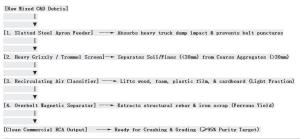
1. Optimal Equipment Sequence for a C&D Recycling Line
Equipment order dictates operational uptime. Placing air classifiers or crushers ahead of primary scalping units subjects sensitive components to unconditioned heavy impact.
2. Technical Performance Matrix by Processing Stage
| Processing Stage | Equipment Integrated | Primary Engineering Function | Key Feature for Line Longevity |
| Stage 1: Primary Feeding | Steel Apron Feeder | Regulates continuous feed rate into the line without surges. | Slatted manganese steel pans absorb extreme drop loads. |
| Stage 2: Primary Sizing | Armored Trommel Screen | Fractionates fines (<30mm) from large rubble blocks. | Tumbling action continuously scours inner screen holes clean. |
| Stage 3: Density Sorting | Recirculating Air Classifier | Lifts light plastics, foam, and wood away from stone. | Closed-loop air circulation prevents site dust emissions. |
| Stage 4: Ferrous Scrap | Overbelt Magnet | Extracts structural wire mesh and rebar. | Positioned cross-belt over drop chutes for free-fall extraction. |
3. How Air Classification Upgrades Aggregate Purity to >95%
Unprocessed demolition rubble retains significant quantities of lightweight contaminants (wood studs, plastic film, insulation). Standard vibratory screening cannot separate materials of similar size but different mass densities.
An integrated recirculating air classifier (wind sifter) applies controlled aerodynamic drag forces to the falling material stream:
-
Light Contaminant Recovery: High-velocity air jets lift low-density plastics and wood into cyclone collection chambers, creating a secondary Refuse-Derived Fuel (RDF) or biomass fuel fraction.
-
Heavy Aggregate Stream: Dense concrete and natural stone drop cleanly onto the discharge belt, achieving the purity required for certified aggregate sub-base applications.
4. CapEx Budgeting & Operational ROI Expectations
Capital expenditures for a turnkey construction waste recycling plant depend primarily on hourly tonnage (TPH) and automation levels:
- 30 – 50 TPH Commercial Line: Estimated CapEx ranging from $250,000 to $450,000 USD.
- 60 – 100+ TPH Industrial Line: Estimated CapEx ranging from $500,000 to $1,000,000+ USD.
By integrating an automated construction waste sorting machine network, plant operators reduce manual sorting labor by up to 70% while generating revenue across three distinct streams: avoided landfill tipping fees, high-purity aggregate sales, and ferrous scrap monetization.
Technical Support & Plant Layout Engineering
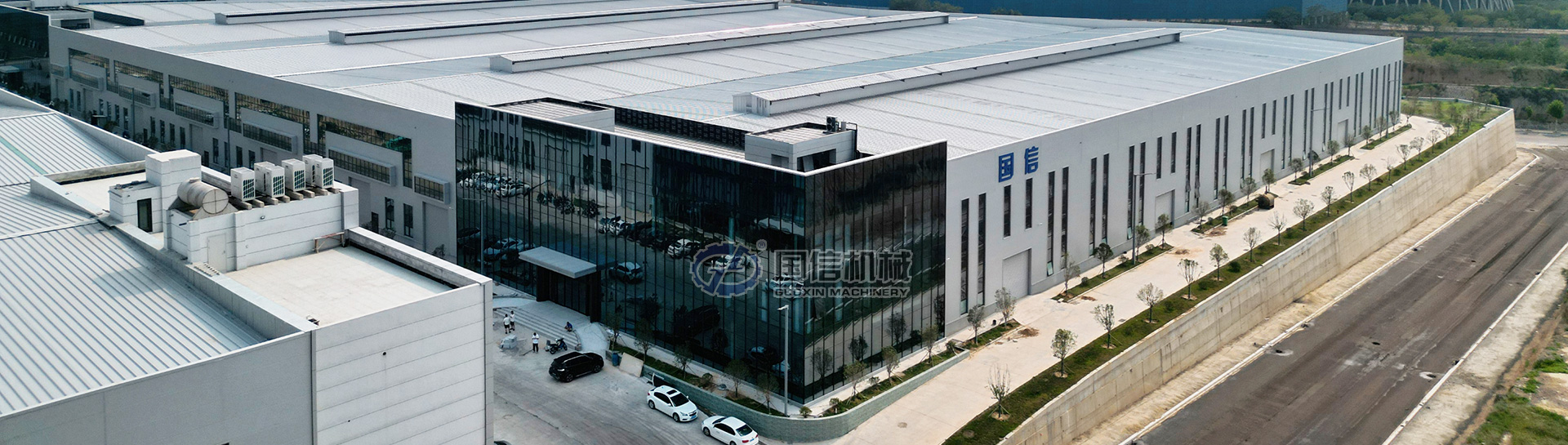
Guoxin Machinery manufactures heavy-duty C&D processing machinery, providing custom 3D spatial layout modeling and mass-balance calculation models.
Contact our technical desk at Eve@guoxinmachinery.com to request itemized equipment specifications and line flowcharts for your facility.