
For municipal waste project developers and investment groups, establishing a 20 Ton-Per-Hour (TPH) MSW pretreatment and Refuse-Derived Fuel (RDF) facility requires balancing Capital Expenditure (CapEx) against long-term Operational Expenditure (OpEx).
Below is an itemized breakdown of equipment budgeting, power requirements, labor reduction metrics, and return-on-investment (ROI) timelines for a 20 TPH MSW sorting facility.
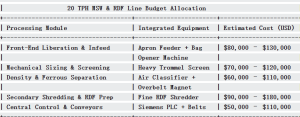
1. Equipment CapEx Breakdown (Estimated Budget: $350,000 – $650,000 USD)
Note: Total budget varies based on automation level, local voltage specs, and steel plate wear grades.
2. Operational Expenditure (OpEx) Key Metrics
-
Installed Power Capacity: Approximately 280 kW – 380 kW for complete 20 TPH line.
-
Average Electricity Consumption: ~220 kWh to 290 kWh per operational hour under standard material loading.
-
Labor Savings: Installing an automatic front-end waste bag opener machine eliminates 4 to 6 manual bag-slitting sorting staff, saving $40,000–$90,000 annually depending on regional wage rates.
3. ROI & Payback Timeline Calculation
A 20 TPH facility operating on an 8-hour daily shift processes approximately 160 tons per day (48,000 tons annually).
Primary Revenue & Cost Avoidance Drivers:
- Landfill Tipping Fee Avoidance: Diverting organic and RDF fractions reduces landfill volume by 70%+.
- RDF Fuel Sales: High-calorific RDF fluff sold to local cement kilns or power plants ($20–$45 per ton).
- Automated Bag Opening Payback: Direct payback period for installing a dedicated bag opener machine is achieved within 8 to 14 months through reduced manual labor and zero unwrap downtime.
To request customized mass-balance calculations, 3D line CAD drawings, and itemized quotations for your plant, contact our engineering desk at Eve@guoxinmachinery.com or explore our complete waste bag opener machine matrix.