
Project Location: Inner Mongolia, China
Application: Construction and Demolition (C&D) Waste Recycling
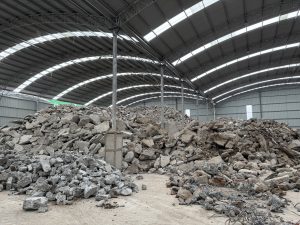
Input Material: Heavy concrete rubble, bricks, and structural debris
Processing construction and demolition (C&D) waste requires extreme mechanical durability. Unlike municipal waste, C&D debris is highly abrasive, dense, and physically punishing on standard conveying equipment. To turn discarded building materials into profitable, reusable construction aggregates, we need a specialized heavy-duty crushing and sorting system.
This case study highlights a recently deployed C&D waste processing site in Inner Mongolia. The facility successfully processes large volumes of structural rubble, converting it into stratified, high-value recycled materials.
1. System Process Flow & On-Site Engineering
Based on the operational footage from the Inner Mongolia facility, the plant utilizes a continuous, high-impact processing line designed for maximum volumetric throughput.
Phase 1: Heavy-Duty Infeed and Dosing
The recycling process begins inside a covered steel-framed facility.
- A heavy-duty SANY tracked excavator is utilized to manage the raw waste stockpile.
- The excavator continuously loads massive chunks of concrete, bricks, and mixed rubble directly into the system’s elevated receiving hopper.
- The hopper is integrated with a vibrating feeder base, which absorbs the massive kinetic shock of the falling concrete blocks and meters the material evenly into the crushing chamber.
Phase 2: Primary Crushing and Conveying
-
Once the material drops from the vibrating feeder, it enters the primary crushing unit (housed in the grey and green reinforced casing) to break down the oversized structural debris.
-
The crushed material is then transported along inclined conveyor belts for further processing and sorting.
-
The conveying line is equipped with an overhead suspension structure, designed to separate specific fractions before the final stockpiling stage.
Phase 3: Final Product Stratification and Stockpiling
The true value of a C&D recycling plant lies in its ability to output clean, graded materials. This facility extends its final discharge conveyors outside the building to create distinct, high-volume stockpiles.
- Fine Fraction Output: One exterior conveyor belt discharges a dark, highly pulverized soil-like fine material into a dedicated pile. This fraction is typically utilized for landfill cover, land reclamation, or sub-grade backfilling.
- Recycled Aggregate Output: A second, separate conveyor belt continuously deposits clean, uniformly crushed aggregate. The final close-up confirms that the heavy concrete and bricks have been successfully reduced to a consistent gravel-sized product (approximately 20mm-40mm), which serves as a premium recycled sub-base for new road construction.
2. Driving ROI in C&D Waste Recycling
The Inner Mongolia site demonstrates the core objective of modern C&D waste management: creating a closed-loop material economy. By implementing a robust feeding and crushing architecture, the operator has successfully diverted heavy construction debris from landfills and converted it into two distinct, monetizable products.
This localized processing capability drastically reduces transport costs, minimizes environmental impact, and provides a sustainable source of structural aggregates for regional infrastructure projects.