
What are the critical engineering configurations required to process highly erratic, mixed construction waste into high-purity recycled aggregates?
An industrial-grade mixed construction and demolition (C&D) waste recycling facility requires a synchronized sequence of heavy-duty impact or jaw crushing, high-amplitude multi-deck vibrating screens, high-gradient overbelt magnetic separators, and localized air classifiers.
In a continuous circuit, this configuration effectively separates abrasive aggregates from tramp metals and low-density combustibles (wood, plastic, textiles), delivering a secondary resource recovery yield of over 95% while meeting municipal dust and environmental emission controls.
Project Profile & Feedstock Material Liabilities
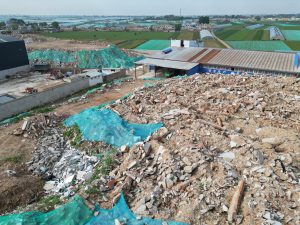
A large-scale environmental reclamation firm in Liaoning, China, commissioned us to design and deliver a comprehensive, high-capacity indoor C&D waste processing facility. The region’s inbound feedstock presents severe material challenges typical of mixed urban demolition debris:
- Massive Volumetric Heterogeneity: the inbound material consists of highly erratic piles of mixed red bricks, reinforced concrete blocks, loose soil, mortar fragments, and surface dust sheet aggregates.
- Severe Contamination Profiles: The mineral aggregates are deeply intermingled with high-tensile steel rebar fragments, wire mesh, timber scraps from formwork, and packaging plastics.
- Abrasive and Fragile Dynamics: Processing thousands of tons of high-hardness concrete alongside brittle clay bricks requires an optimized crushing sequence that prevents the over-generation of unmarketable ultra-fine powder while maintaining structural machine longevity.
To convert this raw liability into certified engineering aggregates, Guoxin Group implemented an enclosed, multi-stage automated processing matrix.
Enclosed Facility Infrastructure & Materials Handling Layout
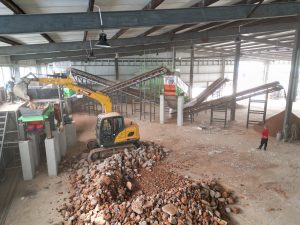
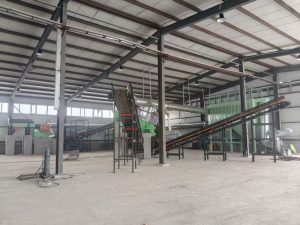
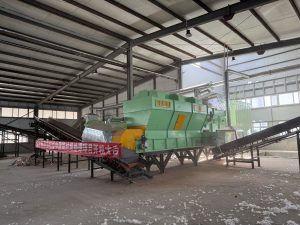
To satisfy rigorous domestic environmental dust control guidelines, the entire recycling array is integrated within a dedicated, high-clearance structural steel industrial building.
[Raw Inbound C&D Accumulation] ──► [Excavator Volumetric Feeding] ──► [Primary Crushing Array]
                                                                                │
                                                                                ▼
[Fine Sand / Soil Fraction] ◄── [Multi-Deck Vibrating Screen] ◄── [VFD Transit Conveyors]
                                        │
                                        ▼
[Recycled Aggregate Commodities] ◄── [Overbelt Magnetic Purification] & [Air Classification]
The layout optimizes spatial efficiency by arranging long-transit, variable-frequency drive (VFD) conveyor belts that link separate processing nodes. The background features an extensive, high-volume centralized pulse-jet baghouse dust collection system connected via a network of galvanized ducting to intercept fugitive particulate matter right at the point of origin.
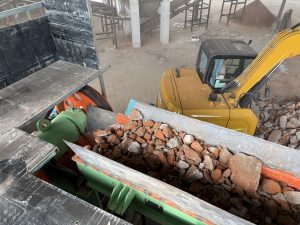
The material processing sequence begins at the primary charging dock. The heavy excavator acts as the initial volumetric metering controller, depositing raw, un-crushed rubble directly into a heavy-duty vibrating grizzly feeder built upon reinforced concrete foundations. This setup ensures isolated vibration dampening and steady throughput to the primary crushing station.
High-Amplitude Screening & Metallurgical Separation Matrices
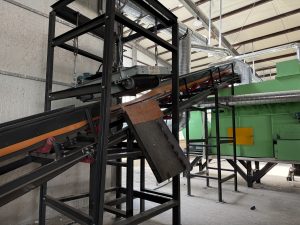
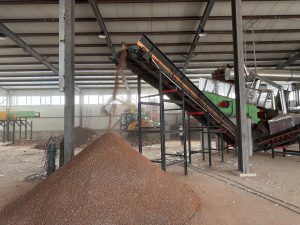
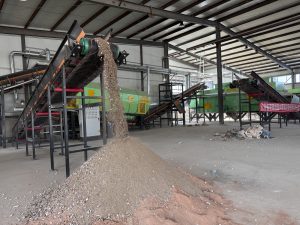
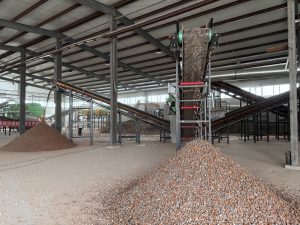
Once the raw rubble undergoes primary size reduction, the combined stream is conveyed rapidly into the sizing and purification circuit.
[Primary Crushed Stream] ──► [Vibrating Screen Node (Enclosed)] ──► [Overbelt Magnet Node] ──► [Clean Aggregate Pile]
                                     │                                    │
                                     ▼                                    ▼
                          [Fine Earth Segregation]              [Extracted Scrap Iron]
The sorting and sizing node relies on a high-amplitude, multi-deck inclined vibrating screen machine.
- Targeted Extraction Hoods: The vibrating screen is entirely enclosed within a heavy-duty polymer shield to lock in airborne silica dust. Large-diameter, negative-pressure dust extraction hoods are positioned directly above the screen deck discharge chutes to capture volatile particulate currents before they enter the wider facility floor.
- Dimensional Classification: The vibrating screen separates the crushed mix into distinct particle sizing brackets. The fraction consisting of heavy, medium-sized brick and concrete fragments is directed under a high-intensity magnetic station.
The crushed material passes beneath a high-gradient cross-belt overbelt magnetic separator suspended above the sorting mezzanine. The intense magnetic circuit instantly pulls out rebar wires and iron contaminants, safely dropping them into an independent collection bin. The remaining mineral fraction drops below, forming clean, high-density, uniform piles of recycled crushed aggregate ready for brick-making or road-base application.
Technical Specifications & Output Deliverables Matrix
The structured engineering data table below outlines the operational baselines and mass-balance configurations implemented across Guoxin Group’s standard industrial C&D processing systems.
| Equipment Station / Processing Node | Primary Mechanical Component | Core Engineering Configuration | Verified Operational Objective / Output |
| Material Intake & Feeder Loop | Heavy Grizzly Vibrating Feeder | VFD Flow Regulation + Wear-resistant liner | Continuous, non-clogging primary jaw/impact crusher charging |
| Secondary Material Sizing Node | High-Amplitude Inclined Vibrating Screen | Multi-deck configuration with dust suppression hoods | Sizing segregation (<10 mm、10–40 mm、>40 mm fractions) |
| Metallurgical Purification Station | Cross-Belt Permanent Overbelt Magnet | Rare-earth NdFeB circuit (≥3500 Gauss) | 99% extraction of embedded structural rebar scrap and tramp iron |
| Airborne Particulate Management | Pulse-Jet Baghouse Filtration Array | Closed-loop suction ducts over screening/crushing points | Complete facility floor negative pressure; compliance with local PM emissions standards |
| Final Product Output (Aggregate Pile) | Clean Recycled Brick/Concrete Fractions | High-density stackable sorting conveyors | Production of high-purity road-base aggregate, sub-base fills, and clean fine sand |
How does the plant isolate clean fine sand from mixed construction waste containing high clay and soil contamination?
The system is engineered to generate a clean, isolated pile of fine sub-10mm sand and soil aggregate separate from the structural stone fractions. This is accomplished by placing a specialized fine-mesh screening deck at the bottom tier of the vibrating screen matrix. By screening out the friable soil and fine mortar sand before the intermediate aggregate hits the magnetic or air classifiers, the plant keeps the downstream recycling machinery clean and prevents fine dust from binding to the larger recycled brick surfaces.
What mechanism protects the downstream conveyors and screens from being sliced by sharp rebar exposed during crushing?
When reinforced concrete blocks are crushed, jagged rebar wires are liberated, posing a severe threat to standard rubber conveyor belts. To counter this, Guoxin Group implements two protection layers: first, the primary discharge conveyor beneath the crusher uses a heavy-duty, puncture-resistant steel cord rubber belt; second, the cross-belt magnetic separator is positioned at the exact trajectory point where material discharges from the conveyor head pulley. This configuration leverages material inertia to cleanly pull iron fragments out of mid-air, avoiding belt friction and wear.
Request a Custom C&D Recycling Facility Design & Layout Proposal
Henan Guoxin Machinery Manufacturing Co., Ltd. is a premier manufacturer of heavy-duty industrial waste sorting, screening, and material resource recovery plants worldwide. Our in-house engineering group provides comprehensive site inspections, customized 3D CAD structural workflow planning, and optimized equipment arrays matched to your precise daily processing targets.
Contact Our Industrial Engineering Division for Technical Consultations