
Executive Summary
-
Project Location: Xi’an, Shaanxi Province, China
-
Feedstock Matrix: Highly heterogeneous, contaminated urban renewal mixed Construction and Demolition (C&D) waste (concrete fractions, brick fragments, timber, rebar, soil, and mixed light 2D combustibles).
-
System Throughput Capacity: 200–250 Tons per Hour (TPH) continuous operational rating.
-
Core Engineering Objective: Transition raw, unsegregated demolition debris into certified structural aggregate, compressed high-density alternative fuel fractions (RDF), and high-purity recycled eco-pavers via an unbroken, closed-loop mechanical workflow.
1. Operational Site Challenges: The Heterogeneity Conflict
Urban redevelopment and infrastructure expansions generate severe volumes of mixed C&D waste. The raw material profile at the Xi’an processing site presented multi-phase engineering bottlenecks that conventional linear crushing lines cannot resolve:
-
High Moisture Mud and Fines Contamination: The inbound waste matrix contained up to high-cohesion soil and micro-fine mineral dust, which blinds standard secondary crushers and compromises downstream brick bonding chemistry.
-
Intertwined Light 2D Fractions: Plastic packaging films, geotextiles, and woven bags wrap around high-speed rotary shafts, inducing thermal overloads and bearing failures.
-
Tramp Metal Ingress: Embedded structural rebar and heavy iron castings pose catastrophic fracture risks to high-torque secondary sizing shredders.
To transform this erratic material feed into a high-yield commercial operation, the system design required a complete, multi-stage Mechanical Separation, Aerodynamic Cleaning, Refining, and Inline Manufacturing configuration.
2. Integrated Process Architecture & Mechanical Workflow
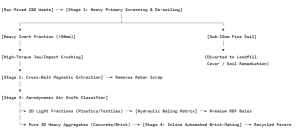
Phase 1: Primary Heavy-Duty Mechanical Segregation and De-soiling
The raw material is loaded via a heavy-duty apron feeder into a high-amplitude, multi-deck rotary trommel screen paired with an inclined flip-flow screen deck.
-
Engineering Action: The primary system separates the material into three size categories: (fine soil and sand), (mid-size mineral fragments), and (coarse concrete chunks and oversized light fractions). The sub-15mm soil is instantly isolated and evacuated, preventing downstream equipment fouling and preserving aggregate purity.
Phase 2: High-Torque Size Reduction & Tramp Metal Extraction
The oversized heavy inert fractions are directed into a primary heavy-duty impact crusher.
-
Engineering Action: The crusher reduces the aggregate profile to a uniform grain geometry. Following size reduction, the material passes under a high-intensity neodymium cross-belt overbelt magnet. The magnetic field extracts embedded structural rebar, wire meshes, and tramp metals, protecting the downstream refining equipment and securing a valuable secondary metal stream.
Phase 3: Aerodynamic Classification & High-Density Hydraulic Baling
The crushed aggregate remains contaminated with shredded lightweight plastics, wood chips, and paper fibers.
-
Engineering Action: The material drops through a high-velocity Air Knife Fluidization Separator. The positive air blast lifts the lightweight 2D combustible components into a cyclone collection system, while the dense, heavy stone and concrete fractions drop straight through. The isolated plastics and textiles are routed to a heavy-duty hydraulic baling press, which compresses the materials into high-density alternative fuel (RDF) bales optimized for transboundary transport and cement kiln co-processing.
Phase 4: Downstream Inline Block and Brick Manufacturing
The recovered, highly purified concrete and brick aggregates are transferred directly via conveyor into the mixing bins of the inline block production factory.
-
Engineering Action: The reclaimed aggregates are blended with cement, water, and specialized additives. The mixture is fed into a high-vibration hydraulic block-forming matrix. By utilizing precise particle packing gradations, the automated line manufactures high-strength, eco-friendly interlocking pavers and structural blocks without requiring virgin river sand or mined aggregates.
3. Plant Mass Balance and Operational Yield Metrics
The table below outlines the continuous mass-balance distribution and performance parameters achieved at the operational Xi’an facility:
| Reclaimed Material Fraction | Primary Mechanical Processing Method | Mass Recovery Share (By Weight) | Physical & Mechanical Output Metrics | Downstream Commercial Destination |
|---|---|---|---|---|
| Recycled Aggregate () | High-impact crushing + Air knife cleaning | High purity, zero organic film contamination | Direct feed for inline block and eco-paver manufacturing | |
| Stabilized Humus Soil | High-amplitude flip-flow screening () | Free of large inerts; high soil density | Backfill matrix; urban landscaping; daily landfill cover | |
| Light Combustible Fraction | Positive-pressure aerodynamic extraction | Low ash content; dense hydraulic baling | Alternative fuel feedstock (RDF) for industrial boilers | |
| Ferrous Metals | Cross-belt magnetic separator loop | Clean extraction accuracy | Steel foundries and scrap metal recycling markets |
4. Key Systems Engineering Innovations
Advanced Particle-Size Distribution for High-Strength Blocks
To achieve an unconfined compressive strength exceeding in recycled bricks, the aggregate matrix must be precisely graded. The combination of jaw and impact crushing steps optimizes the ratio between coarse aggregate (), fine aggregate (), and recycled mineral powder, reducing the amount of cement binder required and maximizing the block production line’s return on investment (ROI).
Automated PLC Overload Protection Across the Integrated Line
The entire line from primary feeding to downstream baling is monitored by a central SCADA system running specialized PLC control loops. If an uncrushable piece of steel enters the crushing chamber, the system registers a sudden current spike on the Variable Frequency Drive (VFD), automatically opens the hydraulic discharge gate to clear the object, and resets the line within seconds, avoiding catastrophic rotor damage and minimized downtime.
Complete Turnkey EPC Project Delivery and Infrastructure Capabilities
The successful implementation of the Xi’an integrated C&D waste sorting, crushing, and block-making line highlights the value of data-driven systems engineering. Henan Guoxin Machinery Manufacturing Co., Ltd. (Guoxin Group) engineers, manufactures, and delivers heavy-duty, high-capacity solid waste resource recovery plants built to withstand highly abrasive operational conditions.
From initial raw feedstock testing and mass-balance modeling to complete 3D factory layout configuration and PLC systems integration, our engineering divisions provide robust solutions that turn environmental liabilities into sustainable corporate profits.
Planning an integrated resource recovery plant or upgrading an existing C&D waste line? Contact to request a comprehensive engineering proposal: Eve@guoxinmachinery.com