
Project Snapshot
| Operational Parameter | Factory Test Details |
| Test Date | August 21, 2026 |
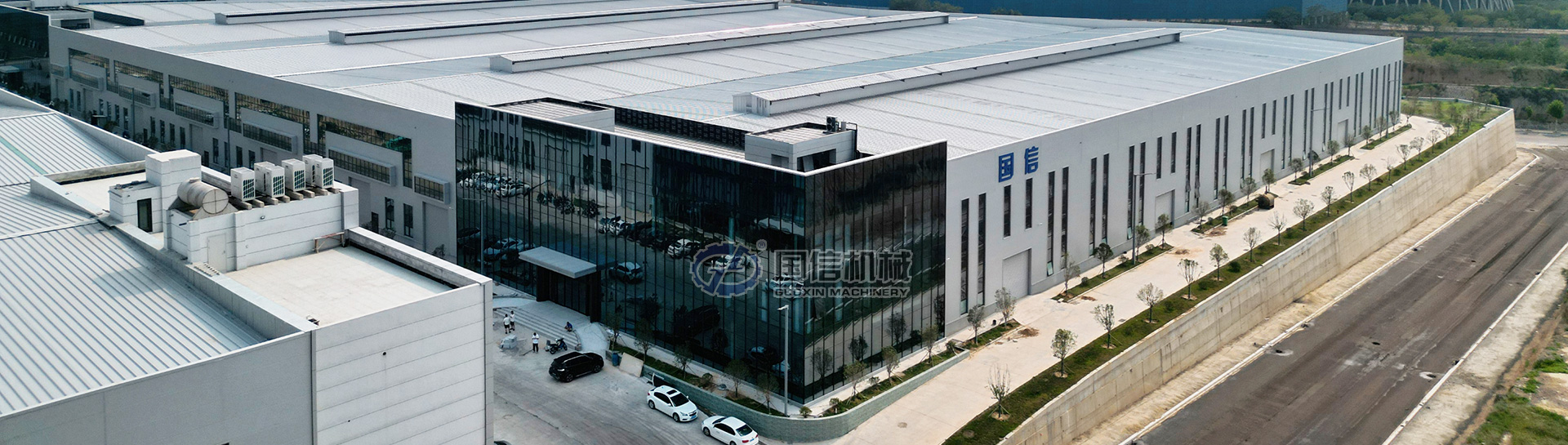
| Test Location | Guoxin Group Workshop |
| Equipment Tested | Heavy-Duty Double-Shaft Industrial Shredder |
| Feed Materials | Dried Tree Branches/Twigs & Dense Coconut Shells/Husks |
| Primary Outputs | Uniform Wood Chips, Fibrous Mulch & Coconut Coir Granules |
| Target Applications | Biomass Energy (RDF/Pelletizing), Composting, Volume Reduction |
| Equipment Provider | Guoxin Group |
The Challenge: Processing High-Fiber & Tough Organic Waste Streams
In municipal green waste sorting, forestry processing, and tropical biomass recycling, materials like bulky tree branches and thick coconut shells pose distinct operational obstacles:
-
High Tensile Strength & Shaft Wrapping: Long wood fibers and tough coconut coir tend to wrap around conventional single-shaft rotors, causing frequent jams and motor burnout.
-
High Shell Hardness: Hardened coconut shells demand high instantaneous torque to crush without slippage.
-
Inconsistent Output Size: Unprocessed biomass leads to slow decomposition in composting plants and poor combustion efficiency in biomass boilers or RDF lines.
Workshop Trial Highlights & Processing Stages
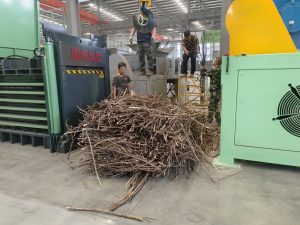
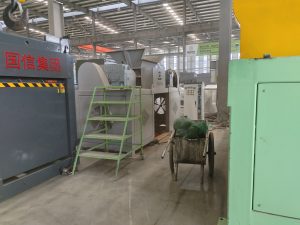
During the August 21 factory test, Guoxin Group engineers subjected the heavy-duty double-shaft shredder to a two-phase material trial to verify shear force, blade grip, and discharge quality:
- Phase 1: Multi-Directional Branch & Twig Shredding
Engineers loaded bundles of dry, multi-branched tree limbs into the hopper. The counter-rotating dual shafts instantly grabbed the bulky limbs, shearing them through low-speed, high-torque claw blades. The branches were sliced cleanly into uniform wood chips and mulch without bridge formation in the hopper.
- Phase 2: High-Density Coconut Shell Pulverization
A full bag of dry coconut shells and husks was fed into the cutter chamber. The heavy-duty alloy blades effectively gripped the rounded shell surfaces, crushing the hard outer walls and tearing apart the inner fibrous husks. The material was processed smoothly in a single pass without cutter slippage or dust clouds.
- Phase 3: Discharge & Fiber Liberation Inspection
Manual inspection of the discharged material underneath confirmed optimal size reduction. The tree limbs were converted into high-surface-area wood fibers, while the coconut shells were reduced to a clean mix of coir fiber and shell particles—ideal feedstocks for organic composting, pelletizing, or biomass boiler fuel.
Key Technical Advantages for Biomass & MSW Plants
-
Dual-Shaft Counter-Rotating Shearing: Low RPM with extreme torque ensures continuous biting action on rounded shells and long fibrous branches.
-
Wear-Resistant Alloy Blade Geometry: Forged, heat-treated cutter discs handle highly abrasive organic fibers with minimal edge wear.
-
Automated PLC Jam Protection: Smart sensors continuously monitor motor current, triggering instant reverse rotation to clear uncrushable debris before returning to normal operation.
-
Versatile Modular Setup: Interchangeable blade thickness and tooth counts allow plants to adjust output particle sizes according to local composting or RDF specification needs.
Guoxin Group’s biomass double-shaft shredders deliver reliable, high-throughput size reduction for tough organic waste streams worldwide. Contact our engineering specialists today to request a custom test on your material or to receive tailored layout proposals.