
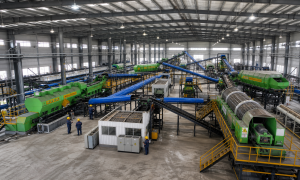
Establishing a Municipal Solid Waste (MSW) sorting plant requires a balanced capital expenditure (CAPEX) model tailored to daily throughput (TPD), waste input composition, and required output purity. Total investment generally ranges from $800,000 to over $18,000,000, scaling with plant automation and downstream Refuse-Derived Fuel (RDF) or recycling integration.
This guide provides an engineering-grade financial and technical baseline for municipal decision-makers, EPC contractors, and private waste management operators.
1. Executive Summary: CAPEX Benchmark by Plant Capacity
Total plant turnkey costs combine equipment manufacturing, electrical controls (PLC/SCADA), civil engineering, and installation.
| Plant Capacity (TPD) | Automation Level | Equipment CAPEX Range | Total Turnkey Cost (Incl. Civil Work) | Recommended Footprint |
| 100 – 200 TPD | Semi-Automated (Mechanical + Manual) | $800,000 – $1,800,000 | $1,500,000 – $3,000,000 | 2,500 – 4,000 m² |
| 300 – 500 TPD | Fully Automated (Air Density + Magnetic) | $2,500,000 – $5,500,000 | $4,500,000 – $8,500,000 | 5,000 – 8,500 m² |
| 500 – 1,000+ TPD | Advanced (AI Optical + RDF Line) | $6,000,000 – $14,000,000 | $10,000,000 – $22,000,000 | 10,000 – 18,000 m² |
(Note: Figures represent global EPC averages based on 2026 industrial manufacturing standards).
2. Waste Sorting Machine Price Breakdown (Standalone Component CAPEX)
Waste Sorting Machine Prices: Budgetary Reference Ranges
The equipment prices below are preliminary budgetary references for initial project evaluation, not formal quotations. Actual prices vary according to processing capacity, equipment configuration, material characteristics, automation requirements, manufacturing specifications and delivery conditions.
Before comparing suppliers, confirm whether the quoted price includes electrical controls, auxiliary equipment, installation, commissioning, spare parts, packaging, freight, import duties and local taxes. These items can materially affect the final delivered cost.
For an accurate quotation, provide the target throughput, incoming waste characteristics, required output materials, installation location and preferred equipment configuration.
If upgrading an existing facility or procuring individual processing units, equipment costs account for 55% to 70% of total project investment. Below are standalone budget references for primary sorting line machinery:
| Equipment Type | Technical Function | Standard Unit Price (USD) |
| Chain Plate & Belt Feeders | Heavy-duty intake feeding & material synchronization | $15,000 – $45,000 |
| Automatic Bag Openers | High-torque dual-shaft plastic bag breaching | $35,000 – $85,000 |
| Trommel Screens (Rotary Sieve) | Size fractionation (e.g., <50mm organics vs. >50mm combustibles) | $45,000 – $120,000 |
| Air Density Separators (Windshifters) | Separates light plastic/paper films from heavy stone/glass inerts | $65,000 – $150,000 |
| Overband Magnetic Separators | Automated extraction of ferrous metals and rebar | $12,000 – $35,000 |
| Eddy Current Separators (ECS) | High-frequency separation of non-ferrous aluminum and copper | $40,000 – $95,000 |
| NIR Optical Sorters (AI/Sensor) | High-speed polymer classification (PET, HDPE, PP, PE) | $120,000 – $280,000 |
| Heavy-Duty Industrial RDF Shredders | Secondary size reduction for Refuse-Derived Fuel preparation | $85,000 – $220,000 |
Request a Waste Sorting Equipment Quotation
To prepare a suitable equipment quotation, our engineering team needs to understand your required processing capacity, incoming waste composition, target output materials and installation location. For a complete sorting plant, the proposed process flow, equipment list, installation scope and site requirements should also be confirmed.
Contact Guoxin to discuss your project requirements and request a configuration-specific quotation.
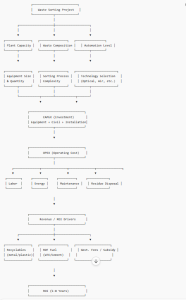
Process diagram of waste sorting plant cost analysis from feeding to RDF output
3. Operational Expenditure (OPEX) & Cost Per Ton Analysis
Evaluating ongoing operational costs is essential for accurate ROI projections. Standard operational expenses generally range between $12 and $28 per ton of waste processed.
Core OPEX Cost Drivers:
- Power Consumption: Modern mechanical sorting lines consume approximately 12 to 22 kWh per ton of input waste. Incorporating heavy secondary shredders or thermal drying units increases power draw up to 35 kWh per ton.
- Labor Expenses:
- Basic/Manual Sorting Lines: Require 15 to 30 sorting operators per shift ($15 – $25/ton).
- Automated Lines: Require 4 to 8 monitoring technicians per shift ($4 – $8/ton).
- Wear & Maintenance: Blade adjustments for bag breakers/shredders, belt replacements, and bearing lubrication average 3% to 5% of total machinery CAPEX annually.
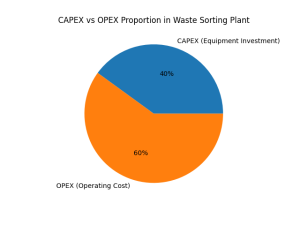
Breakdown of MSW sorting plant cost factors: machinery, civil works, and operation
4. Total Cost Structure: Where Is the Budget Allocated?
A complete turnkey MSW sorting facility allocation breaks down into four main investment categories:
-
Machinery & Processing Lines (55% – 65%): Front-end feeding, mechanical screens, magnetic/air separation systems, and downstream processing equipment.
-
Civil Works & Building Infrastructure (20% – 30%): Enclosed workshop structural steel framing, concrete foundations, deep hopper pits, and roads.
-
Electrical Control & Automation (8% – 12%): Centralized PLC control cabinets, SCADA monitoring interfaces, sensors, and cabling.
-
Environmental Control Systems (5% – 8%): Negative pressure dust collection, deodorization spray towers, and leachate containment tanks.
5. Revenue Streams & Financial Payback Model
A well-designed MSW sorting plant generates multiple streams of commercial value to offset initial capital expenditure:
- Recyclable Commodities Sale: Clean extraction of ferrous metals, aluminum cans, PET bottles, and high-density plastics.
- Alternative Fuel (RDF/SRF): High-calorific light fractions sold to local cement kilns, thermal power plants, or low-temperature cracking facilities.
- Organic Compost Base: Screened under-size (<50mm) organic fractions directed to anaerobic digestion or composting lines.
- Municipal Tipping Fees: Tonnage-based processing fees paid by municipal authorities to private plant operators.
Project ROI Timeline: Basic mechanical sorting facilities typically achieve full capital payback within 24 to 36 months. Fully automated plants integrating RDF production units reach ROI within 18 to 28 months due to higher end-product market values.
FAQ
Q1: What is the average cost to process one ton of municipal waste?
The average processing cost ranges from $12 to $28 per ton depending on labor costs, power tariffs, and system automation levels. High automation significantly reduces per-ton labor costs.
Q2: Why does an AI optical sorting system increase CAPEX significantly?
AI optical sorters utilize Near-Infrared (NIR) sensors and high-speed air jets to categorize plastics by resin type in milliseconds. While unit costs range from $120,000 to $280,000, they replace up to 10 manual pickers per line and yield over 95% material purity.
Q3: Can a waste sorting plant be integrated with downstream Waste-to-Energy (WtE) or cracking systems?
Yes. Modern municipal sorting plants serve as the front-end preparation stage for Waste-to-Energy systems. Isolating non-combustibles (metals, stones) and wet organics dramatically increases the calorific value of RDF fed into incinerators, gasifiers, or low-temperature molecular cracking units.