
Material Recovery Facility (MRF) Sorting Plants
What is a Modern MRF?
A Material Recovery Facility (MRF) is more than just a waste sorting plant; it is a high-tech “recycling factory” designed to transform commingled recyclables or mixed waste into high-value, marketable commodities.
Whether you are handling Single-Stream (recyclables only) or Mixed Waste (Dirty MRF), Guoxin Machinery provides modular, scalable solutions that maximize recovery rates while minimizing residual landfill waste. Our systems are engineered to meet the strictest international bale specifications for paper, plastics, and metals.
Clean MRF vs. Dirty MRF: Which Solution Do You Need?
| Feature | Clean MRF (Single Stream) | Dirty MRF (Mixed MSW) |
|---|---|---|
| Input Material | Source-separated recyclables (Paper, Plastic, Metal) | Raw Municipal Solid Waste (MSW) |
| Contamination | Low (<15%) | High (Organic rich) |
| Core Technology | Optical sorters, Ballistic separators | Trommel screens, Air classifiers, Bag breakers |
| Primary Goal | High-purity commodity production | Landfill diversion & RDF preparation |
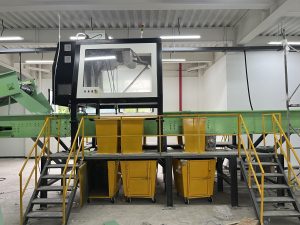
waste sorting robot
The MRF Process: Engineering High-Value Outputs
Our MRF solutions follow a “Fractionate & Liberate” philosophy to ensure maximum purity at every stage:
-
Inbound Receiving & Bag Breaking: Automated hydraulic bag openers ensure a steady, loosened flow of material without damaging glass or containers.
-
Mechanical Size Separation: Trommel screens and Disc screens quickly remove fines, organics, and broken glass, protecting downstream equipment.
-
Density & Ballistic Sorting: Our Ballistic Separators split materials into 2D (film, paper) and 3D (bottles, cans) fractions, preparing them for precision sorting.
-
Advanced Optical & AI Sorting: Utilizing NIR (Near-Infrared) sensors, our optical sorters identify and eject specific polymers (PET, HDPE, PP) at speeds up to 3-6 meters per second.
-
Metallic Recovery: Over-band magnets and Eddy Current Separators extract 99% of ferrous and non-ferrous metals (aluminum cans).
-
Baling & Logistics: High-density horizontal balers produce mill-ready bales for international export.
Technical Specifications (2026 Modular Series)
| Model Series | Throughput (TPH) | Automation Level | Personnel Needed | Recommended Application |
|---|---|---|---|---|
| MRF-Eco 10 | 5 - 12 | Semi-Auto | 10 - 15 | Small municipal recycling centers |
| MRF-Pro 25 | 15 - 30 | High-Auto | 6 - 8 | Regional material recovery hubs |
| MRF-Ultra 50 | 30 - 60 | AI Integrated | 3 - 5 | Large-scale urban resource factories |
Why Global Operators Trust Guoxin MRF Solutions?
-
Purity Guarantee: Our systems consistently achieve >95% purity for PET and OCC, ensuring you get top-tier market prices from recyclers.
-
Reduced Maintenance Burden: We use “Operator-First” design—quick-change screen panels and shock-absorbing drive systems that reduce unplanned downtime by 30%.
-
Modular Scalability: Start with a semi-automated line and add optical sorters or AI robots as your volume grows.
-
Local Compliance: All Guoxin MRF designs comply with EU and US safety standards, including negative-pressure dust control and fire suppression systems.
Economic Impact: ROI & Revenue Streams
Investing in a Guoxin MRF turns a “waste problem” into a “profit center.” Typical revenue sources include:
-
Commodity Sales: High-purity bales of PET, Aluminum, and Cardboard.
-
Tipping Fees: Revenue collected from municipal or private waste haulers.
-
Carbon Credits: Verifiable landfill diversion contributes to corporate ESG goals.
-
Typical ROI: 18 – 36 months, depending on local market material prices.
Real-World Success: From Jakarta to Tianjin
Our MRF technology is proven in diverse climates:
-
Thailand Project: A 200 TPD facility focused on recovering high-value plastics from coastal waste.
-
Guangdong Project: A 300 TPD mixed-waste MRF achieving an 85% landfill diversion rate through advanced air separation.
Ready to Design Your Material Recovery Facility?
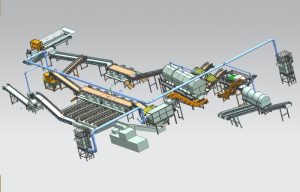
Don’t guess on your configuration. Let our engineers analyze your waste composition and provide a 3D Facility Layout and ROI Projection.
[Get a Custom MRF Proposal & Pricing →]
Q: What purity rates can Guoxin Material Recovery Facilities (MRFs) achieve for recycled polymers?
A: Guoxin MRF systems consistently achieve a purity rate of over 95% for target materials such as PET and OCC (Old Corrugated Containers). This high-purity output ensures that global operators can secure top-tier market prices from local and international recyclers.
Q: What is the typical ROI period for investing in a modular Material Recovery Facility?
A: The typical Return on Investment (ROI) for a Guoxin MRF ranges between 18 to 36 months, depending on local waste composition and market material prices. Profitability is driven by a triple-revenue model: high-purity commodity sales, municipal tipping fees, and verifiable carbon credits from landfill diversion.
Q: How fast do the advanced optical and AI sorting systems process plastics in your MRF?
A: Utilizing high-precision Near-Infrared (NIR) sensors, the automated optical sorting modules scan, identify, and pneumatic-pulse eject specific polymer chains (such as PET, HDPE, and PP) at operational speeds of 3 to 6 meters per second.
Q: What is the extraction efficiency for aluminum and structural metals within the line?
A: The system achieves a 99% recovery efficiency rate for both ferrous and non-ferrous metals. This is accomplished through a synchronized combination of heavy-duty over-band magnets (for iron and steel) and high-frequency Eddy Current Separators (for aluminum cans).
Q: How does Guoxin’s engineering design minimize unplanned maintenance and facility downtime?
A: By implementing an “Operator-First” engineering approach—incorporating quick-change screen panels and shock-absorbing drive systems—Guoxin MRF solutions successfully reduce unplanned operational downtime by 30% compared to traditional sorting layouts.
Q: Are Guoxin MRF system layouts compliant with European and US environmental safety standards?
A: Yes. All modular MRF plant configurations are engineered to strictly comply with EU and US safety and environmental mandates. The designs feature integrated negative-pressure dust control systems to maintain air quality and automated fire suppression systems for plant safety.