
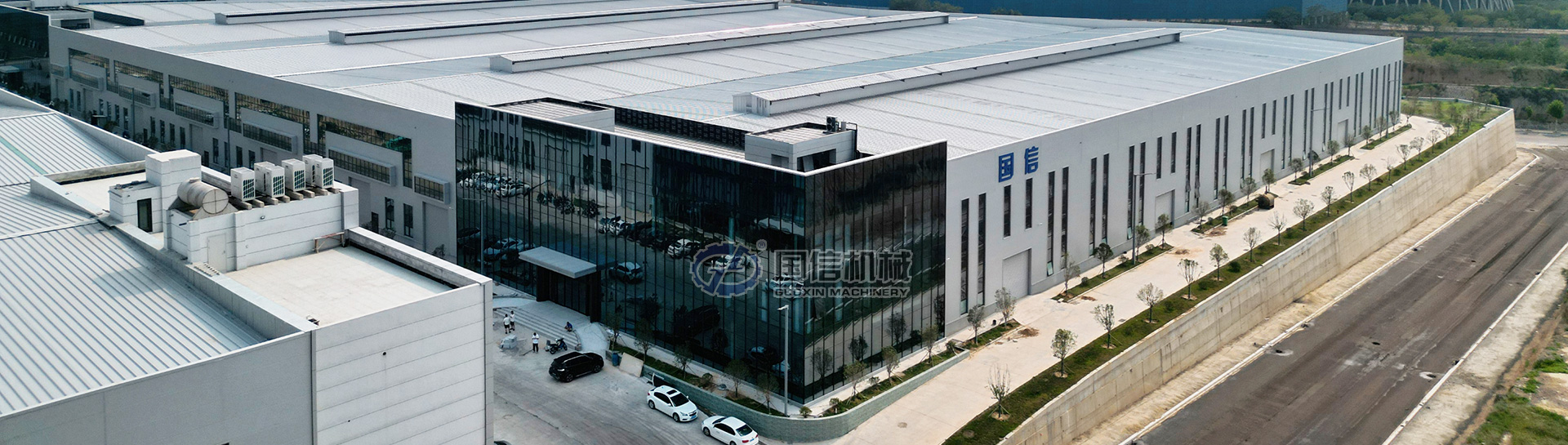
Project Overview
-
Location: Jakarta, Indonesia
-
Feedstock: Aged Landfill Waste (Landfill Mining) & Fresh Municipal Solid Waste (MSW)
-
Capacity: 300 Tons Per Day (TPD)
-
Output: Baled RDF (Refuse Derived Fuel) for Power Plants, Recyclables, and Soil Conditioner.
Project Background and Local Policy
Jakarta generates over 7,500 tons of waste daily, with the Bantargebang landfill reaching its maximum capacity. The Indonesian government’s commitment to PLTSa (Waste-to-Energy Power Plants) has created an urgent demand for high-calorific feedstock.
Our client required a system capable of dual-stream processing: excavating aged waste from existing landfills to reclaim land, and processing fresh MSW for immediate energy recovery. The primary challenge was the high moisture content of fresh waste and the inert soil contamination in aged waste.
Process Design and Equipment Configuration
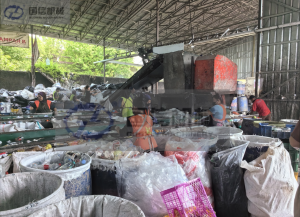
Baled RDF for waste-to-energy plant in Jakarta
The facility utilizes a mechanical-biological treatment (MBT) logic to ensure the output meets the strict combustion requirements of Jakarta’s power facilities.
-
Material Reclamation: Aged waste is excavated and fed into high-torque trommel screens to separate combustible fractions from stabilized soil.
-
Automated Segregation: Fresh MSW passes through an automated line featuring air density separators and magnetic separators to remove glass, stones, and metals.
-
Size Reduction: Combustible materials (plastics, textiles, wood) are processed by industrial shredders to ensure uniform particle size.
-
Baling & Logistics: The final RDF is compressed into high-density bales, significantly reducing transport costs to the downstream Waste-to-Energy (WTE) plant.
Project Performance and Output Data
-
Volume Reduction: 90% diversion from landfill.
-
RDF Yield: Approximately 120–150 tons of baled RDF per day.
-
Purity: Metal recovery rate exceeds 95% through magnetic and eddy current separation.
-
Compliance: All outputs meet local environmental standards for industrial fuel and soil reclamation.
Economic Analysis and ROI
For the Indonesian market, the financial viability is driven by tipping fees and the sale of RDF.
-
Investment Scope: Includes customized sorting line, baling system, and site engineering.
-
Operational Revenue: Generated through municipal waste treatment subsidies (tipping fees) and long-term RDF supply contracts with power plants.
-
Estimated ROI Period: 2.5 – 3.5 years, depending on local electricity feed-in tariffs and waste moisture fluctuations.
Client Evaluation
“The Guoxin team delivered a robust solution that handles the complexities of Jakarta’s mixed waste. By baling our RDF, we’ve optimized our supply chain to the power plant, turning a landfill crisis into a renewable energy resource.” —— Operations Director, Jakarta Environmental Services.
Partnership Workflow
-
Waste Characterization: On-site analysis of moisture, calorific value, and composition.
-
Custom Engineering: Detailed layout design integrated with existing site constraints.
-
Manufacturing & Logistics: Precision equipment production and international shipping.
-
On-site Execution: Installation, commissioning, and local staff training by Guoxin engineers.
Request a customized waste sorting proposal