
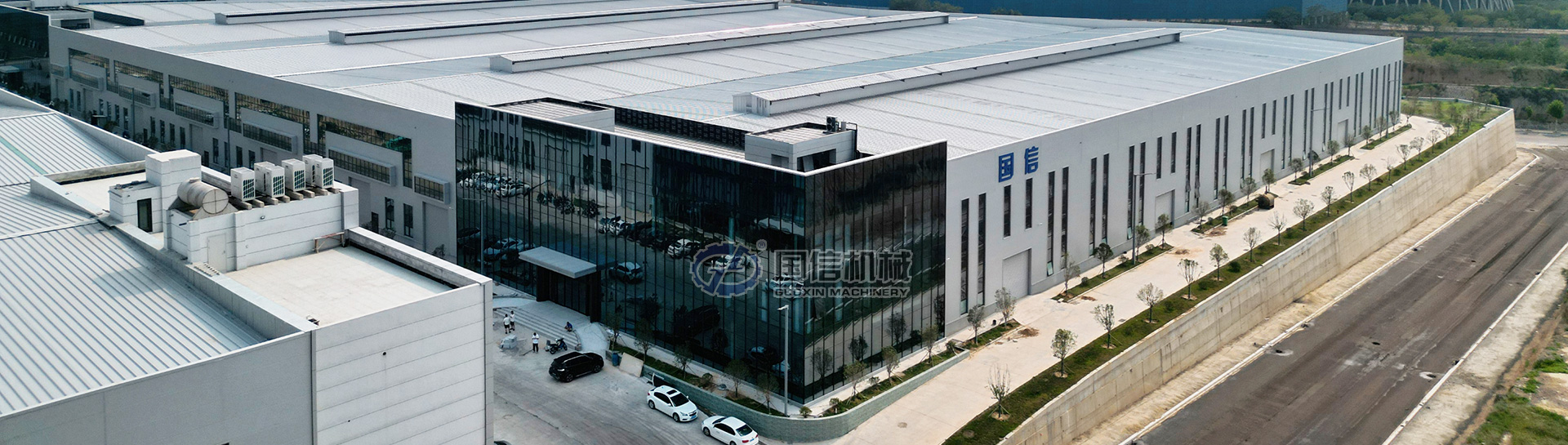
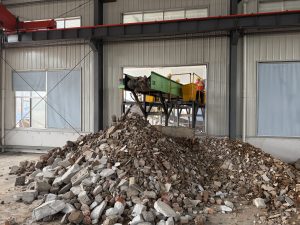
The economic viability of a Construction & Demolition (C&D) waste recycling facility depends on the market value of its primary output: recycled aggregates. Standard mechanical crushing configurations frequently yield low-grade aggregate fractions contaminated with wood, plastics, and light mineral contaminants (such as gypsum/drywall fragments), limiting their use to low-value sub-base backfill.
To penetrate the premium market for Structural-Grade Recycled Concrete Aggregate (RCA), facilities require advanced, multi-stage material refinement. Guoxin designs and delivers fully integrated C&D sorting complexes that eliminate light contaminants and inert foreign matter, enabling operators to supply ready-mix concrete producers and precast manufacturers with aggregates that meet stringent structural standards.
Process Engineering: Eliminating the Contamination Vector
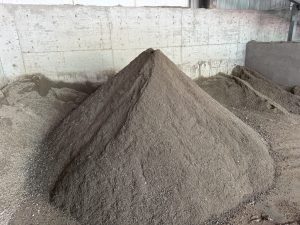
Transforming raw demolition debris into high-modulus aggregate requires a sequential separation matrix based on particle size, magnetic susceptibility, and bulk density.
Stage 1: Front-End Scalping & Fines Extraction
Mixed C&D waste enters through a high-stroke vibrating grizzly feeder. Before any crushing occurs, a heavy-duty finger screen or eccentric trommel isolates the <20mm soil and dust fraction. Removing these fine minerals immediately minimizes downstream conveyor belt wear and prevents moisture-laden soil from blinding the secondary sizing screens.
Stage 2: Structural Liberation & Metal Recovery
The scalped concrete fragments feed into a high-torque jaw crusher lined with Mn13Cr2 steel. This primary reduction breaks the bond between structural concrete and embedded steel rebar. As the crushed material discharges onto the main line, a high-gradient 2400 Gauss overbelt magnetic separator extracts the liberated rebar, protecting downstream components and capturing high-value ferrous scrap.
Stage 3: Multi-Stage Density & Air-Knife Segregation
Lightweight organic and inorganic impurities (such as wood studs, plastic conduit, insulation board, and drywall remnants) severely compromise the compressive strength of recycled aggregate concrete. Guoxin integrates a double-action air-knife system to eliminate these low-density fractions. A primary high-velocity blower lifts flexible film plastics and paper, while a secondary adjustable air-density separator isolates wood pieces and brittle light mineral contaminants from the falling stream of heavy concrete and brick aggregates.
Stage 4: Precision Screen Fractionation
The purified heavy fraction is delivered to a multi-deck horizontal vibrating screen. The material is calibrated into commercial sizing brackets required by ready-mix batching plants: 0–5 mm (recycled sand), 5–10 mm, 10–20 mm, and 20–40 mm (coarse aggregates).
Standard Output Fraction Specifications (Structural Grade RCA)
A properly configured Guoxin RCA processing line separates raw crushed concrete into four marketable fractions:
- 0–5 mm (Recycled Concrete Sand):Used for mortar mixing, block making, and asphalt filler.
- 5–10 mm (Fine Aggregate): Ideal for precast concrete products and pipe bedding.
- 10–20 mm (Medium Coarse Aggregate): Primary sizing for standard ready-mix structural concrete.
- 20–40 mm (Coarse Aggregate): Utilized for high-strength road base layers and heavy ballast.
Technical Performance Benchmarks
Our heavy-duty processing systems are engineered for continuous 24/7 industrial duty cycles, optimizing energy consumption per ton of finished aggregate.
| System Configuration | Input Capacity (TPH) | Key Equipment Matrix | Aggregate Purity Rate | Target Contaminant Removal | Control Interface |
| C&D-RCA 120 | 100 – 120 TPH | Heavy Grizzly Feeder + Jaw Crusher + Overbelt Magnet + Air Separator + 2-Deck Screen | ≥ 97% | Wood, Plastics, Rebar | Central PLC Console |
| C&D-RCA 250 | 200 – 250 TPH | Vibrating Grizzly + Jaw Crusher + Impact Crusher + Dual Magnet + Double-Action Air Knife + 3-Deck Screen | ≥ 98.5% | Full Light Fraction + Light Mineral Impurities | Siemens SCADA Panel |
| C&D-RCA 400+ | 350 – 500 TPH | Modular Multi-Stage Crushing Array + Multi-Deck Vibrating Screens + High-Gradient Magnets + Advanced Air Classifiers | ≥ 99.2% | Multi-Stage Micro-Refinement & Light Contaminants | Full Automation / VFD Load Control |
Structural Reliability Against High-Impact Abrasives
Processing hundreds of tons of concrete blocks per hour causes severe abrasion. Guoxin minimizes maintenance overhead through advanced metallurgy and engineering safeguards:
- NM450 and Hardox Wear Liners: Installed in all receiving hoppers, bypass chutes, and transfer points to resist the sliding abrasion of sharp crushed granite and flint.
- Reinforced Dual-Bearing Assemblies: Screen boxes and primary feeders are equipped with heavy-duty spherical roller bearings housed in cast steel blocks, engineered to survive sustained high-G vibrations.
- PLC-Integrated Anti-Jam Logic: Variable Frequency Drives (VFD) link the primary feeder to the jaw crusher motor. If the crusher approaches its peak operating amperage, the feeder instantly recalibrates the material flow rate to eliminate structural choking.
Single-Source EPC Project Delivery
We mitigate structural and mechanical interface risks for recycling concessionaires through single-source project execution:
- Detailed mass-balance calculations based on local C&D waste site samples.
- Custom 3D site layout designs tailored to fit existing land configurations or covered structures.
- Mechanical assembly, electrical integration, dust suppression balancing, and on-site operator training.
Request a Mass-Balance Simulation & Processing Layout
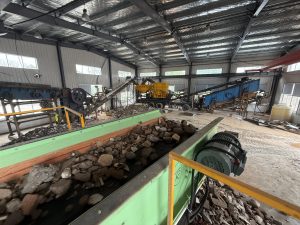
Every demolition waste matrix varies by concrete strength, brick ratio, and moisture content. Submit your feedstock parameters to our engineering team for a customized process layout and technical ROI assessment.
EPC Project: Eve@guoxinmachinery.com
FAQ
Q1: What parameters dictate whether recycled aggregate can be used in structural concrete?
A: Ready-mix concrete batching plants primarily evaluate three metrics: water absorption, crushing value, and impurity content (specifically organic matter like wood and sulfate-based gypsum). By implementing our front-end scalping screens and high-velocity air separators, Guoxin processing lines reduce total impurities to under 1%, bringing the water absorption and crushing values within the acceptable boundaries of local structural concrete regulations.
Q2: How does the RCA processing line eliminate gypsum and drywall impurities that degrade concrete strength?
A: Sulfate-based minerals like gypsum cause internal expansion and cracking in new concrete structures over time. Since drywall and gypsum break down into lighter, brittle fragments compared to dense crushed concrete, our process sequence targets these physical density differences. Front-end screening isolates soft fines, while high-velocity air-density knives lift and separate lightweight sheet fragments from the falling stream of heavy concrete aggregate, keeping total sulfate contaminants well within structural concrete compliance standards.
Q3: Can this plant setup handle wet, clay-contaminated demolition waste?
A: Yes. If your raw material contains high clay or mud ratios, we adjust the front-end layout by replacing the standard vibrating grizzly with a heavy-duty rotary trommel screen or a mud-clearing log washer module. This ensures the clay is stripped from the stone surfaces before the material reaches the primary crushing stage.
Q4: What is the typical operational lifespan of the jaw plates and blow bars?
A: Lifespan depends heavily on the silica content of your concrete aggregates. When processing standard limestone-aggregate concrete, our high-manganese (Mn13Cr2) primary jaw plates typically average 800 to 1,200 operating hours before requiring replacement, while the secondary impact blow bars range between 400 and 600 operating hours under continuous rated loads.
For unsegregated mixed demolition waste containing high soil and timber ratios, explore our comprehensive [C&D Waste Recycling Plant] solution.