
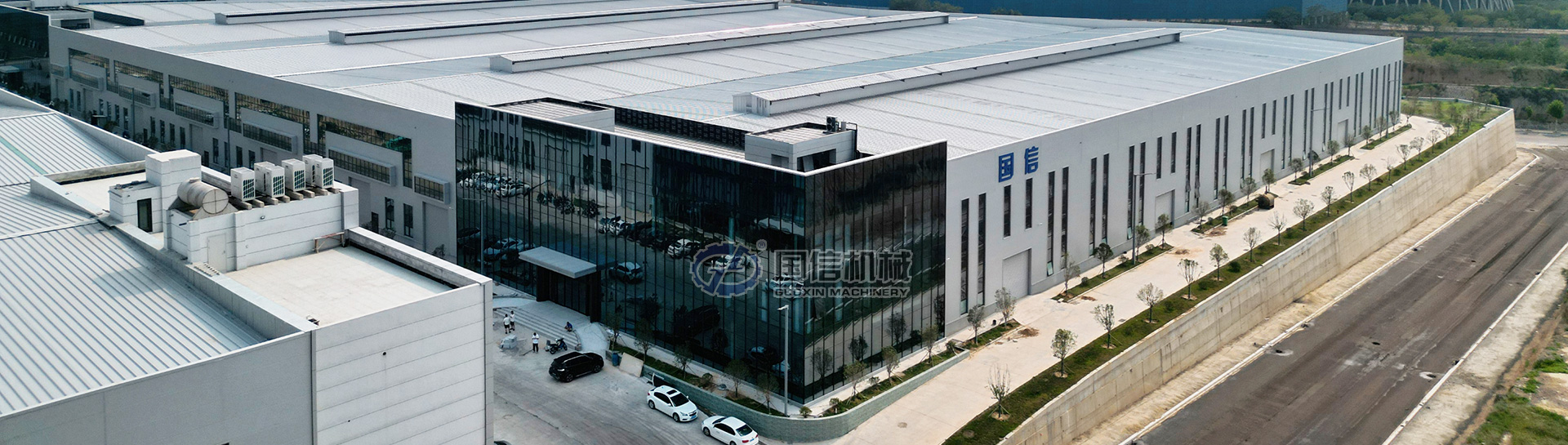
The complex composition, high sorting difficulty, high labor costs, and low efficiency of mixed solid waste have become major bottlenecks restricting the industry’s development.
Guoxin Machinery’s 500-ton/day (Mixed Solid Waste)MSW Sorting Machine(shredding + screening + recycling) provides a highly efficient, reliable, and economically viable industrial and intelligent turnkey solution. This addresses the core challenges faced by numerous waste treatment centers and resource recycling companies, with a commitment to delivery and commissioning by 2025.
———————————————————————————————————————————————————————————————————————————–
I. The Economic and Environmental Dilemma of Mixed Solid Waste Disposal
Mixed household waste, construction waste, and other similar materials are extremely complex, often involving the use of plastic bags, dry and wet mixing, and a combination of light and heavy materials. Simple treatment methods are not only ineffective but also fail to efficiently separate the recyclable materials (such as metals, plastics, and paper) and realize their market value.
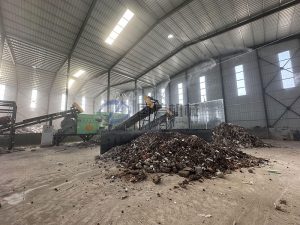
Mixed Solid Waste
II. Core Technology: A Value-Releasing System of “Shuttering + Screening + Recycling.”
Guoxin Machinery’s 500-ton/day Mixed Solid Waste Sorting Machine is not a single piece of equipment, but a precisely coordinated “value-releasing system.” It simulates the most efficient industrial sorting logic, transforming chaotic mixed solid waste into pure commodities through three core stages.
- Coarse Crushing and Homogenization Stage: Dual-Shaft Shredder
The production line begins with a heavy-duty dual-shaft shear shredder.
Its function is to forcibly crush large pieces of waste and bagged waste, breaking (bag opener machine)the constraints of bagging and homogenizing the material particle size.
This creates homogeneous material conditions for subsequent fine sorting and is the cornerstone of the stable and efficient operation of the entire process.
- Intelligent Screening and Classification Stage: Multi-Stage Sorting Joint Operation
This is the system’s “decision-making center.” The material first passes through a trommel screen for preliminary grading according to size, achieving the separation of coarse, medium, and fine materials.
- Subsequently, various specialized sorting equipment perform their respective functions
magnetic separators powerfully remove ferrous metals; eddy current separators precisely separate non-ferrous metals such as aluminum and copper; and air separators utilize air resistance differences to separate lightweight plastic films and paper from heavier materials.
- Fine Purification and Packaging Stage: Resource Realization
Materials sorted in the previous steps, such as various plastics, metals, and paper, will undergo final purification using AI-intelligent optical separators or intelligent sorting robots.
These devices utilize AI visual recognition technology to accurately identify items of various materials and colors, ensuring the high purity of the final product and thereby obtaining a higher market price. Finally, the material is compressed into regular blocks by a baler for easy storage and transportation.
————————————————————————————————————————————————————————————————–
III. Why 500 tons/day? The Critical Point of Efficiency for Scaled Operations
- Choosing a processing scale of 500 tons/day is an ideal balance point derived from an analysis of the solid waste generation and return on investment in most prefecture-level cities and large industrial parks in China.
- This scale satisfies the needs of regional centralized processing while avoiding the high initial investment and material collection difficulties associated with excessively large-scale operations.
- From an economic perspective, a designed capacity of 500 tons/day translates to an annual processing capacity exceeding 160,000 tons (based on 330 days of operation). This scale is sufficient to support a project with a complete resource recovery industrial chain, achieving stable profitability through the sale of high-value products such as recycled plastics, metals, and RDF fuel.
- From an investment perspective, compared to production lines with a processing capacity of a few hundred tons less, the unit investment cost (investment per ton of processing capacity) of a 500-ton/day production line is more advantageous. Furthermore, it is a modular system, allowing for flexible capacity expansion through future module additions, protecting the customer’s long-term investment.
————————————————————————————————————————————————————————————————–
IV. Guoxin Machinery’s Unique Advantages: From Equipment Supplier to Turnkey Partner
Guoxin Machinery is more than just an equipment manufacturer. We are committed to becoming a turnkey, end-to-end partner for our customers in the path of solid waste resource recovery. Our advantages are rooted in a deep understanding of the industry and solid engineering practice.
- Deeply customized process design is the starting point of our services. We understand that no two types of waste are exactly alike. At the project’s outset, our engineers conduct an in-depth analysis of the physical composition and characteristics of the client’s local solid waste, tailoring the most suitable process routes and equipment combinations to ensure the solution is well-suited to the local environment.
- Independent R&D and manufacturing of core equipment guarantees quality. From durable shredder blades to the recognition algorithms of intelligent sorting robots, we have independent control over key technologies and components. This ensures equipment reliability, ease of maintenance, and allows clients to achieve optimal cost-effectiveness.
- Turnkey project delivery represents the ultimate value proposition. We provide a one-stop service from project consultation, process design, equipment manufacturing and supply, installation and commissioning, personnel training, to long-term operational support. Clients only need to provide the site and access conditions to await the commissioning of a mature production line, significantly reducing project complexity and risk.
————————————————————————————————————————————————————————————————–
V. Towards a Circular Economy: Intelligent Sorting, the Future is Here
With the deepening implementation of dual-carbon goals, the strategic significance of solid waste resource utilization is increasingly prominent. Future competition will not only be about processing scale but also about resource recycling efficiency and the level of intelligence.
Guoxin Machinery’s 500-ton/day sorting system is designed for the future. Its modular architecture allows for future integration of more advanced AI recognition, robotic gripping, and digital management systems.
Our goal is to make each production line not just an environmental protection facility, but a data-driven, continuously optimized, and stable green profit-generating modern factory, helping customers seize opportunities in the circular economy wave.
Mr. Li, the project manager, said: Since production began last year, revenue from metal recycling has covered more than 30% of the production line’s operating costs, while the sale of recycled aggregates is bringing in continuous net profit.