
The generation of organic waste (including kitchen waste, garden waste, agricultural waste, etc.) is exploding. Traditional landfill methods not only consume large amounts of land resources but also produce leachate and greenhouse gases such as methane, causing secondary pollution to the environment.
I. The Necessity of Organic Waste Shredding
1. Material Inhomogeneity: Mixing large pieces of material (such as fruits, whole garden plants) with small particles leads to uneven mass and heat transfer within the reactor.
2. Slow Degradation Rate: Large-sized materials have a small specific surface area, resulting in insufficient contact with microorganisms and significantly prolonging the fermentation or composting cycle.
3. Equipment Operation Obstacles: Long fibers and flexible materials (such as plastic bags and fibrous fabrics) easily become entangled in the stirring shaft, clogging pumps, valves, and pipes.
4. Inconsistent Product Quality: The final product (such as compost) may contain incompletely decomposed lumps, affecting quality and commercial value.
The Organic waste shredder uses physical mechanical force to crush complex materials to target sizes (typically 10-80mm), fundamentally altering their physical properties and creating optimal conditions for subsequent processes.
II. Advantages of Guoxin Machinery’s Organic Waste Shredder
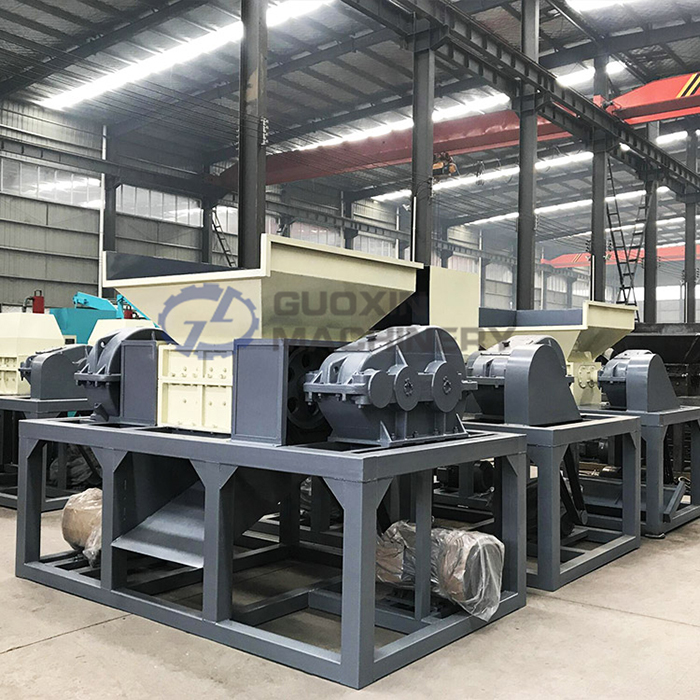
organic waste shredder
1. Significantly Increased Specific Surface Area: The crushed material exposes more fresh surface area, allowing microorganisms, enzymes, or chemical reagents to contact and decompose organic matter more quickly and fully.
2. Achieved Material Homogenization: The shredder crushes and mixes waste of different origins and forms (such as kitchen waste, fruit and vegetable waste, and garden branches) into a slurry or fragmented material with relatively uniform particle size.
3. Effective Impurity Separation: During the shredding process, some inert impurities that are not tightly bound to organic matter (such as plastic flakes, small pieces of glass, and metal bottle caps) are loosened and separated.
4. Improved Material Flowability: The crushed slurry or fragments have better flowability, facilitating transportation in closed pipeline systems via pumps, screw conveyors, etc., reducing blockages and achieving automated and hygienic workshop logistics. 5. Release of Intracellular Substances
For fruits, vegetables, and kitchen waste, shredding disrupts plant cell walls, releasing easily degradable sugars, proteins, and other substances within the cells, allowing them to enter the biological metabolic pathway more quickly.
III. Key Technical Features of Organic Waste Shredder
1. Blade Disc/Roller Design: Mostly employ a dual-axis or quad-axis shearing design, equipped with high-strength, high-toughness, and corrosion-resistant alloy tool steel blades.
2. Anti-Adhesion and Self-Cleaning: The internal design of the machine cavity is smooth and seamless, with no dead corners.
3. Drive and Torque: Equipped with a high-power, high-torque hydraulic or electric drive system, featuring automatic overload protection and reverse function to ensure automatic handling of hard objects (such as small stones), protecting core components.
4. Sealing and Corrosion Resistance: The entire machine uses high-standard sealing to prevent sewage and odor leakage; key components use stainless steel or special anti-corrosion coatings to resist corrosion from landfill leachate.
5. Intelligent Control: Integrated PLC control system, real-time monitoring of spindle speed, torque, temperature, and other parameters, achieving automated operation, fault diagnosis, and remote monitoring.
IV. How to Choose an Organic Waste Shredder
The shredder selection must match the overall process route and downstream equipment:
1. Anaerobic Digestion Process:
Requirements: Fine output particle size (usually <30mm), in slurry form, easy to pump into the digester.
Recommendation: High-torque, fine-crushing twin-shaft or quad-shaft shear shredder, often used in conjunction with a pulper and impurity removal system.
2. Aerobic Composting Process:
– Requirements: Uniformly sized fragments, maintaining a certain porosity for ventilation.
– Recommendation: Shear shredder, adjustable output particle size (usually 20-50mm). For processing large quantities of garden waste, a coarse-crushing branch shredder should be used as a pre-processing step.
3. Insect Farming (Black Soldier Flies, etc.):
– Requirements: Loose material, free of sharp or hard objects, with moderate moisture content.
– Recommendation: Lightweight shear shredder, focusing on uniformly crushing kitchen waste for easy feeding by insects.
4. RDF (Waste-Derived Fuel) Preparation:
– Requirements: Crushed material must be easy to dry and granulate.
– Recommendation: Coarse crushing and shredding as primary crushing; subsequent fine crushing may be required.
A thorough understanding of the technical aspects of shredders and in-depth communication with experienced equipment suppliers across the entire process flow are indispensable for project success.