

Products Description
For small to medium-sized municipalities and industrial parks, building a cost-effective Waste-to-Energy (WtE) facility requires precise mass balance and capital allocation.
Based on actual project data, this guide provides a detailed technical and financial breakdown for a 300 Tons Per Day (TPD) Municipal Solid Waste (MSW) processing facility.
At Henan Guoxin Machinery, we specialize in the front-end MSW pre-sorting and the back-end leachate treatment. In this model, our sorting line processes 300 TPD of raw mixed waste, extracting the inerts and high-moisture organics to yield 60 TPD of high-calorific combustible waste (RDF) for the incineration partner, while managing the 30 TPD of highly concentrated leachate generated in the process.
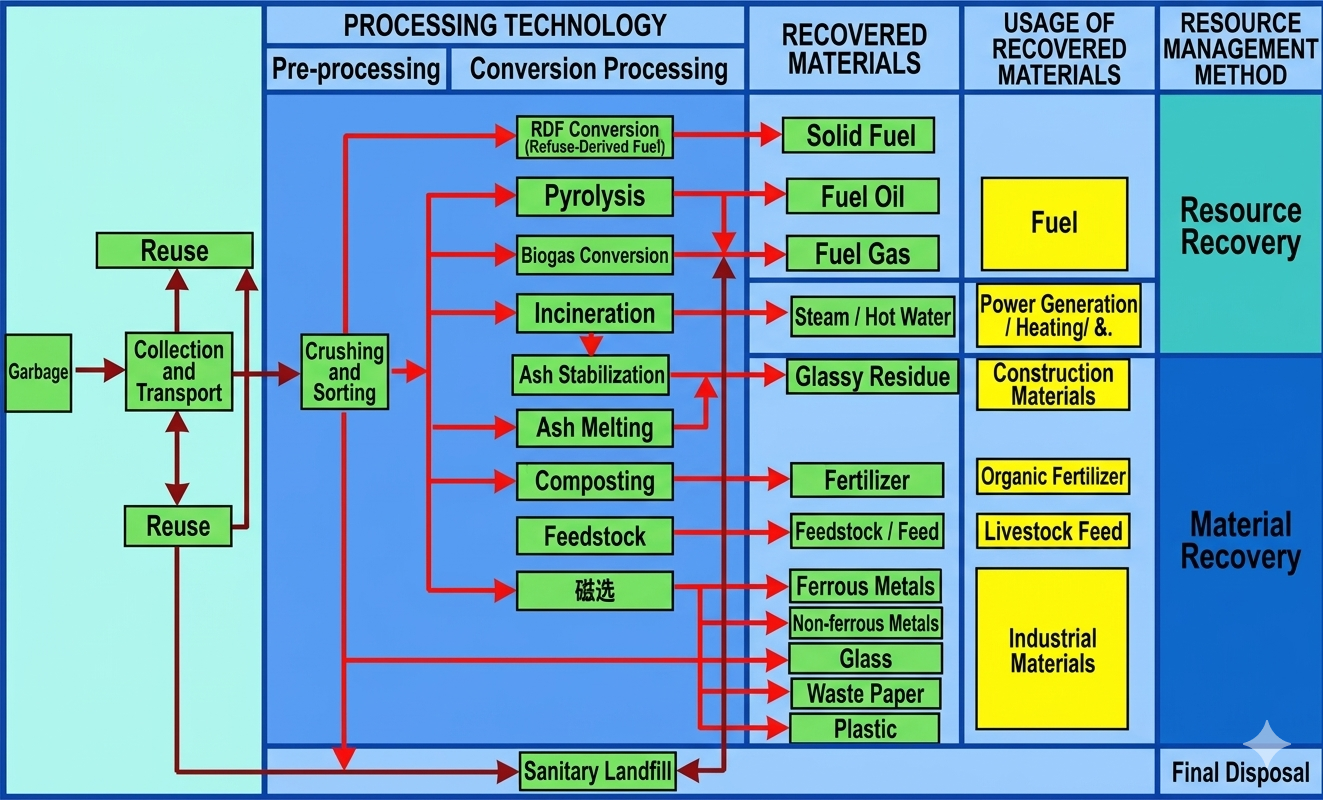
Project Mass Balance & Process Workflow
This project is a small-scale, highly optimized WtE system. The workflow relies on strict pre-treatment to reduce the required size of the incinerator, thereby lowering overall CAPEX.
Phase I: Reception & Pre-sorting (Guoxin Machinery Scope)
-
Mass Balance: 300 TPD Raw MSW Input → 60 TPD Combustible Output + 30 TPD Leachate.
-
Process: Garbage is weighed and discharged into a negative-pressure storage pit. Using grab cranes and heavy-duty crushers, the waste is mixed and reduced to a uniform particle size. Non-combustibles (metals, bricks, stones) are extracted to improve the Lower Heating Value (LHV) and protect the downstream furnace. Odorous air from the pit is extracted by fans and used as combustion air.
Phase II: Incineration & Power Generation (Partner Scope)
-
Incineration: The 60 TPD of sorted combustible waste is fed into a Mechanical Grate Furnace. It burns thoroughly at 850-1000℃, ensuring complete decomposition of dioxins.
-
Power Gen: Heat generates high-temperature, high-pressure steam (e.g., 4MPa, 400℃) in the waste heat boiler, driving a 1.5-2MW steam turbine generator. Power is stepped up and connected to the grid. Bottom slag is cooled and sold for construction materials.
Phase III: Flue Gas & Leachate Treatment (Guoxin Synergy)
-
Flue Gas: Passes through an acid removal tower (lime slurry for HCl, SO₂), activated carbon injection (for heavy metals/dioxins), and a bag filter to meet strict emission standards via chimney discharge.
-
Leachate (Guoxin Scope): The 30 TPD of leachate from the pit is processed through our specialized biochemical and membrane filtration system (Transfer Pump + Biochemical System + Reverse Osmosis), ensuring compliance with industrial discharge limits.
CAPEX: Equipment & Investment Budget
Table 1:CAPEX – Initial Investment Breakdown (USD)
| Investment Category | Sub-System | Estimated Cost (Million USD) |
| I. Core Equipment | Incinerator System (Mechanical Grate) | $1.11 – $1.67 |
| Waste Heat Boiler | $0.83 – $1.25 | |
| Steam Turbine Generator (1.5-2MW) | $0.83 – $1.39 | |
| Flue Gas Purification System | $0.55 – $0.83 | |
| MSW Pre-sorting System (Guoxin) | $0.28 – $0.42 | |
| Leachate Treatment System (Guoxin) | $0.11 – $0.14 | |
| II. Civil & Auxiliaries | Civil Engineering & Plant Buildings | $0.70 – $1.11 |
| Electrical & Water Auxiliaries | $0.42 – $0.70 | |
| Infrastructure (Roads, Fire Safety) | $0.28 – $0.42 | |
| III. Indirect Costs | Design, Commissioning & Working Capital | $1.40 |
| Total CAPEX | Complete WtE Plant Investment | ~$9.09 Million |
The estimated total investment for this 300 TPD Sorting + 60 TPD Incineration project is approximately $9.09 Million. (Note: Calculated based on standard domestic operating models converted to USD)
A. Core Equipment (Est. $5.31 Million)
-
Incinerator System (Mechanical grate, feeding, slag removal): $1.11 – $1.67 Million
-
Waste Heat Boiler: $0.83 – $1.25 Million
-
Turbine Generator Set (1.5 – 2MW): $0.83 – $1.39 Million
-
Flue Gas Purification (Deacidification, Carbon, Bag filter): $0.55 – $0.83 Million
-
Pre-sorting & Pit Equipment (Guoxin: Cranes, Shredders, Screens): $280,000 – $420,000
-
Leachate Treatment System (Guoxin: Biochemical + RO for 30 TPD): $110,000 – $140,000
B. Civil Engineering & Auxiliaries (Est. $2.09 Million)
-
Civil Works: Plant buildings, waste pit, and chimney construction: $0.70 – $1.11 Million
-
Auxiliaries: Circulating water, electrical control systems, and general wastewater: $420,000 – $700,000
-
Infrastructure: Roads, landscaping, and fire protection systems: $280,000 – $420,000
C. Indirect Costs (Est. $1.40 Million)
-
Includes project design, engineering supervision, system commissioning, and initial working capital.
Through Guoxin’s upstream sorting process, the scale of the Client’s incinerator was reduced from a 300-ton class to a 60-ton class, directly saving the Client millions of dollars in CAPEX (total investment).
Economic Evaluation & ROI Estimation
Table 2: Annual Operational Revenue & Expenses (USD)
| Operational Item | Category | Annual Value (USD) |
| Annual Revenue | Waste Processing Fees ($21-$35/ton) | $450,000 – $765,000 |
| Electricity Sales ($0.09/kWh) | $595,000 – $795,000 | |
| Slag & Recyclable Sales | $5,500 – $15,300 | |
| Total Gross Revenue | $1,050,500 – $1,575,300 | |
| Annual OPEX | Consumables, Water & Power | $140,000 – $210,000 |
| Labor Costs (15-20 Personnel) | $140,000 – $210,000 | |
| Maintenance, Taxes & Depreciation | $140,000 – $280,000 | |
| Total Annual OPEX | $420,000 – $700,000 |
A. Annual Revenue Streams (Est. $1.06 – $1.57 Million)
-
Waste Processing Fee: Based on processing 60 TPD of sorted waste (approx. 21,900 tons/year) at a subsidy of $21 – $35/ton. (Yields: $450,000 – $765,000/year)
-
Electricity Sales: Generating 300-400 kWh per ton of combusted waste. Totaling 6.57-8.76 million kWh/year at a grid price of $0.09/kWh. (Yields: $595,000 – $795,000/year)
-
Slag Sales: Sold for brick-making at $2.80 – $7.00/ton. (Yields: $5,500 – $15,300/year)
B. Annual Operating Costs (Est. $420,000 – $700,000)
-
Consumables & Power: Water, grid electricity, lime, and activated carbon ($140,000 – $210,000).
-
Labor: Plant staffing of 15-20 personnel ($140,000 – $210,000).
-
Maintenance & Depreciation: Equipment maintenance, taxes, and 15-year straight-line depreciation ($140,000 – $280,000).
C. Profitability Analysis
Table 3: Financial Performance & ROI Indicators
| Indicator | Standard Projection (Value) |
| Annual Net Profit | $360,000 – $878,000 |
| Internal Rate of Return (IRR) | 8% – 15% |
| Static Payback Period | 6 – 15 Years |
| Equipment Service Life | 15 – 20 Years |
| Processing Efficiency | 300 TPD Raw MSW → 60 TPD RDF Burn |
-
Estimated Net Profit: $360,000 – $878,000 per year.
-
Internal Rate of Return (IRR): 8% – 15%. (Aligns with typical yields for small-scale municipal environmental projects).
-
Payback Period: 6 – 15 years, highly dependent on local government waste subsidies and grid tariffs.
Figures are estimates based on standard international engineering models. Final ROI depends on local tipping fees, electricity feed-in tariffs (FiT), and MSW moisture content.
Project Risk Management
When executing a project of this scale, EPCs must account for three primary variables:
-
Operational Risk: Fluctuations in raw MSW volume or moisture content can decrease the LHV and power output. Our front-end sorting specifically mitigates this by guaranteeing a stable 60 TPD RDF supply.
-
Environmental Risk: Failure to meet emission standards requires costly secondary treatment. Maintaining 850℃+ combustion and utilizing RO for leachate is mandatory.
-
Policy Risk: Changes in municipal tipping fees or renewable energy subsidies directly impact the payback timeline.
FAQ
Q: Why process 300 tons of MSW to only burn 60 tons?
A: Raw MSW contains high volumes of moisture, glass, and heavy metals. By utilizing Guoxin’s pre-sorting system, we extract the non-combustibles and wet organics. This reduces the required capacity (and CAPEX) of the incinerator from 300 TPD down to 60 TPD, while ensuring the feedstock has a high enough LHV to burn efficiently without auxiliary fuel.
Q: What is included in the 30 TPD Leachate Treatment system budget?
A: The estimated $110,000 – $140,000 covers the complete skid-mounted or integrated system, including transfer pumps, the primary biochemical reaction tanks, and the Reverse Osmosis (RO) membrane system to ensure the effluent meets discharge standards.
Q: Can this 60 TPD incineration scale be profitable?
A: Yes, with an IRR of 8%-15%, it is viable for county-level municipalities or industrial parks. However, profitability relies heavily on securing a stable local waste processing fee (tipping fee) and favorable grid-connection tariffs.
Planning a WtE project? The financial success of your incineration plant depends on the quality of your front-end sorting and the compliance of your leachate system.
[Consult Guoxin Engineers for a Custom Equipment Quotation] | [Download Technical Drawings]